



ISLAMABAD: Pakistan’s foreign minister Shah Mahmood Qureshi on Wednesday emphasized the significance of greater political convergence among Muslim countries by enhancing trade and economic activities among them while addressing the closing session of a two-day conference of the Organization of Islamic Cooperation (OIC).
The 48th session of the OIC Council of Foreign Ministers (CFM) was held in Islamabad from March 22-23 in which the participating countries discussed a wide range of issues facing the Muslim world and adopted 140 resolutions.
The CFM meeting is an annual event held to take important decisions and discuss new policies by OIC member states. It also reviews implementation or progress made on decisions taken during previous meetings.
“All our efforts will aim at promoting peace, prosperity and knowledge among the Muslim ummah,” Qureshi said while addressing the closing session. “In that backdrop, greater economic cooperation and increased intra-OIC trade could help forge convergence on political issues.”
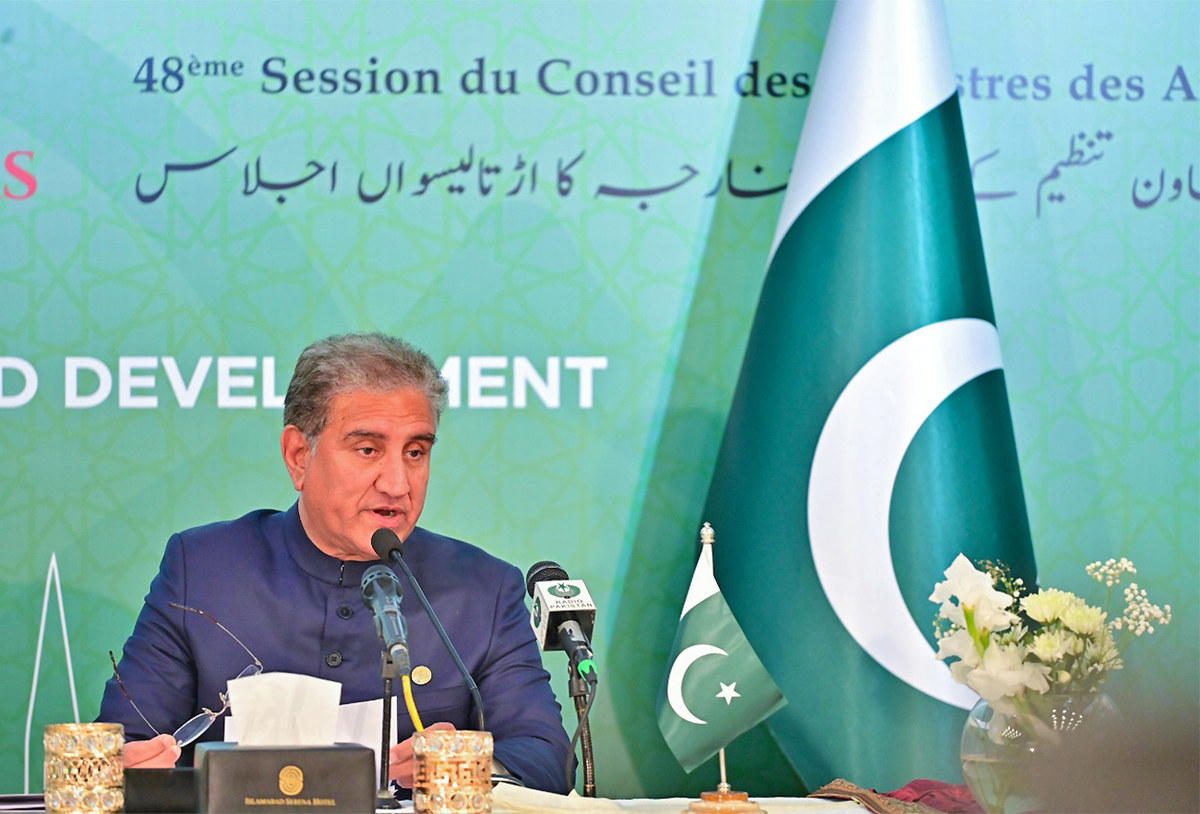
Pakistan's foreign minister Shah Mahmood Qureshi addresses the the closing session of a two-day conference of the Organization of Islamic Cooperation (OIC) in Islamabad, Pakistan, on March 23, 2022. (APP)
The foreign minister said Pakistan would work with other Muslim countries to take tangible steps toward building “bonds of solidarity, cooperation and joint Islamic action.”
The visiting dignitaries adopted the Islamabad Declaration during the two-day meeting which summed up their assessment of global challenges and how best to address them.
The declaration highlighted the desire of OIC member states to promote and protect their common interests, support “just causes” such as the Palestine and Kashmir issues, uphold the rights and interests of Muslim minorities in non-OIC countries, and pursue a shared vision for greater social, economic, scientific and technological development and integration within the Muslim world.
It also welcomed the decision of the United Nations General Assembly to proclaim March 15 as International Day to Combat Islamophobia and the CFM decision to appoint a special envoy for this purpose.
A joint communique was also prepared by the OIC Contact Group on Jammu and Kashmir which said the foreign ministers of Muslim states “reaffirmed their support for the legitimate struggle of the Kashmiri people for realization of their inalienable right to self-determination and freedom from Indian occupation.”
It added that they “reiterated that India must reverse all illegal and unilateral measures taken on or after 5 August 2019” when it revoked the special constitutional status of the region.
Later, addressing a joint news conference with OIC Secretary General Hissein Brahim Taha, Qureshi said Pakistan had raised the issue of India’s recent accidental missile firing, adding it could have led to serious consequences. India accidentally released a missile, which landed in Pakistan, about 7 p.m. last Wednesday during routine maintenance and inspection, the Indian defense ministry has said.
“The accidental fire could have led to an accidental war in South Asia,” he said. “It is as serious as that. So, I am grateful to the members of OIC for sharing our concerns.”
The foreign minister said he had also conveyed Pakistan’s concerns about the incident to the international community and demanded a “joint probe” to ensure such incidents were not repeated in the future.
Speaking at the occasion, the OIC secretary general thanked Pakistan for its hospitality. He also described the Kashmir issue as a “just cause” while adding that the institutionalization of March 15 as a day to combat Islamophobia was a collective achievement of OIC countries.
“The questions for our agenda in this conference mainly included the issues of peace, unity and justice,” he said. “We also discussed the phenomenon of Islamophobia. We [the OIC] managed to impress upon the United Nations to adopt 15th of March of each year as International Day for Combating Islamophobia. This is a further proof that whenever we, the OIC states, work together, we manage to achieve our goals.”
The OIC secretary general also congratulated the people of Pakistan on their 75th independence year.


