

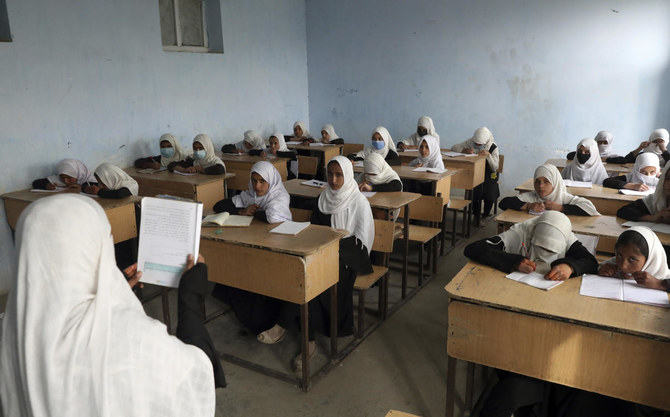
Schools reopen in Afghanistan but not for teenage girls

The Taliban have imposed a slew of restrictions on women, effectively banning them from many government jobs, policing what they wear and preventing them from traveling outside of their cities alone. (File/AP)
Short Url
Updated 23 March 2022
Follow

Schools reopen in Afghanistan but not for teenage girls

  • Schools were set to open for all boys, girls following months of restrictions after Taliban took control of country
  • Authorities suddenly changed decision, requesting girl students aged over 13 to wait until further notice

KABUL: Afghan teenage girls were sent back home when they arrived in schools after months on Wednesday, as Taliban authorities reversed their earlier decision to allow all girl students to return to classrooms.

Schools had been set to open again after restrictions were brought in when the Taliban took control of Afghanistan in August.

The Ministry of Education said on Monday that all boys and girls would be welcomed back, but it made a last-minute decision, requesting girl students above the age of 13 to wait until further notice.

Ministry spokesperson, Aziz Ahmad Rayan, told reporters on Wednesday that a plan for secondary and high schools for girls, developed in accordance with Islamic law, would be revealed at a later date.

“All secondary and high schools for girls should be informed that their studies are suspended until the next notice,” he said. “Girls’ schools will be officially informed when a comprehensive proposal regarding girls’ education is developed based on Shariah (Islamic law) and the Afghan tradition and the instructions of the Islamic Emirate’s leadership are issued.”

Many of the girls returning excitedly to schools were reduced to tears as teachers asked them to go home.

“When we went to school this morning, the head teacher told us at the school gate that only younger girls were allowed and that we should go back home,” Nasima, a 17-year-old student at the Tajwar Sultana high school in Kabul, told Arab News.

Schools had been ready to receive them, but their plans have now had to be put on hold.

“We are waiting for orders from the provincial education officials,” Alia Salaar, a school principal in Herat, said. “We are ready to start the studies in all grades.”

In a statement shared with reporters, Suhail Shaheen, Taliban government spokesperson and permanent representative-designate to the UN, said the postponement was related to school uniforms and should be resolved soon.

“There is no issue of banning girls from schools,” he added. “It is only a technical issue of deciding on form of school uniform for girls. This is the cause of postponement.”

There had been fears that the Taliban would put an end to women’s education once they regained control of the country, after they barred girls from schools during their first stint in power from 1996 to 2001.

The international community has made the education of girls one of its key demands for any future recognition of the Taliban administration.

Hamid Karzai, who served as Afghanistan’s president from 2001 to 2014 and remained in the country after the Taliban takeover in August, tweeted that he was in “deep sorrow and concern over the closure of girls’ schools.”

Karzai took office after the previous Taliban administration was ousted by a US-led invasion of Afghanistan in 2001. It was under his rule that women’s education was restored in the country.

“The former president asks the caretaker government of the Islamic Emirate to allow girls’ education for a developed and prosperous Afghanistan,” he said. “Don’t let plans of others who want an Afghanistan deprived of education to be implemented.”


Nepal’s rapper-turned-politician takes early lead in key polls

Updated 5 sec ago
Follow

Nepal’s rapper-turned-politician takes early lead in key polls

  • The polls are one of the most hotly contested elections in the Himalayan republic of 30 million people since the end of a civil war in 2006

Nepal’s centrist party of rapper-turned-politician Balendra Shah took an early lead in the high-stakes parliamentary election on Friday, as slow counting continued after the first polls since last year’s deadly uprising.
But despite Shah’s party loyalists dancing on the streets of Katmandu in celebration — the numbers of votes counted remain too low to be confident that it will translate into concrete wins.
By Friday afternoon, 24 hours after polls closed, early trends issued by the Election Commission put Shah’s Rastriya Swatantra Party ahead.

HIGHLIGHT

Alongside Shah, key figures vying for power include Marxist leader KP Sharma Oli, four-time prime minister who was ousted by the September 2025 anti-corruption protests, and the newly elected leader of the Nepali Congress party, Gagan Thapa.

Alongside Shah, key figures vying for power include Marxist leader KP Sharma Oli, four-time prime minister who was ousted by the September 2025 anti-corruption protests, and the newly elected leader of the Nepali Congress party, Gagan Thapa.
At 5:00 p.m. (1115 GMT), RSP was leading in more than half of the 165 constituencies.
But there were only two declared results, and RSP had been confirmed only in one, the same as Nepali Congress.
Prakash Nyupane, a spokesman for the Election Commission, said that counting was ongoing “in a peaceful manner” across the Himalayan nation, from snowbound high-altitude mountain regions to the hot plains bordering India.
Voters have chosen who replaces the interim government in place since the September 2025 uprising, in which at least 77 people were killed, and parliament and scores of government buildings were torched.
Youth-led protests under a loose Gen Z banner began as a demonstration against a brief social media ban, but were fed by wider grievances at corruption and a woeful economy.
Kunda Dixit, publisher of the weekly Nepali Times, told AFP that if trends did reflect final wins, the political shift was dramatic.
“This is even a bigger upset than we expected — it underscores the level of public disenchantment with the old parties for under-performance, as well as anger over the events of September,” he said.

 ‘Fate of the country’ 

The polls are one of the most hotly contested elections in the Himalayan republic of 30 million people since the end of a civil war in 2006.
All eyes are watching the results in the key head-to-head battleground constituency of Jhapa-5, a usually sleepy eastern district, where 35-year-old Shah challenged directly the veteran Oli, aged 74.
Shah, better known as Balen, snappily dressed in a black suit and sunglasses, has cast himself as a symbol of youth-driven political change.
At 5 p.m. local time, at 10 percent of the votes counted in Jhapa-5, Shah was ahead by nearly five times as many votes as Oli.
Soldiers with armored trucks manned barbed wire barricades around the counting center in Jhapa.
“I hope this result changes the fate of the country for the better,” Bhagawati Adhikari, 38, told AFP, who was among a crowd of dozens at Jhapa gathered outside the security cordon.
“The country should be peaceful and secure, youth should get opportunities, corruption should stop — that’s my appeal.”

’Rest peacefully’ 

More than 3,400 candidates ran for 165 seats in direct elections to the 275-member House of Representatives, the lower chamber of parliament, with 110 more chosen via party lists. Turnout was 59 percent.
Full nationwide tallies could take several days.
Dixit raised the possibility that Shah’s RSP could stage a dramatic win.
“If RSP hits the magic 138 seats, Balen will become prime minister — and hopefully a cabinet of technocrats,” added Dixit.
Sushila Karki, the interim prime minister, praised the peaceful conduct of a vote she has said was critical in “determining our future.”
Karki, a 73-year-old former chief justice who reluctantly left retirement to lead the nation, now faces the challenge of managing the reaction to results.
The election saw a wave of younger candidates promising to tackle Nepal’s dismal economy, challenging veteran politicians who have dominated for decades and argue that their experience guarantees stability and security.
In Jhapa, 68-year-old shopkeeper Ved Prasad Mainali sat listening to a radio.