BuzzFeed cutting jobs, top editors leaving news division

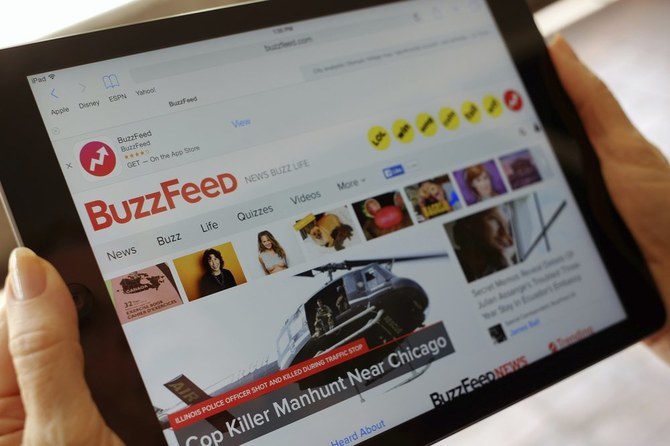
File photo of the BuzzFeed website in 2015. (AP)
Short Url
Updated 22 March 2022
Follow

BuzzFeed cutting jobs, top editors leaving news division

  • The New York-based company is offering voluntary buyouts in its high-profile, 100-person newsroom and some top editors are leaving
  • BuzzFeed News is unprofitable but has won awards, including its first Pulitzer last year

DUBAI: BuzzFeed is reorienting and shrinking its news division as the digital media company best known for its lighthearted lists and quizzes strives to increase its profitability.
The New York-based company is offering voluntary buyouts in its high-profile, 100-person newsroom and some top editors are leaving. They include Mark Schoofs, the editor in chief of BuzzFeed News, and deputy editor in chief Tom Namako, who announced a move to NBC News Digital on Tuesday. Ariel Kaminer, the executive editor for investigations, is also leaving.
BuzzFeed News is unprofitable but has won awards, including its first Pulitzer last year, and its staff has been regularly poached by traditional news organizations. BuzzFeed spokesman Matt Mittenthal said about 35 people were eligible for the buyouts, but the company doesn’t expect all of them to take one.
Buyouts will be offered to news staffers on the investigations, inequality, politics and science teams, as BuzzFeed focuses more on big breaking news and lighter content.
“We’ve had freedom to chase wild, impossible stories,” tweeted Rosalind Adams, an investigative reporter at BuzzFeed News. “It’s a sad day to watch @BuzzFeedNews move away from valuing that work.”
Beyond the newsroom buyouts, the company also said it is cutting 1.7 percent of its staff. In a January filing with securities regulators, Buzzfeed said it had 1,524 US and international employees, so the cuts would amount to roughly 25 people.
BuzzFeed’s shares have dropped more than 40 percent since the company went public in early December via what’s known as a SPAC, merging with a company that already trades, rather than an IPO.
The company had a solid year in 2021, it reported Tuesday in its earnings release. Its revenue rose 24 percent to $397.6 million, thanks to increases in e-commerce and ad revenue, and its profit more than doubled, to $25.9 million.
But it expects revenue to drop in the current quarter if it includes the acquisition of Complex Networks, a group of pop culture sites BuzzFeed acquired last year. The layoffs separate from the news division will come from BuzzFeed Video and the editorial side of Complex.
BuzzFeed also acquired HuffPost in early 2021, and laid off several dozen of its staffers shortly after.
On BuzzFeed’s earnings call Tuesday, CEO Jonah Peretti said the company is accelerating its investment in vertical video, the smartphone format used on the increasingly popular video sharing site TikTok.
As for the news division, it “will need to get smaller,” and “prioritize the areas of coverage our audience connects with most,” Peretti said in a memo to employees.
On the earnings call, he said that the company needs to make BuzzFeed News “a stronger financial contributor to the larger business,” and doing so will involve focusing on big breaking news, culture and entertainment, celebrities, and “life on the Internet.”


Dark times under Syria’s Assad hit Arab screens for Ramadan

Updated 23 February 2026
Follow

Dark times under Syria’s Assad hit Arab screens for Ramadan

  • Talking about Syria’s prisons and the torture, enforced disappearances and executions that took place there was taboo during half a century of the Assad family’s iron-fisted rule


BEIRUT: A Syrian prison warden screams at a group of chained, crouching inmates in a harrowing scene from one of several Ramadan television series this year that tackle the era of former ruler Bashar Assad.
Talking about Syria’s prisons and the torture, enforced disappearances and executions that took place there was taboo during half a century of the Assad family’s iron-fisted rule, but the topics are now fertile ground for creative productions, though not without controversy.
An abandoned soap factory north of the Lebanese capital Beirut has been transformed into a replica of the basements and corridors of Syria’s Saydnaya prison, a facility synonymous with horror under Assad, for the series “Going Out to the Well.”
Crews were filming the last episodes this week as the Muslim holy month kicked off — primetime viewing in the Arab world, with channels and outlets furiously competing for eager audiences’ attention.
Director Mohammed Lutfi told AFP that “for Syrians, Saydnaya prison is a dark place, full of stories and tales.”
The series focuses on the 2008 prison riots in Saydnaya, “when inmates revolted against the soldiers and took control of the prison, and there were negotiations between them and Syrian intelligence services,” he said.
The military prison, one of Syria’s largest and which also held political prisoners, remains an open wound for thousands of families still looking for traces of their loved ones.

Tragedy into drama

The Association of Detainees and Missing Persons of Saydnaya Prison estimates that some 30,000 people were thrown into the facility after the 2011 uprising against Assad began, but only 6,000 came out after he was toppled.
Amnesty International has described the prison outside Damascus, which was notorious for torture and enforced disappearances, as a “human slaughterhouse.”
In the opening scene of the series, the main character is seen in a tense exchange with his family before jumping into a deep well.

A local guides journalists visiting the Palmyra Prison Complex formerly used by the ousted Assad government in Syria's central city of Palmyra on February 7, 2025. (AFP)

The symbolic scene in part captures the struggles of the detainees’ relatives. Many spent years going from one Assad-era security facility to another in search of their missing family members.
Syrian writer Samer Radwan said on Facebook that he finished writing the series several months before Assad’s fall.
Director Lutfi had previously told AFP that challenges including actors’ fears of the Assad authorities’ reaction had prevented filming until after his ouster.
Since then, productions have jumped on the chance to finally tackle issues related to his family’s brutal rule.
Another series titled “Caesar, no time, no place” presents testimonies and experiences based on true stories from inside Syria’s prisons during the civil war, which erupted in 2011.
But in a statement this week, the Caesar Families Association strongly rejected “transforming our tragedy into dramatic material to be shown on screen.”
“Justice is sought in court, not in film studios,” said the association, whose name refers to thousands of images smuggled out of Syria more than a decade ago showing bodies of people tortured and starved to death in the country’s prisons.

Refugees
Another series, “Governorate 15,” sees two Saydnaya inmates, one Lebanese and one Syrian, leave the facility after Assad’s fall and return to their families.
Producer Marwan Haddad said that the series tackles the period of “the Syrian presence in Lebanon” through the Lebanese character.
The show also addresses the Syria refugee crisis through the story of the Syrian character’s family, who fled to the struggling neighboring country to escape the civil war.
“For years we said we didn’t want Lebanon to be (Syria’s) 15th province” and each person fought it in their own way, said Lebanese screenwriter Carine Rizkallah.
Under Assad’s father Hafez, Syria’s army entered Lebanon in 1976 during the country’s civil war and only left in 2005 after dominating all aspects of Lebanese life for almost three decades.
It was also accused of numerous political assassinations.
Lebanese director Samir Habchy said that the actors represent their “own community’s problems” in the “Lebanese-Syrian series.”
The show could prove controversial because it includes real people who “are still alive and will see themselves” in the episodes, he added.