

BuzzFeed to go public after raising less money than expected

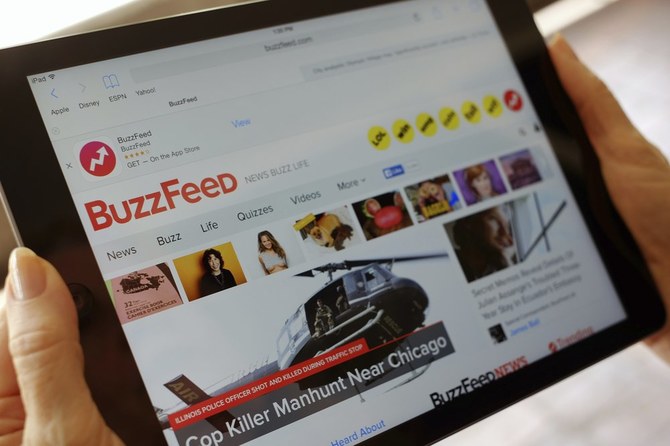
In this Sept. 2, 2015, file photo the BuzzFeed website is displayed on an iPad held by an Associated Press staffer in Los Angeles. (AP)
Short Url
Updated 04 December 2021
Follow

BuzzFeed to go public after raising less money than expected

  • The digital company also raised $150 million in debt financing as part of the deal

American digital company BuzzFeed, known for its viral content and journalism, will go public on Dec. 6 after it initially raised less money than expected.

In a press release on Friday, BuzzFeed said that it had finalized a merger with 890 5th Avenue Partners, a special purpose acquisition company (SPAC), which aims to raise funds through an initial public offering to acquire an existing company.

Buzzfeed’s shares are expected to start trading on the Nasdaq on Monday under the ticker symbol “BZFD.”

BuzzFeed aimed to be valued on Wall Street at $1.5 billion but it raised just $16 million from the SPAC deal, which was announced in June.

The company initially said that 890 5th Avenue Partners held about $288 million in cash, but the majority of investors ultimately withdrew.

The digital company also raised $150 million in debt financing as part of the deal.

BuzzFeed, created in 2006, first became known for its lists and topical quizzes, before broadening its offerings with a Pulitzer Prize-winning news division, YouTube channel and podcasts.

In November 2020, the platform, headquartered in New York, bought the Huffington Post news site from Verizon without disclosing the amount.

Buzzfeed’s public listing comes just days after employees at the news arm staged a 24-hour walkout protesting the company’s failure to offer certain contract conditions, including a salary base of $50,000, after nearly two years of negotiations.

“BuzzFeed won’t budge on critical issues like wages — all while preparing to go public and make executives even richer,” the union said on Twitter.

As part of the SPAC deal, BuzzFeed has also acquired Complex Networks, a media company jointly run by Verizon and Hearst.


Meta to charge Arab advertisers extra fee for reaching European audiences

Updated 11 March 2026
Follow

Meta to charge Arab advertisers extra fee for reaching European audiences

  • US tech giant told advertisers it will add fees ranging from 2 to 5 percent on image and video ads delivered on its platforms to offset digital service taxes
  • Charges are determined by where the audience is located, not where the advertiser is based

LONDON: Meta will from July 1 impose location-based surcharges on advertisers targeting audiences in six European countries, a move that will directly affect Arab businesses that run campaigns across the continent.

The US tech giant announced it will add fees ranging from 2 to 5 percent on image and video ads delivered on its platforms, including Facebook, Instagram and WhatsApp, to offset digital service taxes imposed by individual governments.

Crucially, the charges are determined by where the audience is located, not where the advertiser is based.

That means Saudi, Emirati, Egyptian or other Arab companies paying to reach consumers in the UK, France or Italy will face the additional costs regardless of their own country’s tax arrangements with Meta.

Fees will apply at 2 percent for ads reaching UK audiences, 3 percent for France, Italy and Spain, and 5 percent for Austria and Turkiye.

“If you deliver $100 in ads to Italy, where there is a 3% location fee, you will be charged $100 (ad delivery), plus $3 (location fee), for $103 total,” the company wrote in an email to an advertiser initially reported by Bloomberg. “Note that any applicable VAT will be calculated on top of the total amount.”

The taxes have been introduced at different points, starting with France in 2019, though not the EU as a bloc.

Many tech companies report substantial sales in Europe and millions of users but pay minimal tax on profits. The goal is to claw back locally derived economic value, Bloomberg reported.

The move follows similar decisions by Google and Amazon, which have also begun passing European digital tax costs on to advertisers.

For Arab brands with growing European footprints, particularly in fashion, travel, hospitality and media, the new fees add another layer of cost to campaigns already subject to currency and targeting complexities.

Digital services taxes, levied as a percentage of revenues earned by major tech platforms in individual countries, have drawn criticism from Washington, which argues they unfairly target US companies.

Meta has been reached for comments.