

Ukraine war stokes food security fears in Bangladesh

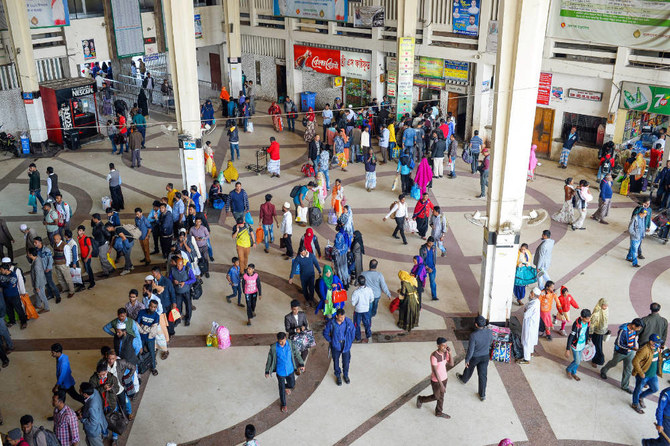
The increasing prices have forced the government to launch on Sunday a special food subsidy program for some of its poorest citizens. (AFP)
Short Url
Updated 22 March 2022
Follow

Ukraine war stokes food security fears in Bangladesh

  • Bangladesh depends on Russia and Ukraine for the bulk of its wheat and oilseed imports
  • Government launched on Sunday a special food subsidy program for poorest citizens

DHAKA: Disruptions in imports following Russia’s invasion of Ukraine have hiked up staple prices in Bangladesh, a top commerce ministry official said on Tuesday, amid growing concerns over food security.

Bangladesh largely depends on Russian and Ukrainian markets for the bulk of its annual wheat and oilseed imports.

Russia’s multipronged assault on Ukrainian territory, which began on Feb. 24, has been followed by a host of sanctions against Moscow, with major international companies pulling out of the market and some Russian banks banned from the Swift payment system that is key for money transactions worldwide.

The sanctions and the volatile situation in Eastern Europe have resulted in a sharp increase in prices for staples in the South Asian nation of 170 million people.

“Due to the Ukraine war, the prices of essentials were fluctuating in the international market,” Commerce Ministry Senior Secretary Tapan Kanti Ghosh told Arab News. “Large importers were hesitant to open new letters of credit for importing wheat and edible oil, which triggered a price hike in the market.”

The increasing prices have forced the government to launch on Sunday a special food subsidy program for some of its poorest citizens.

“Ten million people will be entitled to receive this food support,” Ghosh said, adding that the aid was aimed mostly at rural areas and will initially run for six weeks, until the end of the Muslim fasting month of Ramadan, which starts on April 1. But the program will be an additional burden for the country where COVID-19 disruptions over the past two years have pushed an estimated 26 percent of the population into poverty — a rise of over 5 percentage points since pre-pandemic times.

Dr. Ahsan H. Monsur, executive director of the Policy Research Institute of Bangladesh, told Arab News it will not be easy to keep the program running, as the government is already subsidizing the prices of energy and fertilizer, which increased during COVID-19 lockdowns.

“It will be a great achievement for the government if they can successfully disburse the food aid to 10 million people since it’s a huge number,” he said. “I think the total subsidy amount for this year may cross the figure of $1.1 billion.

“Due to COVID-19 issues, there was already a disruption in the global supply chain,” Monsur said, adding that the quality of life of Bangladeshis has already been “severely impacted.”

“The Ukraine war just added a blow to the existing situation.”


UN chief calls on Israel to reverse NGOs ban in Gaza

Updated 03 January 2026
Follow

UN chief calls on Israel to reverse NGOs ban in Gaza

  • In November, authorities in Gaza said more than 70,000 people had been killed there since the war broke out
  • Israel on Thursday suspended 37 foreign humanitarian organizations from accessing the Gaza Strip after they had refused to share lists of their Palestinian employees with government officials

UNITED NATIONS, United States: UN Secretary General Antonio Guterres called on Friday for Israel to end a ban on humanitarian agencies that provided aid in Gaza, saying he was “deeply concerned” at the development.
Guterres “calls for this measure to be reversed, stressing that international non-governmental organizations are indispensable to life-saving humanitarian work and that the suspension risks undermining the fragile progress made during the ceasefire,” his spokesperson Stephane Dujarric said in a statement.
“This recent action will further exacerbate the humanitarian crisis facing Palestinians,” he added.
Israel on Thursday suspended 37 foreign humanitarian organizations from accessing the Gaza Strip after they had refused to share lists of their Palestinian employees with government officials.
The ban includes Doctors Without Borders (MSF), which has 1,200 staff members in the Palestinian territories — the majority of whom are in Gaza.
NGOs included in the ban have been ordered to cease their operations by March 1.
Several NGOS have said the requirements contravene international humanitarian law or endanger their independence.
Israel says the new regulation aims to prevent bodies it accuses of supporting terrorism from operating in the Palestinian territories.
On Thursday, 18 Israel-based left-wing NGOs denounced the decision to ban their international peers, saying “the new registration framework violates core humanitarian principles of independence and neutrality.”
A fragile ceasefire has been in place since October, following a deadly war waged by Israel in response to Hamas’s unprecedented October 7, 2023, attack on Israel.
In November, authorities in Gaza said more than 70,000 people had been killed there since the war broke out.
Nearly 80 percent of buildings in Gaza have been destroyed or damaged by the war, according to UN data, leaving infrastructure decimated.
About 1.5 million of Gaza’s more than two million residents have lost their homes, said Amjad Al-Shawa, director of the Palestinian NGO Network in Gaza.