

Second Abramovich superyacht docks in sanctions-free Turkey

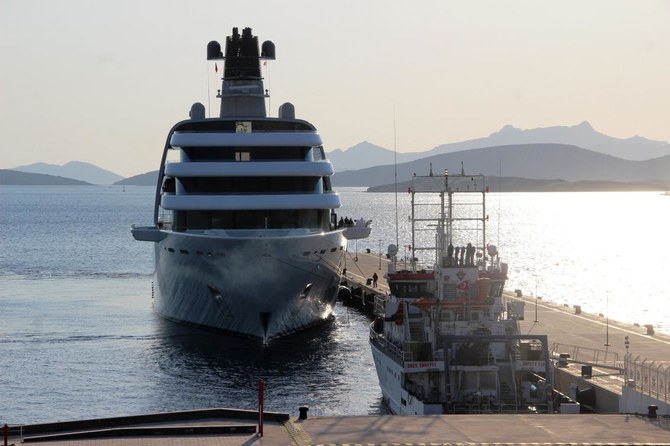
Bermuda-flagged luxury yacht “My Solaris,” belonging to Russian oligarch Roman Abramovich, is docked at the Aegean coastal resort on Bodrum district of Mugla on Monday. (AFP)
Short Url
Updated 22 March 2022
Follow

Second Abramovich superyacht docks in sanctions-free Turkey

  • Western governments have targeted Abramovich and several other Russian oligarchs with sanctions
  • Eclipse, which is one of the world's biggest yachts at 162.5 metres, docked in the resort of Marmaris

DUBAI: A second superyacht linked to Russian billionaire Roman Abramovich docked in a Turkish resort on Tuesday and sources familiar with the discussions said he and other wealthy Russians were looking to invest in Turkey given sanctions elsewhere.
Western governments have targeted Abramovich and several other Russian oligarchs with sanctions as they seek to isolate President Vladimir Putin and his allies over Moscow’s invasion of Ukraine.
While strongly criticizing the invasion, Turkey has said it opposes sanctions imposed by its NATO allies on principle. That could set it up as a possible safe haven for Russians seeking to make investments and preserve assets.
Eclipse, which is one of the world’s biggest yachts at 162.5 meters (533 feet), docked in the resort of Marmaris in southwest Turkey after skirting Greek islands, according to a Reuters witness and tracking data. It sails under a Bermuda flag.
The vessel is reported to have two helipads, nine decks, a swimming pool and built-in missile defenses.
Solaris, another superyacht linked to Abramovich, arrived a day earlier in the resort of Bodrum some 80 km (50 miles) away, after having also avoided the waters of European Union countries that have sanctioned the oligarchs.
They are among a string of yachts owned by Abramovich, according to reports in luxury goods publications SuperYachtFan, SuperYacht and Forbes.
Abramovich, the owner of English football club Chelsea, was in Istanbul briefly last week, according to flight tracking data and people familiar with the travels. There was no indication he was aboard either yacht.
A source in Ankara with knowledge of recent conversations with Abramovich said he and other wealthy Russians were looking to invest in Turkey given the sanctions imposed elsewhere.
“He wants to do some work and may buy some assets,” the source said, adding that the oligarch already had some assets in Turkey. The source did not give details.
Another source in Ankara said Turkey was not currently considering joining sanctions action and expected wealthy Russians to purchases assets and make investments.
“We act sensitively on issues such as bringing the oligarchs’ money to Turkey,” the person said.
A spokesperson for Abramovich did not immediately reply to a request for comment.
The foreign and interior ministries did not immediately comment on whether Western governments had requested that Turkey seize sanctioned assets. Last week, the banking regulator told Reuters it was monitoring sanctions applied on Russia but had not instructed banks to limit citizens of any country.

BOAT PROTESTERS
A small group of people on a motor boat protested in front of Solaris as it docked, holding Ukrainian flags emblazoned with the words “no war,” footage shared by the expat association “Ukrainians in Bodrum” showed.
With the arrival of Eclipse and Solaris, Abramovich has for now stationed upwards of $1.2 billion of his fortune in Turkey, with each vessel estimated to be worth $600 million or more. Russian-linked yachts are stuck in several countries including Italy, Spain and Germany.
Sanctions are delicate for Turkey, which has close trade and diplomatic links with both Russia and Ukraine. Critics of President Tayyip Erdogan’s government have said the balancing act could leave it vulnerable internationally.
“The anchoring in Turkish marinas of yachts embargoed in European countries may leave Turkey in a difficult situation in the international arena,” Utku Cakirozer, an MP from the main opposition CHP party, told Reuters.
After meeting Erdogan in Ankara on Tuesday, Dutch Prime Minister Mark Rutte said he supported Turkey’s role in maintaining dialogue with both Ukraine and Russia.
“Turkey is doing everything that it can do. It is one of the few open lines we have with both,” he told a news conference.
“We would very much favor for Turkey to implement all the sanctions but I think we also have to be happy with the fact that Turkey is playing its diplomatic role.”
Russia calls its invasion a “special military operation” aimed at disarming Ukraine and removing what it says are dangerous nationalists in government. Ukraine and Western allies say that is a false pretext for an unprovoked war.
Turkey has sought to mediate a cease-fire and peace talks between Moscow and Kyiv.
The 140-meter (460-foot) Solaris, which also sails under a Bermuda flag, remained moored in Bodrum on Tuesday, a week after it left Montenegro’s Adriatic resort town of Tivat.


US allows oil majors to broadly operate in Venezuela, new energy investments

Updated 14 February 2026
Follow

US allows oil majors to broadly operate in Venezuela, new energy investments

  • Treasury Department issues general license allowing Chevron, BP, Eni, Shell and Repsol to operate oil and gas operations in Venezuela
  • Move is the most significant relaxation of sanctions on Venezuela since US forces captured and removed President Nicolas Maduro

WASHINGTON: The US ​eased sanctions on Venezuela’s energy sector on Friday, issuing two general licenses that allow global energy companies to operate oil and gas projects in the OPEC member and for other companies to negotiate contracts to bring in fresh investments. The move was the most significant relaxation of sanctions on Venezuela since US forces captured and removed President Nicolas Maduro last month.
The Treasury Department’s Office of Foreign Assets Control issued a general license allowing Chevron, BP, Eni, Shell and Repsol to operate oil and gas operations in Venezuela. Those companies still have offices in the country and stakes in projects, and are among the main partners of state-run ‌company PDVSA.
The authorization ‌for the oil majors’ operations requires payments for royalties and Venezuelan ​taxes ‌to ⁠go through ​the US-controlled ⁠Foreign Government Deposit Fund.
The other license allows companies around the world to enter contracts with PDVSA for new investments in Venezuelan oil and gas. The contracts are contingent on separate permits from OFAC.
The authorization does not allow transactions with companies in Russia, Iran, or China or entities owned or controlled by joint ventures with people in those countries.
The licenses “invite American and other aligned companies to play a constructive role in supporting economic recovery and responsible investment, ” the US State Department said in a release. Additional authorizations may be issued “as necessary,” it said.
A spokesperson for Chevron, ⁠the only US oil firm currently operating in Venezuela, said the company welcomed ‌the new licenses.
“The new General Licenses, coupled with recent changes ‌in Venezuela’s Hydrocarbons Law, are important steps toward enabling the further development ​of Venezuela’s resources for its people and for advancing ‌regional energy security,” the spokesperson said in a statement.
Eni said it is assessing the opportunities in ‌Venezuela that the authorization opens up.

Oil law reform

The US licenses follow a sweeping reform of Venezuela’s main oil law approved last month, which grants autonomy for foreign oil and gas producers to operate, export and cash sale proceeds under existing joint ventures with PDVSA or through a new production-sharing contract model.
The US has had sanctions on Venezuela since ‌2019 when President Donald Trump imposed them during his first administration. Trump is now seeking $100 billion in investments by energy companies in Venezuela’s oil and gas sector. ⁠US Energy Secretary Chris Wright ⁠said on Thursday, during his second day of a trip to Venezuela, that oil sales from the country since Maduro’s capture have hit $1 billion and would hit another $5 billion in months.
Wright said the US will control the proceeds from the sales until Venezuela stands up a “representative government.” Since last month, the Treasury issued several other general licenses to facilitate oil exports, storage, imports and sales from Venezuela. It also authorized the provision of US goods, technology, software or services for the exploration, development or production of oil and gas in Venezuela.
The Venezuelan government expropriated assets of Exxon Mobil and ConocoPhillips in 2007 under then-President Hugo Chavez. The Trump administration is trying to get those companies to invest in Venezuela as well. At a meeting at the White House with Trump last month, Exxon Mobil CEO Darren Woods said Venezuela was “uninvestable” at ​the moment.
Wright said on Thursday that Exxon, ​which no longer has an office in Venezuela, is in talks with the government there and gathering data about the oil sector. Exxon did not immediately comment.