


Hope aid will reach Afghans, Kabul envoy says after OIC launches humanitarian fund in Islamabad

Acting Afghan ambassador to Pakistan, Sardar Ahmed Khan Shakib, speaks with Arab News in an exclusive interview in Islamabad, Pakistan, on January 11, 2022. (AN/File)
Short Url
Updated 22 March 2022
Follow

Hope aid will reach Afghans, Kabul envoy says after OIC launches humanitarian fund in Islamabad

  • Pakistan is hosting 48th OIC Council of Foreign Ministers which is also reviewing crisis in Afghanistan
  • Envoy says acting foreign minister Muttaqi could not attend conference because he was travelling abroad

ISLAMABAD: Afghan foreign minister Amir Khan Muttaqi could not attend this week's Organization of Islamic Cooperation (OIC) foreign ministers’ meeting due to another visit abroad, the acting Afghan envoy to Pakistan said on Tuesday, adding that he hoped the signing of a charter for a humanitarian trust fund for Afghans would finally see aid channeled to those who deserved it.
More than 600 delegates from 56 member states and observer countries are participating in the 48th Organization of Islamic Cooperation's Council of Foreign Ministers being held in Islamabad on March 22-23. The theme of this year’s conference is "Partnering for Unity, Justice, and Development."
OIC countries formally launched a trust fund on Monday to help ease the humanitarian and economic crisis in Afghanistan where millions of people face poverty and famine. The OIC and the Islamic Development Bank (IsDB) signed the charter for the Afghanistan Humanitarian Trust Fund at a ceremony hosted by Islamabad.
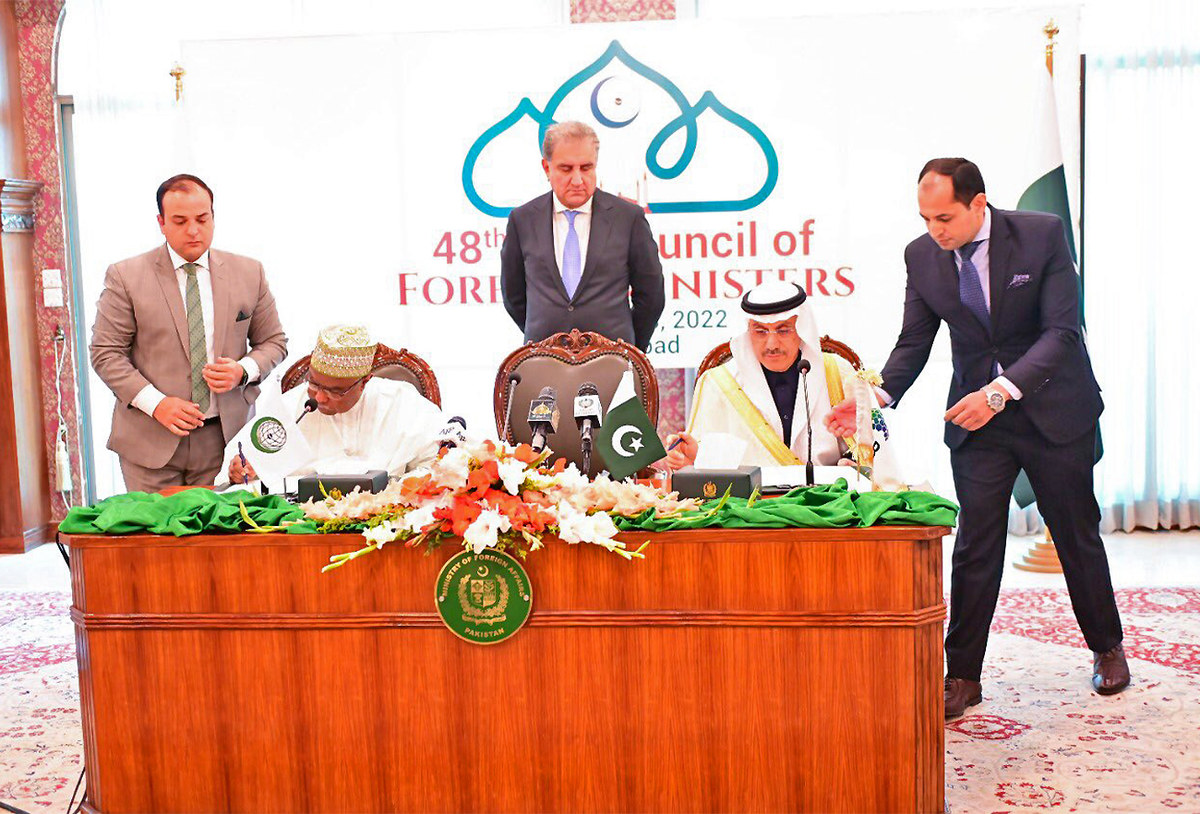


OIC Secretary-General (left) and Chairman of the Islamic Development Bank sign Afghanistan Humanitarian Trust Fund in Islamabad, Pakistan, on March 21, 2022. (OIC/Twitter)

The decision to establish the fund was taken during an emergency OIC meeting held in Pakistan in December last year.
Acting Afghan ambassador to Pakistan Sardar Ahmed Khan Shakib said he hoped the signing of the charter for the fund would bring relief to the Afghan people.
“We hope that the signing of the charter to implement the Afghan humanitarian trust fund will lead to practical steps and aid will now actually reach the Afghan people,” the envoy told Arab News on the sidelines of the OIC conference. “We also have high hopes from Pakistan and Afghan people are looking towards them that they will stand with Afghans in this difficult time.”
When asked about the Afghan acting foreign minister’s absence from this week’s conference he said:
“The Afghan foreign minister Muttaqi could not come to Pakistan to attend the OIC conference as he is abroad on an official visit.”
Shakib did not specify where exactly Muttaqi was traveling.


ADB, Pakistan sign over $300 million agreements to undertake climate resilience initiatives

Updated 30 December 2025
Follow

ADB, Pakistan sign over $300 million agreements to undertake climate resilience initiatives

  • Pakistan ranks among nations most vulnerable to climate change and has seen erratic changes in weather patterns
  • The projects in Sindh and Punjab will restore nature-based coastal defenses and enhance agricultural productivity

ISLAMABAD: The Pakistani government and the Asian Development Bank (ADB) have signed more than $300 million agreements to undertake two major climate resilience initiatives, Pakistan’s Press Information Department (PID) said on Tuesday.

The projects include the Sindh Coastal Resilience Sector Project (SCRP), valued at Rs50.5 billion ($180.5 million), and the Punjab Climate-Resilient and Low-Carbon Agriculture Mechanization Project (PCRLCAMP), totaling Rs34.7 billion ($124 million).

Pakistan ranks among nations most vulnerable to climate change and has seen erratic changes in its weather patterns. In 2022, monsoon floods killed over 1,700 people, displaced another 33 million and caused over $30 billion losses, while another 1,037 people were killed in floods this year.

The South Asian country is ramping up climate resilience efforts, with support from the ADB and World Bank, and investing in climate-resilient infrastructure, particularly in vulnerable areas.

“Both sides expressed their commitment to effectively utilize the financing for successful and timely completion of the two initiatives,” the PID said in a statement.

The Sindh Coastal Resilience Project (SCRP) will promote integrated water resources and flood risk management, restore nature-based coastal defenses, and strengthen institutional and community capacity for strategic action planning, directly benefiting over 3.8 million people in Thatta, Sujawal, and Badin districts, according to ADB.

The Punjab project will enhance agricultural productivity and climate resilience across 30 districts, improving small farmers’ access to climate-smart machinery, introducing circular agriculture practices to reduce residue burning, establishing testing and training facilities, and empowering 15,000 women through skills development and livelihood diversification.

Earlier this month, the ADB also approved $381 million in financing for Pakistan’s Punjab province to modernize agriculture and strengthen education and health services, including concessional loans and grants for farm mechanization, Science, Technology, Engineering and Mathematics (STEM) education, and nursing sector reforms.