ISLAMABAD: Prime Minister Imran Khan on Tuesday urged member states of the Organization of Islamic Cooperation (OIC) to mediate and help “bring about a cease-fire” between Russia and Ukraine.
The prime minister was speaking at the 48th OIC Council of Foreign Ministers (CFM) being hosted by Islamabad on March 22-23. This year’s conference theme is “Partnering for Unity, Justice and Development.”
Though Russian troops have failed to capture any major Ukrainian city more than four weeks into their invasion, they are increasingly now resorting to causing massive destruction to residential areas using air strikes, long-range missiles and artillery.
“We, like everyone else in the world, are all worried about what’s happening there [in Ukraine],” Khan said. “May I suggest that the OIC, during its discussions, the foreign ministers, we should think how we represent 1.5 billion people, how we can mediate, how we can bring about a cease-fire, how can we bring about an end to the conflict.”
On February 23, Russian President Vladimir Putin ordered a full-scale invasion of Ukraine, recognizing the rebel-held Ukrainian territories of Luhansk and Donetsk, saying they had asked for his help.
The move drew widespread condemnation from countries around the world and triggered sanctions by Western powers on Russia and Putin’s allies in the country. Pakistan remains one of the few countries in the world that have refrained from condemning Russia directly, though it has called for the use of diplomacy to resolve the crisis.
Islamabad has also stated categorically that it does not want to be part of any bloc and repeatedly called for de-escalation.
During Tuesday’s address, Khan said he would hold a meeting with Chinese foreign minister Wang Yi during the OIC summit to discuss how Beijing, together with the OIC, could help resolve the conflict.
“This conflict will have great consequences for the world,” he warned, adding that Pakistan was already suffering as oil, wheat and gas prices had shot up in Pakistan due to the Russian invasion of Ukraine.
Speaking about a humanitarian crisis in Afghanistan, the prime minister said Afghans were reeling from sanctions due to which the country was engulfed in a humanitarian crisis.
He said a peaceful and stable Afghanistan could keep international “terrorism” in check, calling on the world to engage with Afghans to save them from a humanitarian catastrophe.
Khan also said “we [OIC] have failed both the Palestinians and the people of Kashmir.”
“I am sad to say that we have been able to make no impact at all,” he said, adding that Muslim countries were “a divided house.”
In his opening remarks as chair of the conference, Foreign Minister Shah Mahmood Qureshi warned about the “threat of genocide” faced by the Muslims of Indian-administered Kashmir and called for international support for the government of Afghanistan against militant outfits that were a threat to Pakistan.
“The threat of genocide is most imminent,” Qureshi said during his address, referring to Indian-administered Kashmir, which has long been a flashpoint between India and Pakistan. Both claim all of the region but rule only in part.
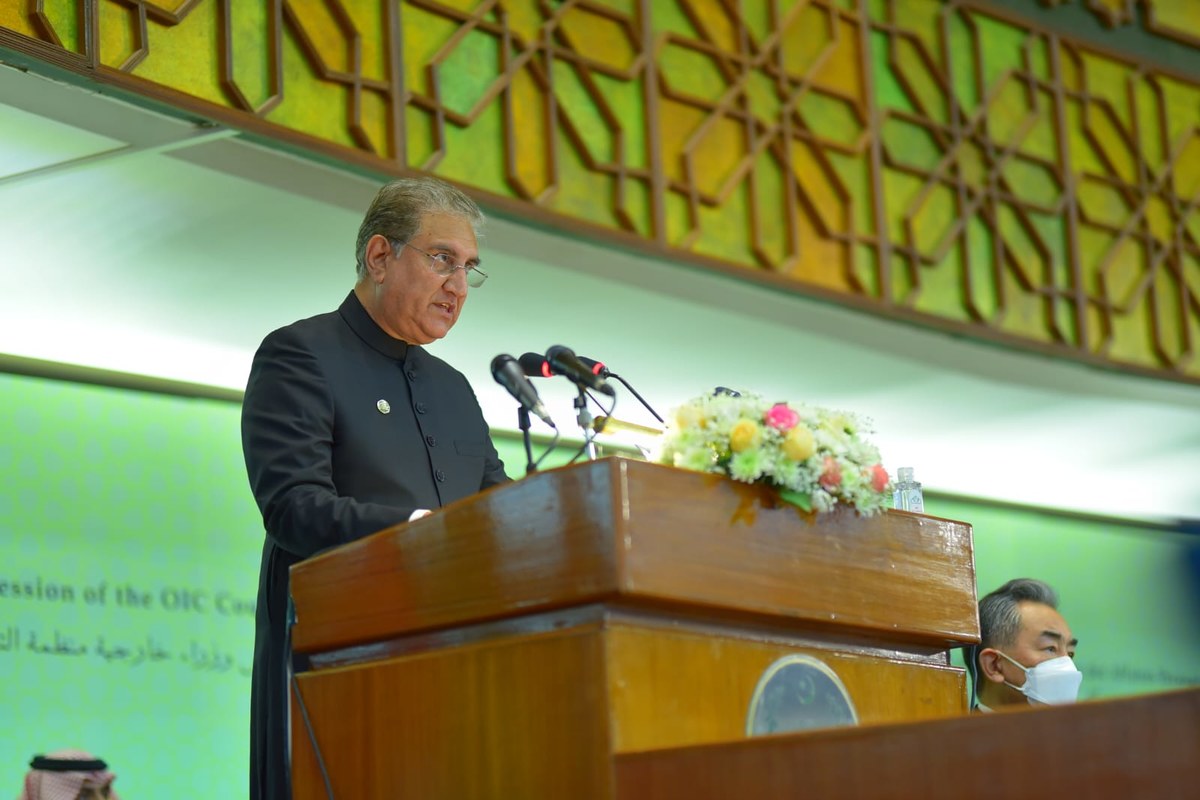
Pakistani Foreign Minister Shah Mahmood Qureshi addresses the 48th session of OIC Council of Foreign Ministers in Islamabad on March 22, 2022. (PID)
Qureshi said the government of Prime Minister Narendra Modi had “unleashed a reign of terror” since August 2019 when it withdrew Indian-administered Kashmir’s autonomy in order to tighten the central government’s grip over the territory, provoking outrage in Pakistan and the downgrading of diplomatic ties and suspension of bilateral trade.
He called on the OIC member states to partner with the international community and take “concrete and tangible” steps for the resolution of the conflicts in Kashmir, as well as Palestine.
Later, he thanked the OIC for supporting the cause while addressing its Contact Group on Jammu and Kashmir. He also urged India to “reverse the demographic changes in the occupied territory” and hold a free and impartial plebiscite to allow Kashmiris to choose their own political destiny.
Qureshi also called for international support for efforts by Afghan authorities to eliminate militant groups like Daesh.
“Effective strategies are also needed to deal with other terrorist groups in Afghanistan,” he added, naming the Tehreek-e-Taliban Pakistan (TTP), the China-based East Turkestan Islamic Movement (ETIM), Islamic Movement of Uzbekistan.
After Qureshi’s speech, Saudi foreign minister Prince Faisal bin Farhan Al Saud delivered his opening statement, announcing “support to the people of Jammu and Kashmir.”
“We also support the efforts made by the international community to reach a just solution for the Jammu and Kashmir issue,” he said.
Saud also condemned aggression by Houthi rebels in Yemen and called on Muslim nations to apply more pressure on the group.
“In line of international resolutions Saudi Arabia calls to neutralize Houthi groups and wants to stop the importing of arms in Yemen,” he said. “We reiterate the importance of the role of brothers to imply more pressure on Houthis so that they can be stopped from jeopardizing the security of the Kingdom.”
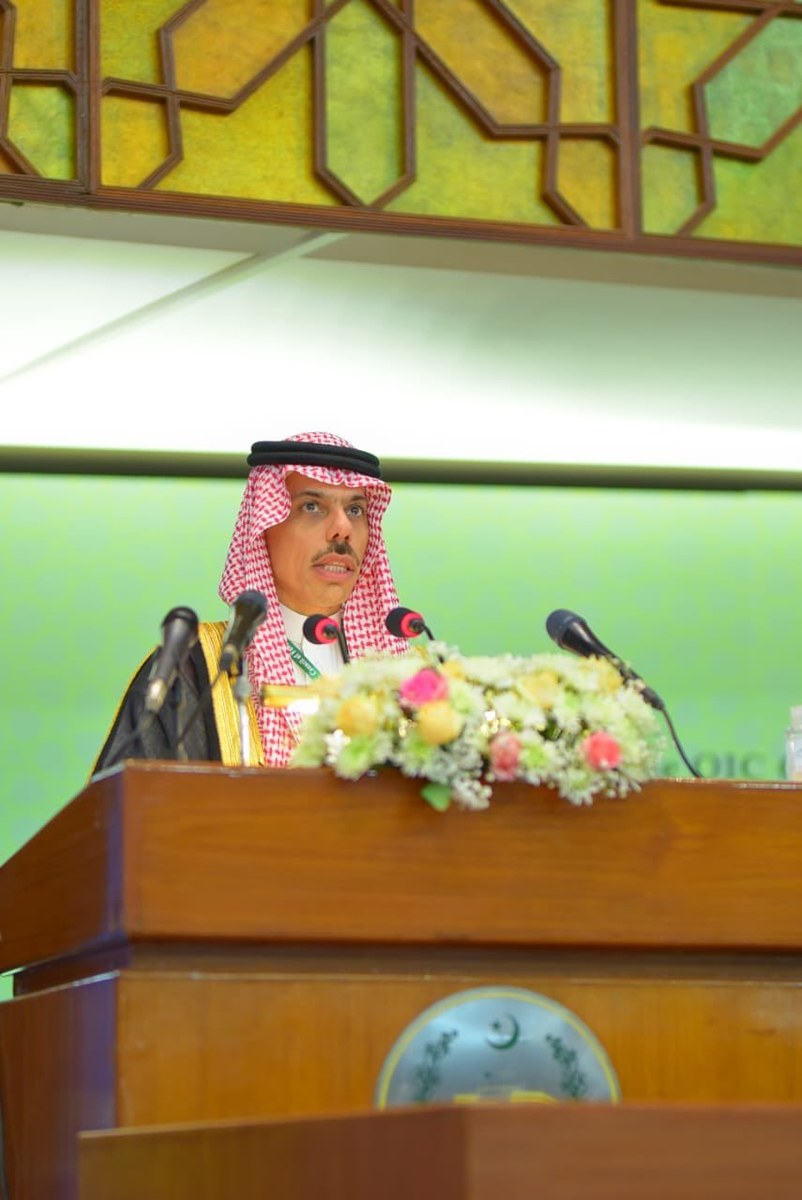
Saudi Foreign Minister Prince Faisal bin Farhan Al Saud addresses the 48th session of OIC Council of Foreign Ministers in Islamabad on March 22, 2022. (APP)
The Saudi foreign minister later held a meeting with Prime Minister Khan before flying back to the kingdom.
During his conversation with Saud, Khan commended the leadership role of the kingdom in turning the OIC into a “vital platform for Islamic world’s causes,” according to an official statement.
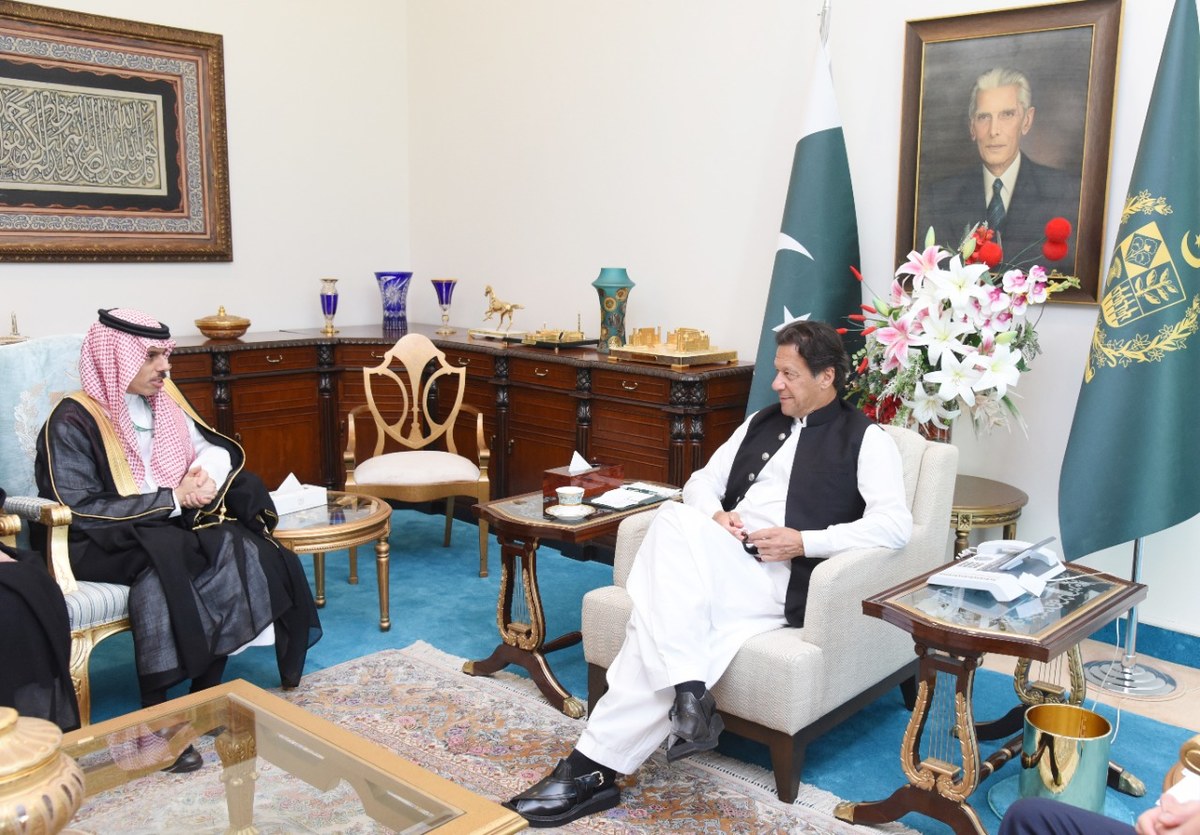
Saudi foreign minister Prince Faisal bin Farhan (left) calls on Pakistan Prime Minister Imran Khan in Islamabad, Pakistan, on March 22, 2022. (PM Office, Pakistan)
The prime minister also met with the foreign ministers of China, Iraq and Kazakhstan.
He discussed the multibillion-dollar China-Pakistan Economic Corridor with Wang Yi while hoping it would result in greater cooperation between the two states in areas like industrial development, agriculture and information technology.