

India, Australia working to reach free trade agreement ‘very soon’

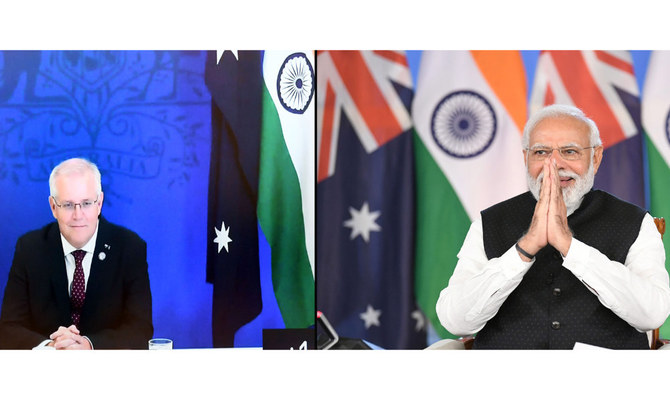
This combination photograph shows Australian Prime Minister Scott Morrison, left, and Indian Prime Minister Narendra Modi holding a virtual summit on Monday. (AP)
Short Url
Updated 21 March 2022
Follow

India, Australia working to reach free trade agreement ‘very soon’

  • Australia also announced an initial $119 million investment plan in India during the summit
  • Prime ministers agree to focus partnership on Indo-Pacific region

NEW DELHI: India and Australia are working to reach a free trade agreement “very soon,” as the two countries on Monday expressed commitments to further bilateral relations and to focus on the Indo-Pacific region during a virtual summit between their leaders.

India and Australia established a comprehensive strategic partnership in June 2020 and are working to boost cooperation through a free trade agreement.

Indian Prime Minister Narendra Modi and his Australian counterpart Scott Morrison said during their opening remarks that the two countries have made “great progress” on this matter.

“I am very sure that we will reach an agreement very soon on the remaining issues as well,” Modi said.

“The quick conclusion of (the Comprehensive Economic Cooperation Agreement) is important for our economic ties, economic revival and economic security.”

Morrison said the two countries will “redouble efforts” on the upcoming agreement “to unlock new opportunities and benefits for both our economies.”

India-Australia bilateral trade was worth an estimated $12 billion in 2021, and both countries have been seeking to diversify trade to cut their economic dependence on China, which is Australia’s top trading partner and India’s main source of imports.

Navdeep Suri, former Indian high commissioner to Australia, said relations between the two countries have been driven by their shared perspectives on China.

Having suffered trade friction with the Asian economic powerhouse, the situation “creates fertile ground for middle-level powers like Australia and India to come together,” Suri told Arab News.

“China is an elephant in the room for both India and Australia.”

Australia also announced a landmark investment plan in India during the summit, with programs ranging from a $13.2 million skills package, an agreement to work together on critical minerals, a $18.6 million package on space cooperation, and a $26.4 million “green steel” partnership, according to the Australian Associated Press. 

The two countries are expected to sign more agreements later this month, with the total package likely to reach more than $200 million.

“The agreement on critical minerals, and given India’s focus on electric vehicles and mobility and Australia’s willingness to supply lithium to India, fits very well into our plan to emerge as a $5 trillion economy,” Suri added.

Australia accounts for 55 percent of global lithium production, and has over 20 percent of global lithium deposits. Lithium is a key active material in the rechargeable batteries that run electric cars.

Modi and Morrison also agreed to focus on the Indo-Pacific region, and briefly touched on the Russian invasion of Ukraine during their meeting.

India, which is part of the Quad grouping with Australia, the US, and Japan, has taken a neutral stance on the war in Europe, a position that Morrison had expressed “understanding” towards, Indian Foreign Secretary Harsh Vardhan Shringla said.


Australia passes tougher laws on guns, hate crimes after Bondi shooting

Updated 4 sec ago
Follow

Australia passes tougher laws on guns, hate crimes after Bondi shooting

  • The gun control laws passed with the support of the Greens party despite opposition from the opposition conservative Liberal-National coalition
  • The anti-hate laws passed with support from the Liberal party

SYDNEY: Australia has enacted new laws for a national gun buyback, tighter background checks for gun licenses and a crackdown on hate crimes in response to the country’s worst mass shooting in decades at a Jewish festival last month.
Two bills for stricter gun control and anti-hate measures passed the House of Representatives and Senate late on Tuesday during a special sitting of parliament.
The gun control laws passed with the support of the Greens party despite opposition from the opposition conservative Liberal-National coalition. The anti-hate laws passed with support from the Liberal party.
Introducing the gun reforms, Home Affairs Minister Tony Burke said individuals with “hate in their hearts and guns in their hands” carried out the December 14 attack at the famed Bondi Beach that killed 15 people.
“The tragic events at Bondi demand a comprehensive response from government,” Burke said. “As a government we must do everything we can to counter both the motivation and the method.”
The father and son gunmen allegedly behind the attack ⁠on Jewish Hanukkah celebrations used powerful firearms that were legally obtained, despite the son being previously examined by Australia’s spy agency.

PARLIAMENT RECALLED EARLY FOR SPECIAL SESSION
Prime Minister Anthony Albanese recalled parliament early from its summer break for this week’s special two-day session to toughen curbs after a shooting that shocked the nation and prompted calls for more action on gun control and antisemitism.
The proposed gun control measures enable the largest national buyback scheme since a similar campaign after a 1996 massacre in Tasmania’s Port Arthur, in which a lone gunman killed 35 people.
They also toughen firearm import laws as well as background checks for firearm licenses issued ⁠by Australian states, making use of information from the Australian Security Intelligence Organization.
Australia had a record 4.1 million firearms last year, the government said on Sunday, with more than 1.1 million of those in New South Wales, its most populous state and the site of the Bondi attack.
“The sheer number of firearms currently circulating within the Australian community is unsustainable,” Burke said.
The bill passed without the support of the opposition coalition, with a vote of 96-45 in the lower house, and 38-26 in the Senate.
“This bill reveals the contempt the government has for the million gun owners of Australia,” said Shadow Attorney-General Andrew Wallace of the Liberals.
“The prime minister has failed to recognize that guns are tools of trade for so many Australians.”

HATE CRIME PENALTIES STEPPED UP
A second bill steps up penalties for hate crimes, such as jail terms up to 12 years when a religious official or preacher is involved, and allows bans on groups deemed to spread hate.
The bill, ⁠which also provides new powers to cancel or refuse visas for those who spread hate, passed the lower house by a 116-7 margin and the Senate 38-22.
It won support from Liberal party lawmakers after ruling Labor struck a deal to include changes such as a requirement the government consult the opposition leader on the listing and delisting of extremist organizations.
The Liberals’ coalition partners abstained from the vote and the Greens opposed it, arguing it would have a “chilling effect” on political debate and protest.
“This bill targets those that support violence, in particular violence targeted at a person because of their immutable attributes,” said Attorney-General Michelle Rowland.
Such conduct is not only criminal but sows the seed of extremism leading to terrorism, she added. Police say the alleged Bondi gunmen were inspired by the Daesh group.
The measures were originally planned for a single bill, but backlash from both the coalition and the Greens forced the government to split the package and drop provisions for an offense of racial vilification.
In its own reforms, New South Wales limits individuals to possession of four guns, and beefs up the power of police to curb protests during designated terrorist attacks.