

Government files presidential reference in Supreme Court for interpretation of Article 63-A

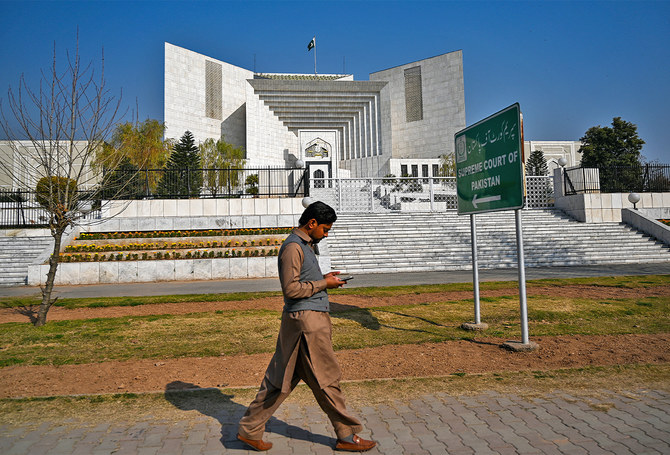
A man walks past the Supreme Court building in Islamabad, Pakistan, on January 29, 2021. (AFP/File)
Short Url
Updated 21 March 2022
Follow

Government files presidential reference in Supreme Court for interpretation of Article 63-A

  • The constitutional provision deals with the issue of disqualification of parliamentarians on grounds of defection
  • The government wants to know if dissident lawmakers can be disqualified for life and stopped from voting in parliament

ISLAMABAD: Pakistan's attorney general Khalid Javed Khan on Monday submitted a reference in the country's top court on behalf of President Arif Alvi to seek detailed interpretation of Article 63-A of the constitution which deals with the disqualification of parliamentarians on grounds of defection.

The development took place in the context of a no-confidence motion against Prime Minister Imran Khan which was filed by an alliance of opposition parties earlier this month.

The government's coalition partners and several lawmakers of the ruling Pakistan Tehreek-e-Insaf (PTI) party have publicly criticized the prime minister and his administration in recent weeks.

The ruling party also issued show-cause notices to its 14 lawmakers, saying their interviews with media outlets had created a perception that they had abandoned the party. The lawmakers were also given a week to present themselves before the prime minister who is also the PTI party chief.

The presidential reference on Monday described floor-crossing as "constitutionally prohibited and morally reprehensible conduct," asking the Supreme Court how the government should ensure "purification of the electoral process and democratic accountability" by dealing with dissident parliamentarians.

Should Article 63-A be interpreted, it asked, in a way that suggests that "defections warrant no preemptive action save de-seating the member as per the prescribed procedure with no further restriction or curbs from seeking election afresh?"

It also mentioned "a robust, purpose oriented and meaningful interpretation of Article 63A" as an alternative that "visualizes this provision as prophylactic enshrining the constitutional goal of purifying the democratic process, inter alia, by rooting out the mischief of defection by creating deterrence, inter alia, by neutralizing the effects of vitiated vote followed by lifelong disqualification for the member found involved in such constitutionally prohibited and morally reprehensible conduct."

The government has previously accused opposition parties of using money to buy the loyalties of its lawmakers.

However, the dissident PTI members maintain they want to vote during the no-confidence session according to their conscience.

Some of them have also pointed out that their party leaders have been trying to prevent them from participating in the no-trust session.

The presidential reference also requested the court to clarify if a member engaging in "constitutionally prohibited and morally reprehensible act of defection can ... nevertheless claim a vested right to have his vote counted and given equal weightage."


Pakistan reviews austerity measures amid Middle East crisis, urges strict nationwide implementation

Updated 11 March 2026
Follow

Pakistan reviews austerity measures amid Middle East crisis, urges strict nationwide implementation

  • Deputy Prime Minister Ishaq Dar chairs review meeting of austerity steps
  • Officials briefed on salary cuts, school closures, four‑day week, petrol conservation

ISLAMABAD: Pakistan’s government on Wednesday assessed progress on a sweeping set of austerity measures introduced to mitigate the country’s economic strain from sharply rising global oil prices and supply disruptions linked to the ongoing war in the Middle East.

Prime Minister Shehbaz Sharif this week announced a series of austerity steps, including a four‑day work week for government offices, requiring 50  percent of staff to work from home, cutting fuel allowances for official vehicles by half, grounding up to 60  percent of the government fleet and closing all schools for two weeks to conserve fuel amid the global oil crisis.

The measures were unveiled in response to global oil market volatility triggered by the conflict involving the United States, Israel and Iran, which has disrupted supply routes such as the Strait of Hormuz and pushed crude prices sharply higher, straining Pakistan’s heavily import‑dependent energy sector.

“The meeting stressed the importance of strict and transparent adherence to the austerity measures, promoting fiscal responsibility and prudent use of public resources,” Deputy Prime Minister and Foreign Minister Senator Mohammad Ishaq Dar said in a statement.

He was chairing a meeting of the Committee for Monitoring and Implementation of Conservation and Additional Austerity Measures, constituted under the directions of the PM, bringing together federal and provincial officials to review execution of the broad cost‑cutting plan. 

Dar emphasized the government’s commitment to enforcing the PM’s austerity steps nationwide. The committee’s review also covered reductions in departmental expenditure, deductions from salaries of senior officials earning over Rs. 300,000 ($1,120), and coordination with provincial administrations to ensure uniform implementation of the plan.

Participants at the meeting reiterated that all ministries and divisions must continue strict monitoring and reporting, with transparent oversight mechanisms, as Pakistan navigates the economic pressures from the prolonged Middle East crisis and its fallout on global energy and trade markets.