PM Boris Johnson accused of ‘poor grasp’ of Zaghari-Ratcliffe case while UK foreign secretary

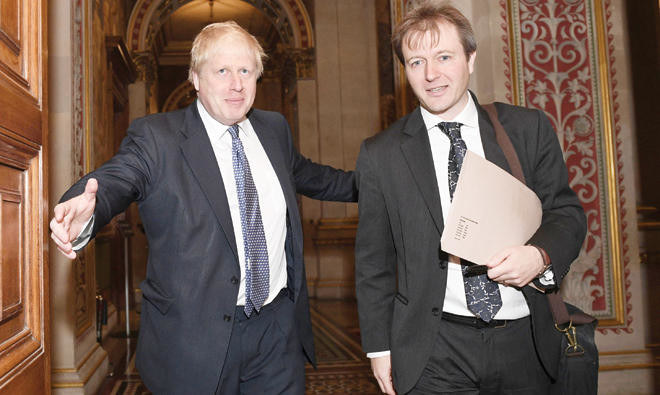
Britain’s then-Foreign Secretary Boris Johnson with Richard Ratcliffe, the husband of British-Iranian woman Nazanin Zaghari-Ratcliffe, at the Foreign and Commonwealth Office in London. (AFP/File Photo)
Short Url
Updated 20 March 2022
Follow

PM Boris Johnson accused of ‘poor grasp’ of Zaghari-Ratcliffe case while UK foreign secretary

  • Zaghrari-Ratcliffe family’s member of parliament, Tulip Siddiq, has released new evidence of shortcomings in the Foreign Office during her ordeal

LONDON: Evidence suggesting Boris Johnson made errors involving the case of Nazanin Zaghari-Ratcliffe as UK foreign secretary was revealed on Sunday.

The former charity worker was reunited with her husband, Richard, and daughter, Gabriella, on Thursday after being released by Iran following a six-year detention.

Reports said the release was facilitated by a near-£400 million ($527 million) debt payment by the British government to Iran relating to a decades-old order for Chieftain tanks.

Prime Minister Johnson called the release of Zaghari-Ratcliffe, and fellow British-Iranian captive Anoosheh Ashoori, a result of a “great deal of UK diplomacy.”

However, the Zaghrari-Ratcliffe family’s member of parliament, Tulip Siddiq, has released new evidence of shortcomings in the Foreign Office during her ordeal — and the way Johnson failed to grasp even basic details of the case in 2017.

Writing in The Observer newspaper, Siddiq said as foreign secretary Johnson mistakenly told the Foreign Affairs Select Committee that Zaghari-Ratcliffe was “simply teaching people journalism,” something Iran used as evidence of her alleged crimes.

Siddiq expressed in her article her shock when Johnson displayed ignorance of the case once again when meeting Richard Ratcliffe to discuss his previous error before the committee.

“This disastrous blunder meant Johnson was forced to meet us. Again, I raised my concerns about the debt, which were flatly denied by him,” she wrote.

“Incredibly, he asked if Richard had enjoyed his visit to Iran. Anyone who had read a newspaper article on the case was aware that Richard had been at home in the UK when his wife was arrested in Iran. To this day, I feel astonished by Johnson’s extremely poor grasp of his brief.”

She also lamented how the government “wasted time” in the case, and how a personal campaign she waged allowed Nazanin a medical examination, which the British-Iranian captive later said meant she was the best-protected inmate in the infamous Evin prison.

Siddiq also outlined how successive British prime ministers denied a link between the UK’s Chieftain debt and Zaghari-Ratcliffe’s detention, and how it was only last year when Liz Truss became foreign secretary that the link was acknowledged.

There are growing calls from British MPs for a full investigation into the government’s handling of the case over the six years Zaghari-Ratcliffe was detained, as well as failings by the Foreign Office in other matters, including the evacuation from Afghanistan.


Mali, Burkina say restricting entry for US nationals in reciprocal move

Updated 56 min 37 sec ago
Follow

Mali, Burkina say restricting entry for US nationals in reciprocal move

  • Both countries said they are applying the same measures on American nationals as imposed on them

ABIDJAN: Mali and Burkina Faso have announced travel restrictions on American nationals in a tit-for-tat move after the US included both African countries on a no-entry list.
In statements issued separately by both countries’ foreign ministries and seen Wednesday by AFP, they said they were imposing “equivalent measures” on US citizens, after President Donald Trump expanded a travel ban to nearly 40 countries this month, based solely on nationality.
That list included Syrian citizens, as well as Palestinian Authority passport holders, and nationals of some of Africa’s poorest countries including also Niger, Sierra Leone and South Sudan.
The White House said it was banning foreigners who “intend to threaten” Americans.
Burkina Faso’s foreign ministry said in the statement that it was applying “equivalent visa measures” on Americans, while Mali said it was, “with immediate effect,” applying “the same conditions and requirements on American nationals that the American authorities have imposed on Malian citizens entering the United States.”
It voiced its “regret” that the United States had made “such an important decision without the slightest prior consultation.”
The two sub-Saharan countries, both run by military juntas, are members of a confederation that also includes Niger.
Niger has not officially announced any counter-measures to the US travel ban, but the country’s news agency, citing a diplomatic source, said last week that such measures had been decided.
In his December 17 announcement, Trump also imposed partial travel restrictions on citizens of other African countries including the most populous, Nigeria, as well as Ivory Coast and Senegal, which qualified for the football World Cup to be played next year in the United States as well as Canada and Mexico.