

Pakistan rejects Indian home minister’s remarks questioning partition, location of Gurdwara Darbar Sahib

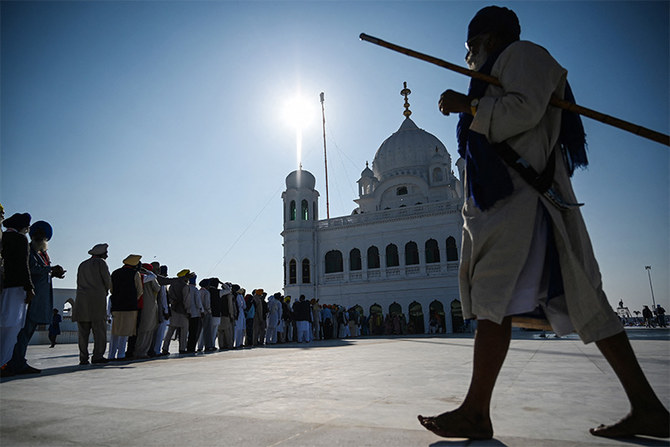
Sikh pilgrims stand in a queue to visit the Shrine of Baba Guru Nanak Dev at Gurdwara Darbar Sahib in Kartarpur, near the Indian border, on November 9, 2019. (AFP/FILE)
Short Url
Updated 19 March 2022
Follow

Pakistan rejects Indian home minister’s remarks questioning partition, location of Gurdwara Darbar Sahib

  • The visa-free border crossing from India to Kartarpur, Pakistan was inaugurated in November 2019
  • Amit Shah claimed there was an "error" in the place being left out of India during the 1947 partition

ISLAMABAD: Islamabad on Friday rejected “unwarranted and gratuitous” remarks made by Indian Home Minister Amit Shah, questioning the partition of the Sub-continent and the location of the revered Gurdwara Darbar Sahib in Kartarpur, Pakistan. 

The visa-free border crossing, from India to Kartarpur in Pakistan's Narowal district, was inaugurated in November 2019 just ahead of the 550th birthday of Sikhism's founder, Guru Nanak.  

The corridor connects the Sikh shrines of Dera Baba Nanak in India to Gurdwara Darbar Sahib in Kartarpur, and is seen as a rare example of cooperation and diplomacy between the two South Asian neighbours. 

On Thursday, Indian Home Minister Amit Shah said there was an "error" in the place being left out of India during the partition of the British-ruled Sub-continent in 1947. 

“Pakistan categorically rejects the unwarranted and gratuitous remarks made by Indian Home Minister Amit Shah, during a recent event, questioning the partition and location of Kartarpur Sahib in Pakistan,” the Pakistani foreign office said in a statement. 

“It is deeply regrettable that distortion of historical facts has become the hallmark of the BJP government along with its ideological fountainhead RSS (Rashtriya Swayamsevak Sangh),” it said.  

“The resort to such delusional thinking by the Indian leadership has been strikingly frequent over the last couple of months in the wake of the elections in several states in India.” 

When Pakistan and India were carved out of the Sub-continent at the end of British rule in 1947, Kartarpur ended up on the Pakistani side of the border, while most of the region's Sikhs remained on the other side. 

For over seven decades, the Sikh community lobbied for easier access to their holiest temple. 

“It is also worth remembering that it was Pakistan which had brought to fruition the idea of Gurdwara Darbar Sahib Kartarpur Corridor, while India kept dragging its feet,” the foreign office noted, saying Islamabad completed the project in record time as a “gift” to the Sikh community in India and worldwide. 


Pakistan rejects claims it approached ICC for dialogue over India match boycott

Updated 5 sec ago
Follow

Pakistan rejects claims it approached ICC for dialogue over India match boycott

  • Indian journalist Vikrant Gupta says Pakistan approached ICC after it informed PCB of legal ramifications of boycotting India clash
  • Pakistan’s government has allowed national team to take part in ongoing World Cup but barred it from playing against India on Feb. 15

ISLAMABAD: The Pakistan Cricket Board (PCB) this week rejected an Indian journalist’s claim that it has approached the International Cricket Council (ICC) for a dialogue regarding Pakistan’s upcoming cricket fixture against India. 

Indian sports journalist Vikrant Gupta wrote on social media platform X on Saturday that the PCB has reached out to the ICC for dialogue over its decision to boycott the Feb. 15 T20 World Cup match against India. 

Gupta said the development took place after the ICC informed the PCB of the legal ramifications and potential sanctions the cricket governing body could impose if Pakistan boycotted its World Cup match against India. 

Gupta said the ICC was responding to the PCB, which had informed the global cricket governing body in writing that it was pulling out of the match as Pakistan’s government had not allowed the national team to play the Feb. 15 fixture. 

“I categorically reject the claim by Indian sports journalist Vikrant Gupta that PCB approached the ICC,” PCB spokesperson Amir Mir said in a statement on Saturday. 

“As usual, sections of Indian media are busy circulating fiction. A little patience and time will clearly show who actually went knocking and who didn’t.”

Pakistan’s government earlier this month cleared the team’s participation in the T20 World Cup but barred them from facing India in Colombo on Feb. 15.

Prime Minister Shehbaz Sharif later said the decision was taken to express solidarity with Bangladesh, after it was replaced by the ICC in the ongoing tournament. 

ICC replaced Bangladesh with Scotland last month after the latter refused to play its World Cup matches in India due to security reasons. 

Pakistan has blamed India’s cricket board for influencing the ICC’s decisions. Defense Minister Khawaja Asif this week called for a the formation of a new cricket governing body, saying the ICC is now hostage to “India’s political interests.”

India generates the largest share of cricket’s commercial revenue and hence enjoys considerable influence over the sport. Critics argue that this financial contribution translates into decisive leverage within the ICC. 

A large part of that revenue comes from the Indian Premier League (IPL), the sport’s most lucrative T20 cricket competition, which is run by the Board of Control for Cricket in India (BCCI). Between 2024 and 2027, the IPL is projected to earn $1.15 billion, nearly 39 percent of the ICC’s total annual revenue, according to international media reports. 

The ICC is headed by Jay Shah, the son of Indian Home Minister Amit Shah. The ICC chair is expected to be independent from any cricket board and take impartial decisions.