Japan PM visits India for ‘candid’ talks on Ukraine

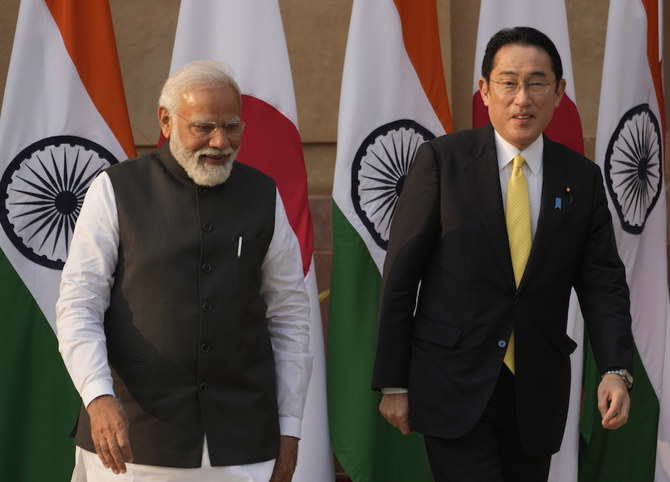
India’s prime minister Narendra Modi welcomes his Japanese counterpart Fumio Kishida upon his arrive in New Delhi on March 19, 2022. (AP)
Short Url
Updated 19 March 2022
Follow

Japan PM visits India for ‘candid’ talks on Ukraine

  • Kishida will also aim to reinforce security and economic ties with India

NEW DELHI: Japanese Prime Minister Fumio Kishida arrived in India on Saturday, with officials in Tokyo predicting “candid discussions” about New Delhi’s unwillingness to condemn Russia’s invasion of Ukraine.
Unlike fellow members of the Quad alliance — Japan, Australia and the United States — India has abstained in three UN votes deploring Moscow’s actions, calling only for a halt to the violence.
Earlier this month in a four-way call of Quad leaders, Kishida, US President Joe Biden and Australian Prime Minister Scott Morrison failed to convince India’s Narendra Modi to take a tougher line.
A joint statement had said they “discussed the ongoing conflict and humanitarian crisis in Ukraine and assessed its broader implications” — without any condemnation of Moscow.
A separate Indian readout pointedly “underlined that the Quad must remain focused on its core objective of promoting peace, stability and prosperity in the Indo-Pacific region.”
Ahead of Kishida’s visit, the first by a Japanese premier since 2017, a foreign ministry official said Tokyo was “aware” of Delhi’s “geographical location and historical ties to Russia.”
“But at the same time we share fundamental values and strategic interests so naturally there will be candid discussions about how we view the Ukraine situation, and also expect to hear a similar explanation from Prime Minister Modi,” the official told reporters.
He added that Modi, 71, and Kishida, 64, would also discuss “issues closer to our region” such as a “free and open Indo-Pacific” — a reference to China — and bilateral issues.
“That will be more the opportunity to take stock of the bilateral cooperation as well as reaffirming our shared strategic vision and interests rather than emphasising on what our differences are,” the official said.
India’s foreign ministry said only that the talks aimed to “review and strengthen the bilateral cooperation in diverse areas as well as exchange views on regional and global issues of mutual interest so as to advance their partnership for peace, stability and prosperity in the Indo-Pacific region and beyond.”
Modi and Morrison are also due to hold a virtual summit on March 21 focused on trade, when the Australian premier may also press his Indian counterpart to fall more into the Western camp over Ukraine.
Russia has been India’s main arms supplier since the Soviet era, but today Delhi also needs more support from the Quad and others in the region and beyond in the face of an increasingly assertive China.
Asked about India’s stance and its continued purchases of Russian oil, White House press secretary Jen Psaki this week urged all foreign nations to “think about where you want to stand when history books are written.”
Tensions between New Delhi and Beijing have been high since a 2020 clash on their disputed Himalayan border killed at least 20 Indian and four Chinese soldiers.
Both have since sent additional military hardware — in India’s case much of it Russian-made — and thousands of extra troops.
In a possible sign of thawing tensions, China’s Foreign Minister Wang Yi will reportedly travel to India later this month, the senior-most official to visit since the 2020 clash.


Indian writer Arundhati Roy pulls out of Berlin Film Festival over Gaza row

Updated 4 sec ago
Follow

Indian writer Arundhati Roy pulls out of Berlin Film Festival over Gaza row

  • Writer pulls out after jury president Wim Wenders said cinema should 'stay out of politics' when asked about Gaza
  • Booker Prize winner describes Israel’s actions in Gaza as 'a genocide of the Palestinian people'
BERLIN: Award-winning Indian writer Arundhati Roy said Friday she was withdrawing from the Berlin Film Festival over jury president Wim Wenders’s comments that cinema should “stay out of politics” when he was asked about Gaza.
Roy said in a statement sent to AFP that she was “shocked and disgusted” by Wenders’s response to a question about the Palestinian territory at a press conference on Thursday.
Roy, whose novel “The God of Small Things” won the 1997 Booker Prize, had been announced as a festival guest to present a restored version of the 1989 film “In Which Annie Gives It Those Ones,” in which she starred and wrote the screenplay.
However, she said that the “unconscionable” statements by Wenders and other jury members had led her to reconsider, “with deep regret.”
When asked about Germany’s support for Israel at a press conference on Thursday, Wenders said: “We cannot really enter the field of politics,” describing filmmakers as “the counterweight to politics.”
Fellow jury member Ewa Puszczynska said it was a “little bit unfair” to expect the jury to take a direct stance on the issue.
Roy said in her statement that “to hear them say that art should not be political is jaw-dropping.”
She described Israel’s actions in Gaza as “a genocide of the Palestinian people by the State of Israel.”
“If the greatest film makers and artists of our time cannot stand up and say so, they should know that history will judge them,” she said.
Roy is one of India’s most famous living authors and is a trenchant critic of Prime Minister Narendra Modi’s government, as well as a firm supporter of the Palestinian cause.

Shying away from politics

The Berlinale traditionally has a reputation for topical, progressive programming, but so far this year’s edition has seen several stars shy away from taking a stance on the big political issues of the day.
US actor Neil Patrick Harris, who stars in the film “Sunny Dancer” being shown in the festival’s Generation section, was asked on Friday if he considered his art to be political and if it could help “fight the rise of fascism.”
He replied that he was “interested in doing things that are apolitical” and which could help people find connection in our “strangely algorithmic and divided world.”
This year’s Honorary Golden Bear recipient, Malaysian actor Michelle Yeoh, also demurred when asked to comment on US politics in a press conference on Friday, saying she “cannot presume to say I understand” the situation there.
This isn’t the first edition of the festival to run into controversy over the Gaza war.
In 2024 the festival’s documentary award went to “No Other Land,” a portrayal of the dispossession of Palestinian communities in the Israeli-occupied West Bank.
German government officials criticized “one-sided” remarks about Gaza by the directors of that film and others at that year’s awards ceremony.
The war in Gaza was sparked by Hamas’s October 7, 2023 attack on Israel, which resulted in the deaths of 1,221 people, according to an AFP tally based on official Israeli figures.
Israel’s retaliation has left at least 71,000 people dead in Gaza, according to the health ministry in the Hamas-run territory, whose figures the UN considers reliable.