Three Russian cosmonauts were due for launch on Friday to the International Space Station (ISS), continuing a two-decade-plus shared Russian-US presence aboard the orbiting outpost despite heightened terrestrial tensions between Moscow and Washington.
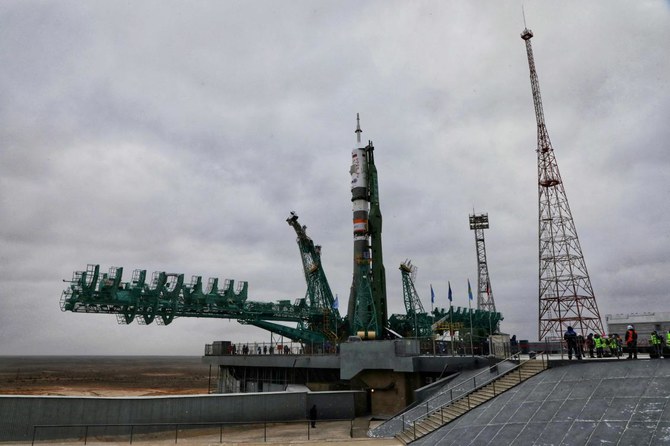
The Soyuz spacecraft carrying the new cosmonaut team was set for lift-off at 1555 GMT (11:55 a.m. Eastern time) from Russia’s Baikonur Cosmodrome in Kazakhstan to begin a three-hour-plus ride to the space station.
Soyuz commander Oleg Artemyev will lead the team, joined by two spaceflight rookies, Denis Matveev and Sergey Korsakov, on a science mission aboard ISS set to last six and half months.
They will join the station’s current seven-member crew to replace three who are scheduled to fly back to Earth on March 30 — cosmonauts Pyotr Dubrov and Anton Shkaplerov and US NASA astronaut Mark Vande Hei.
Vande Hei will have logged a NASA record-breaking 355 days in orbit by the time he returns to Kazakhstan aboard a Soyuz capsule with his two cosmonaut peers.
Remaining aboard the ISS with the newcomers until the next rotation a couple months later are three NASA astronauts — Tom Marshburn, Raja Chari and Kayla Barron — and German crewmate Matthias Maurer of the European Space Agency.
Those four crew members arrived together in November aboard a SpaceX Crew Dragon craft launched from NASA’s Kennedy Space Center in Florida to begin a six-month stint in orbit.
Launched in 1998, the research platform orbiting some 400 kilometers above Earth has been continuously occupied since November 2000 while operated by a US-Russian-led partnership including Canada, Japan and 11 European countries.
The latest change in ISS personnel comes as the durability of longstanding US-Russian collaboration in space is tested by heightened antagonism between the two former Cold War adversaries over Russia’s invasion of Ukraine.
As part of US economic sanctions against Russian President Vladimir Putin’s government last month, US President Joe Biden ordered high-tech export restrictions against Moscow that he said were designed to “degrade” Russia’s aerospace industry, including its space program.
Dmitry Rogozin, director-general of Russian space agency Roscosmos, immediately lashed out in a series of tweets suggesting the US sanctions could “destroy” ISS teamwork and lead to the space station itself falling out of orbit.
A week later, Rogozin retaliated by announcing Russia would stop supplying or servicing Russian-made rocket engines used by two US aerospace NASA suppliers, suggesting US astronauts could use “broomsticks” to get to orbit.
At about the same time, Moscow said it had ceased joint ISS research with Germany and forced the 11th-hour cancelation of a British satellite launch from Baikonur.
The Roscosmos chief also said last month that Russia was suspending its cooperation with European launch operations at the European Spaceport in French Guiana.
The ISS itself was born in part from a foreign policy initiative to improve US-Russian relations following the collapse of the Soviet Union and the Cold War hostility that spurred the original US-Soviet space race.
But Rogozin’s recent actions have prompted some in the US space industry to rethink the NASA-Roscosmos partnership.
Ann Kapusta, executive director of nonprofit space advocacy group the Space Frontier Foundation, said in a recent statement that the United States should end its ISS collaboration with Russia.
Kapusta, a onetime ISS research operations lead for NASA, said “toxic behavior” by Rogozin “shows there is no distance between Roscosmos and Putin’s war machine,” and that Russia can no longer be trusted to safely cooperate in space.
NASA officials, for their part, insist that US and Russian ISS crew, while aware of events on Earth, were still working together professionally and that geopolitical tensions had not infected the space station.
Addressing the US space agency’s 60,000 employees in a video “town hall” on Monday, NASA chief Bill Nelson said: “NASA continues working with all our international partners, including State Space Corporation Roscosmos, for the ongoing safe operations” of the space station.
NASA this week posted a fact sheet outlining the technical interdependency of the US and Russian segments of the space station.
For example, while US gyroscopes provide day-to-day control over ISS orientation in space and US solar arrays augment power supplies to the Russian module, Russia provides the propulsion used to keep the station in orbit.


![]()
![]()

Russian cosmonauts set for Friday launch to International Space Station

Short Url
https://arab.news/47x7c
Russian cosmonauts set for Friday launch to International Space Station
- Soyuz spacecraft carrying the new cosmonaut team set for lift-off at 1555 GMT
- Soyuz commander Oleg Artemyev will lead the team, joined by two spaceflight rookies


Latest updates


Recommended


© 2026 SAUDI RESEARCH & PUBLISHING COMPANY, All Rights Reserved And subject to Terms of Use Agreement.