

Pakistan army chief orders 'comprehensive security measures' for OIC meeting in Islamabad

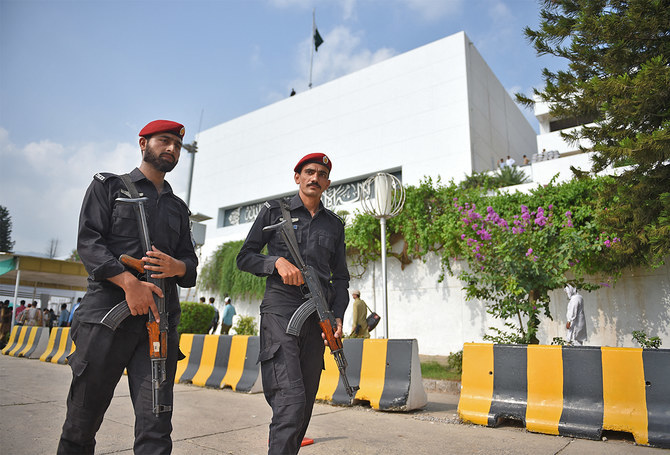
Pakistani police commandos walk in front of the Parliament, in Islamabad on August 17, 2018. (AFP/File)
Short Url
Updated 18 March 2022
Follow

Pakistan army chief orders 'comprehensive security measures' for OIC meeting in Islamabad

  • OIC Council of Foreign Ministers session is scheduled to be held in Islamabad on March 22-23
  • Opposition parties have also announced a ‘long march’ toward Islamabad starting March 23

ISLAMABAD: Pakistan Army Chief General Qamar Javed Bajwa on Tuesday ordered that “comprehensive security measures” be taken for a meeting of the Organization of Islamic Cooperation Council of Foreign Ministers (OIC-CFM) and the Pakistan Day parade scheduled to take place in Islamabad next week, the Pakistani military said.

The 48th session of the OIC-CFM will be held in Islamabad on March 22-23, for which at least 46 OIC foreign ministers or representatives have confirmed their participation. All heads of the visiting delegations have also been invited to witness the Pakistan Day parade on March 23 as "guests of honor."

The parade is held every year to commemorate the Lahore Resolution, which was adopted on the same day in 1940 and laid the foundation for a Muslim-majority state in South Asia.

On Tuesday, the army chief presided over a corps commanders' conference in Rawalpindi to review important global and regional developments as well as the internal security situation.

“COAS [Chief of Army Staff] directed that comprehensive security measures be ensured for peaceful conduct of OIC Council of Foreign Ministers meeting and Pakistan Day Parade,” the Inter-Services Public Relations (ISPR), the Pakistani military's media wing, said in a statement.

“The forum expressed resolve to take all requisite measures to ensure security of the country.”

Pakistan has witnessed intense political turmoil since the opposition filed a no-confidence motion against Prime Minister Imran Khan last week, accusing his administration of misgovernance.

Khan has vowed to gather a “sea of people” in front of parliament on March 27 ahead of the no-trust proceedings in the National Assembly of Pakistan.

In response to his call, Maulana Fazlur Rehman, who is heading the opposition alliance, has asked supporters to embark on a long march towards the capital on March 23.


Pakistan seeks Saudi oil route via Red Sea port as Hormuz closure threatens supplies

Updated 8 sec ago
Follow

Pakistan seeks Saudi oil route via Red Sea port as Hormuz closure threatens supplies

  • Islamabad requests alternative crude shipments through Saudi Arabia’s Yanbu port on the Red Sea
  • Most of Pakistan’s energy imports transit the Strait of Hormuz, now disrupted by regional conflict

ISLAMABAD: Pakistan has asked Saudi Arabia to help secure crude oil supplies through the Red Sea port of Yanbu as the closure of the Strait of Hormuz threatens the country’s energy supply routes, the petroleum ministry said on Wednesday.

The request comes as the strategic waterway between Iran and Oman was shut after escalating hostilities between Iran and the United States and Israel in the Gulf, disrupting tanker traffic through one of the world’s most important oil chokepoints.

About one-fifth of global oil shipments normally pass through the Strait of Hormuz, including exports from Saudi Arabia, Iraq, Kuwait, the United Arab Emirates and Qatar. Pakistan relies heavily on Middle Eastern crude, with the majority of its energy imports typically transiting the strait, making any disruption a major risk to domestic fuel supplies.

During a meeting in Islamabad with Saudi Ambassador Nawaf bin Said Al-Malki, Petroleum Minister Ali Pervaiz Malik discussed contingency plans to maintain Pakistan’s energy supply chain. According to a statement from Malik’s office, Saudi Arabia indicated it could facilitate shipments through the Red Sea port of Yanbu, offering an alternative route if Gulf shipping lanes remain disrupted.

“Saudi Arabian sources had assured security of supplies through the Port of Yanbu on the Red Sea, which can help meet energy requirements,” the statement said.

“Pakistan is closely monitoring the evolving situation on a daily basis, as the majority of Pakistan’s energy supplies transit through the Strait of Hormuz.”

The Saudi ambassador reaffirmed Riyadh’s support, saying the Kingdom was aware of the evolving situation and would stand with Pakistan to meet any emergency requirements, the statement added. 

Saudi Arabia and Pakistan share long-standing economic and strategic ties, with Riyadh serving as one of Islamabad’s key energy suppliers.