MOSCOW: A Russian editor who protested against Moscow’s military action in Ukraine during a prime-time news broadcast on state TV was released with a fine Tuesday after an international outcry over her detention.
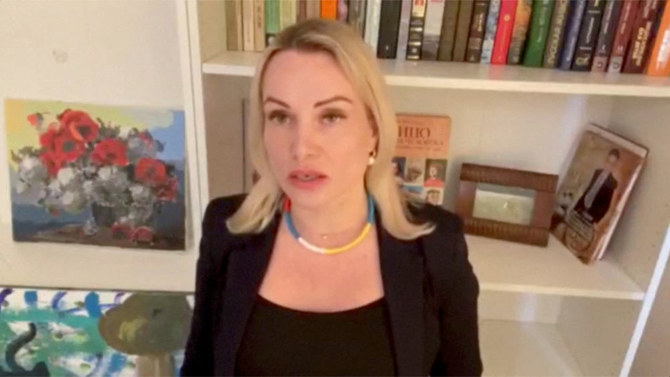
Marina Ovsyannikova, an editor at Channel One television, barged onto the set of its flagship Vremya (Time) evening news late Monday, holding a poster reading “No War” in English.
The mother of two still risks criminal charges with a penalty of up to 15 years in jail, one of her lawyers said.
Ovsyannikova’s case drew international attention and raised new alarm over press freedom in Russia in the wake of President Vladimir Putin’s decision to send troops to pro-Western Ukraine.
On Tuesday, French President Emmanuel Macron offered asylum or other forms of consular protection to the journalist.
After her protest she was detained and questioned for 14 hours, she told reporters on Tuesday.
She was released after a judge at Moscow’s Ostankino district court ordered her to pay a fine of 30,000 rubles ($280) on Tuesday.
She could have faced a maximum punishment of 10 days in detention for calling for illegal protests.
This charge was based not specifically on her interruption of the news broadcast, but on a video statement she released explaining the reasons for her protest and urging Russians to take to the streets.
Ovsyannikova pleaded not guilty in court, saying: “I am still convinced that Russia is committing a crime.”
“These are very difficult days in my life,” she said after the ruling.
“I’ve spent two days literally without sleep.”
One of Ovsyannikova’s lawyers, Daniil Berman, told AFP she also risked criminal charges and up to 15 years in jail under new legislation against “fake news” on the Russian military, introduced after Putin sent troops into Ukraine on February 24.
Macron, who has maintained a dialogue with Putin despite Moscow’s military action, said he would bring up her case during his next conversation with the 69-year-old Russian leader.
“We will launch diplomatic efforts aiming to offer (her) protection — either at the embassy but also protection through asylum,” said Macron.
“I will have the chance at my next talks with President Putin to propose this solution in a very direct and concrete manner,” he added.
Channel One said an internal investigation was underway. It was a highly unusual event in Russia where state media is strictly controlled.
“I want to have as quickly as possible all clarity about her personal situation and her ability to continue with her work,” Macron said.
EU Commission external affairs spokesman Peter Stano said she took a “brave moral stance and dared to object Kremlin’s lies and propaganda live on air on a state-controlled TV channel.”
The incident was widely picked up by international media, while Russian publications blurred out the message on the poster to avoid running afoul of a new media law.
Thousands of people posted tributes on social media to Ovsyannikova’s “extraordinary courage” amid a historic crackdown on the opposition in Russia.
Press freedom activists outside Russia accuse state television of painting a severely distorted picture of Moscow’s military action in a bid to maintain popular support.
Ovsyannikova’s message in Russian read: “Stop the war. Don’t believe propaganda. They are lying to you here.”
It was signed in English: “Russians against the war.”
Ovsyannikova managed to say a few phrases in Russian, including “Stop the war!,” while news anchor Yekaterina Andreyeva tried to drown her out by speaking louder before the channel switched hastily to footage of a hospital.
In a video posted on social media, Ovsyannikova speaking before her action says she is “ashamed” to have been involved in “Kremlin propaganda” and describes Moscow’s military action as a “crime.”
“I’m ashamed I allowed Russian people to be zombified,” she added.
Her action won praise from Ukrainian President Volodymyr Zelensky, who said: “I am grateful to those Russians who do not stop trying to tell the truth and specifically to the lady who entered the studio of Channel One with a poster against the war.”


Russian court fines TV protester amid outcry

https://arab.news/67f83
Russian court fines TV protester amid outcry

- Marina Ovsyannikova, an editor at Channel One television, barged onto the set of its flagship Vremya (Time) evening news late Monday, holding a poster reading “No War” in English
- After her protest she was detained and questioned for 14 hours then was released after a Moscow court judge fined her $280 on Tuesday


Eurovision Sport, Camb.ai to provide live subtitling for Paralympic Winter Games
- Partnership aims to increase accessibility for all audiences
- Milano Cortina Games run from Friday to March 15
LONDON: Eurovision Sport, the European Broadcasting Union’s free-to-air streaming platform, will provide live and on-demand subtitling for coverage of the Milano Cortina 2026 Paralympic Winter Games in partnership with AI language company Camb.ai
The service will run across all competition days, allowing viewers to stream all six Paralympic Winter Games sports on Eurovision Sport with real-time subtitles. The Games open on Friday and run through March 15.
Camb.ai will supply contextual speech-to-text transcription for both live and catch-up coverage, which the organizers said would support accessibility without altering the editorial integrity of broadcasts.
Eurovision Sport Managing Director Alan Fagan said the aim was to make the Games available to “the widest possible audience,” by scaling up digital accessibility across every event on the platform.
The initiative forms part of the EBU’s most extensive digital coverage of a Paralympic Winter Games to date and complements member broadcasters’ linear output.
It also reflects a wider industry push to make live sport easier to follow for viewers watching without sound, people with hearing impairments and audiences consuming content on demand.
Camb.ai’s Chief Technology Officer Akshat Prakash said the company was proud to deepen its partnership with Eurovision Sport, describing the platform as a leader in applying new technology to sports coverage.
The two organizations began working together in 2024, when they delivered what they described as Europe’s first AI-powered real-time translated sports commentary during European Athletics events.


