


RIYADH: The Kingdom’s Human Capability Development Program has announced details of the strategy of the Custodian of the Two Holy Mosques Scholarship Program, which aspires to send 70,000 students abroad by 2030.
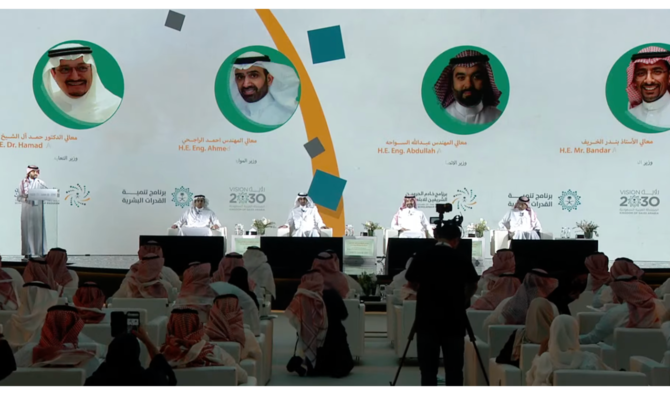
The press conference, held on Sunday in Riyadh by HCDP — one of the programs to achieve the Saudi Vision 2030 — discussed the strategy, its pillars, aims and expected outcomes, and its role in improving human capital efficiency in new and promising sectors.
Minister of Education Hamad Al-Sheikh said that the scholarship strategy would begin with an analysis of 90 scholarship programs globally. The program would then send 70,000 students to 200 educational and training bodies worldwide until 2030.
The strategy comes with four paths, and each of these paths has clear and specific objectives: The Pioneers path, the Research & Development path, the Provider path, and the Promising path.
“The Pioneers path aims to send students to the world’s top 30 educational institutions in all fields, according to internationally accredited university rankings, in empowering Saudi scholarship students to achieve and compete globally in all fields,” Al-Sheikh said.
Minister of Human Resources and Social Development Ahmed Al-Rajhi said that the Provider path would focus on supply and demand of labor market needs, and announced that the number of Saudis working in the private sector had reached more than two million.
“The program’s purpose is to improve labor market efficiency, and the Provider path works to meet labor market needs in certain sectors, which are updated on a regular basis through scholarships to the top 200 colleges to ensure that the labor market has the necessary skills,” he said.
Minister of Communications and Information Technology Abdullah Al-Sawaha talked about the Research & Development path, considered one of the most crucial paths. This supports the research and innovation system that focuses on sending graduate students to the best institutes and universities worldwide, achieving qualification and empowerment to graduate future scientists.
Minister of Industry and Mineral Resources Bandar Alkhorayef spoke about the Promising path, which aims to send students to promising sectors and fields.
“The Promising path will guide students by training them in the best international programs in countries like South Korea, Japan and Germany to provide sectors with globally qualified human capabilities in promising sectors, such as the industry sector, the tourism sector and other sectors,” he said.
Alkhorayef said that this scholarship program included three goals.
Firstly, the program aims to close any gaps in human capital, development and education.
The second goal is to integrate work with the economic development system in general in all sectors such as the tourism industry to ensure sectoral strategies will be served by providing the appropriate human cadres.
Thirdly, the Kingdom aims to expand the economic base and large investments, and one of the most important factors in attracting investments will be the presence of human capabilities.


