

Saudi project clears 325k Houthi mines in Yemen

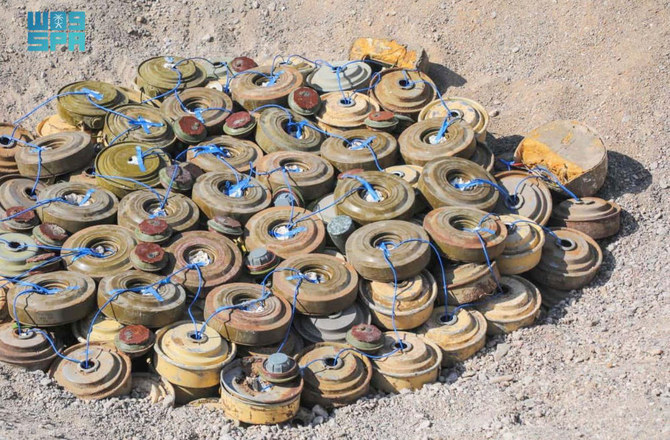
The Saudi Project for Landmine Clearance in Yemen dismantled 1,352 mines in the second week of March. (SPA)
Short Url
Updated 13 March 2022
Follow

Saudi project clears 325k Houthi mines in Yemen

  • More than 1.2 million mines have been planted by the Houthis, claiming the lives of hundreds of civilians

RIYADH: The Saudi government has deactivated 325,277 land mines in Yemen laid by Houthi militia, clearing routes for much-needed humanitarian aid aimed at supporting the country’s embattled citizens.

Implemented by the King Salman Humanitarian Aid and Relief Center, the Saudi Project for Landmine Clearance in Yemen dismantled 1,352 mines in the second week of March.

This figure includes 14 anti-personnel mines, 935 anti-tank mines, 395 unexploded ordinances and eight other explosive devices.

The project is one of several initiatives undertaken by Saudi Arabia on the orders of King Salman to help ease the suffering of the Yemeni people.

The demining took place in Marib, Aden, Jouf, Shabwa, Taiz, Hodeidah, Lahij, Sanaa, Al-Bayda, Al-Dhale and Saada.

More than 1.2 million mines have been planted by the Houthis, claiming the lives of hundreds of civilians.

The Saudi project trains local demining engineers and provides them with modern equipment. It also provides support to Yemenis injured by the devices.

In July 2021, the project’s contract was extended for another year at a cost of $33.6 million.


Rooted in memory: How Rola Daftardar turns Saudi heritage into living art

Updated 5 sec ago
Follow

Rooted in memory: How Rola Daftardar turns Saudi heritage into living art

  • Ma Maison by Rola curates, produces home accessories
  • Aim to reflect Kingdom as ‘authentic, layered and artistic’

RIYADH: For Rola Daftardar, creativity is not simply about design — it is about memory, emotion and belonging.

Saudi by birth, originally from Madinah and raised in Jeddah, Daftardar carries a layered identity shaped further by her Lebanese mother. That blend of cultures, she says, taught her early on to see beauty in contrast and turn it into strength.

“My identity has always been a mix,” she said during a recent interview. “It taught me how to appreciate detail, emotion and storytelling through objects.”

From childhood, she was drawn to art and pieces with soul — objects that feel lived with rather than merely displayed. She went on to study arts, history and media, developing a philosophy that creativity is not only aesthetic but deeply emotional.

“Design is a way of sharing parts of myself,” she explained. “It’s storytelling through material, color and scent.”

Four years ago, that philosophy became Ma Maison by Rola — a brand that began as a personal creative outlet and gradually grew, season by season, into a carefully curated world of home accessories and tablescaping pieces.

Each year, she approaches her collections as chapters. “Every season has its own breath,” she said. “Every year carries a new intention.”

Her work comes most alive during Ramadan and national occasions, when gatherings take center stage and homes become spaces of shared ritual. Between winter and summer, ideas quietly bloom. But this year’s message feels especially personal.

Daftardar’s latest collection is deeply rooted in Saudi heritage, inspired by cities including Jeddah, Riyadh, AlUla and Taif — places she sees as emotional landscapes as much as geographic ones.

“With Saudi Arabia opening to the world, I felt a responsibility to present my country as I see it — authentic, layered and artistic,” she said.

Candles became the starting point of that story. More than fragrance, they are tributes to memory. Musk reflects the warmth of Jeddah, rose captures the calm elegance of Taif, and oud represents the depth and strength of Riyadh.

Hand-painted details and carefully chosen colors complete the sensory narrative.

The idea for her foldable side tables emerged during a walk along Jeddah’s corniche. Watching families gather spontaneously by the sea reminded her of the informal spaces that connect people — a feeling she also associates with historic Al-Balad.

“I wanted to create something simple and functional that carries that spirit of gathering,” she said.

The concept expanded to Diriyah — old and new — and to AlUla, where history and futurism coexist.

Yet it is tablescaping that remains closest to her heart. “I never choose pieces randomly,” she said. “I imagine the people around the table, the dishes being served, the conversations happening.”

For Daftardar, every bowl, riser and glass element forms part of a complete narrative. Every table tells a story.

Her ultimate aim is clear: to reflect Saudi Arabia as she feels it — warm, generous and deeply rooted. A place where modernity meets origin, and tradition evolves without losing its soul.

That is where Ma Maison by Rola lives — in the space between memory and modernity — and it is a story she is proud to tell.