

Syrian doctor fleeing one war is caught by another

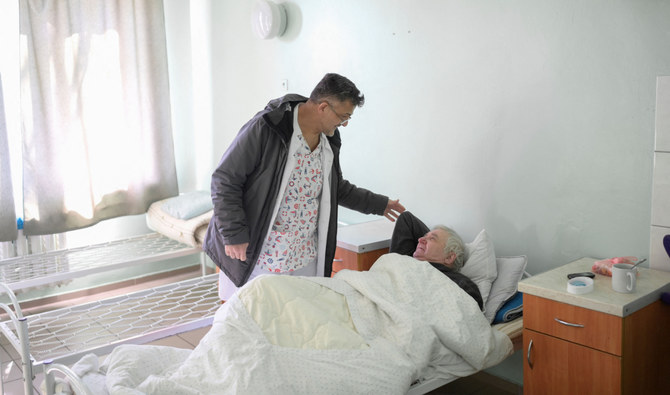
Syrian doctor Ossama Jari (L) tends to a patient at a hospital in Mykolaiv, on March 12, 2022. (AFP)
Short Url
Updated 13 March 2022
Follow

Syrian doctor fleeing one war is caught by another

MYKOLAIV, Ukraine: Syrian doctor Ossama Jari fled Damascus in 2014 to find peace with his Ukrainian wife in the Black Sea port of Mykolaiv. But now war, and Russian bombs, have caught up with him.

In an ophthalmology clinic in the northeast Ingulski district of the city, Jari huddled for safety with other staff and patients in a basement filled with mattresses and jerry cans of water during the merciless bombardment in the night from Friday to Saturday.

While no deaths were reported, windows were blown out, the ground was pockmarked with shell and the neighborhood boiler room was hit. “I couldn’t believe it,” said Jari. “We were living peacefully here. What are the Russians doing? From what are they trying to save us? From themselves?”

Not really dressed for work — kitted out in a shirt printed with nautical motifs — Jari was still trying to treat patients, his eyes weary behind his glasses.

It is a particularly cruel twist of fate for the doctor who had been forced to flee his war-torn homeland during the civil war there, where Russia intervened in 2015 to prop up the regime of President Bashar Assad.

Jari and his wife — whom he met while he was studying medicine in Ukraine — fled the Syrian capital “to find peace” in Mykolaiv.

But the war followed them.

“Syria and Ukraine are in the same situation now,” he said. “War is war, whether it’s over there, here or somewhere else, and it’s the worst thing you can imagine.”

But he would not be drawn on political matters.

“The Russians? Their government? I don’t want to talk about it.”

Jari went upstairs to check on a few patients.

FASTFACT

It is a particularly cruel twist of fate for the doctor who had been forced to flee his war-torn homeland during the civil war there, where Russia intervened in 2015 to prop up the regime of President Bashar Assad.

Among them was a 14-year-old boy called Timur, watched over by his mother Natalia Malichka.

In the first days of the war, Timur got a splinter in his eye while cutting wood with his grandfather.

Unable to get to hospital immediately because no buses were running, the teenager’s eye got worse.

Timur remains silent as his mother, shaking, says she is also worried about her two other sons, aged 10 and 20, at home.

“When I’m here with Timur, I know that my baby is at home, and I don’t know if I’ll see him again. I’m torn,” Malichka says.

She and the two other boys were at home when the neighborhood was shelled.

“I was reassured because I knew that Timur was in the basement of the hospital with the doctors. But despite that, he called me, he was terrified.”

“Everything was shaking,” said the hospital’s director Krasimira Rilkova, who looked as exhausted as Jari.

“We didn’t know if we would find the hospital still standing when we came back up from the basement.”

Mykolaiv, a city of around 500,000, stands in the way of Russia’s campaign to take the Black Sea port of Odessa.

For several days now, Ukrainian forces have managed to hold off the besieging Russian troops.


Sweden unveils new prison conditions for teens

Updated 9 sec ago
Follow

Sweden unveils new prison conditions for teens

  • The loosely-formed networks have increasingly recruited under-15s, often online, as highly-paid hitmen
  • Eight existing prisons have been tasked with preparing special sections for children

STOCKHOLM: Sweden on Thursday revealed prison conditions that teens as young as 13 will face if convicted of a serious criminal offense, once a much-criticized juvenile judicial reform takes effect in July.
The minority rightwing government, which is backed by the far-right Sweden Democrats and has prioritized the fight against surging crime rates, announced in January that it would reduce the age of criminal responsibility from 15 to 13.
A majority of the 126 authorities the government consulted about the change were critical or opposed it outright, including the police and the prison service, but the government has moved forward with its plans regardless.
The Scandinavian country has struggled for more than a decade to contain a surge in organized violent crime, linked primarily to settlings of scores between rival gangs and battles to control the drug market.
The loosely-formed networks have increasingly recruited under-15s, often online, as highly-paid hitmen to carry out bombings and shootings, knowing they would not face prison time if caught.
Eight existing prisons have been tasked with preparing special sections for children, with three of them due to open by July 1 when the reform is scheduled to enter into force, the government said Thursday.
The children will be kept separated from adult inmates, and will be locked in their cells for 11 hours at night instead of the 14 hours for adults, Justice Minister Gunnar Strommer told a press conference.
In addition to attending school lessons during the day, the children will have their own cafeteria, recreation yard, gym and infirmary.
Currently, most minors found guilty of serious crimes are not sentenced to prison.
They are usually ordered into closed detention facilities, called SIS homes, tasked with mandatory care and rehabilitation, rather than a punitive system like prison.
However, many SIS homes have in recent years become recruiting bases for the criminal networks.

- ‘Counter-productive’ -

“Society and crime have changed fundamentally,” Strommer said.
“Young people in general commit fewer crimes. But those who do commit more and much more serious crimes,” he said, adding that “it is much more common for youths to use weapons and explosives.”
He said Sweden was facing “an emergency situation with the gangs, the shootings and explosions with 15, 16 or 17-year-old kids convicted of murder or involvement in murder plots.”
“But there are even younger children involved... For a long time, we have done far too little to address this development, and the system simply hasn’t kept up.”
Children’s rights association Bris said the government’s reform was “counter-productive, insufficiently researched and violates children’s rights.”
It warned that locking such young children away in prison would lead to increased recidivism and encourage criminal networks to recruit ever younger children.
The union representing social workers and prison and SIS home employees, Akademikerförbundet SSR, was also critical, lamenting the speed at which the reform was being pushed through.
“We are very concerned that the Swedish Prison and Probation Service will not have time to build up staff expertise in working with children and to establish a high-quality school,” union expert Fredrik Hjulstrom said.
“The staff of the Prison and Probation Service are qualified to work with adults, and a completely different set of skills is required to succeed with children.”
The reform is being introduced temporarily, limited to five years to start with.
The government is currently trying to rapidly push through a slew of reforms in various areas, ahead of legislative elections in September.