

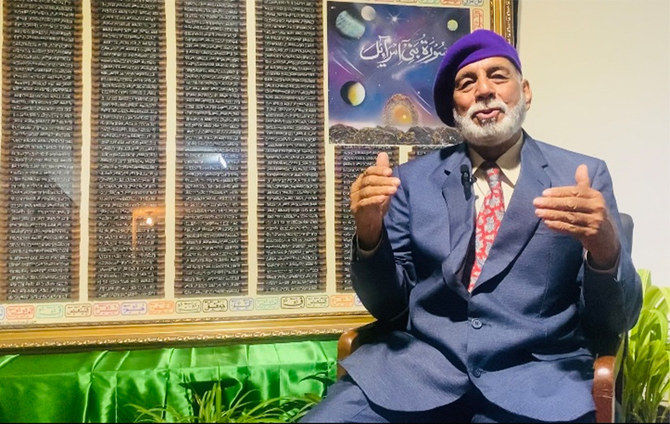

KARACHI: Ten years ago, as Khan Shahnawaz Malhi used a unique technique to knit a verse of the Qur’an on a pencil by hand, he knew he could not stop there.
Over the next decade, the retired policeman painstakingly went on to knit the whole scripture, all 114 chapters and 6,236 verses, on around 8,000 pencils, culminating in a project that is now on display at the National Museum of Pakistan in Karachi. The exhibition will run through March 19.
Malhi, a longtime cop in the southern Sindh province who retired in 2014, said he is the first artist to have weaved the entire holy book with thread on pencils, a technique he learnt from prison inmates during his years as a serving policeman.
Completing the project took up to eight hours of painstaking labor daily over a decade, and Rs3 million in donations from family and friends. Malhi says he even sold his house and moved into a smaller one to use the leftover funds to support the project.
“This is the first Qur’an in the world which has been weaved,” he told Arab News at the opening of his exhibition on Saturday. “It’s the outcome of three million rupees and hard work of ten years.”
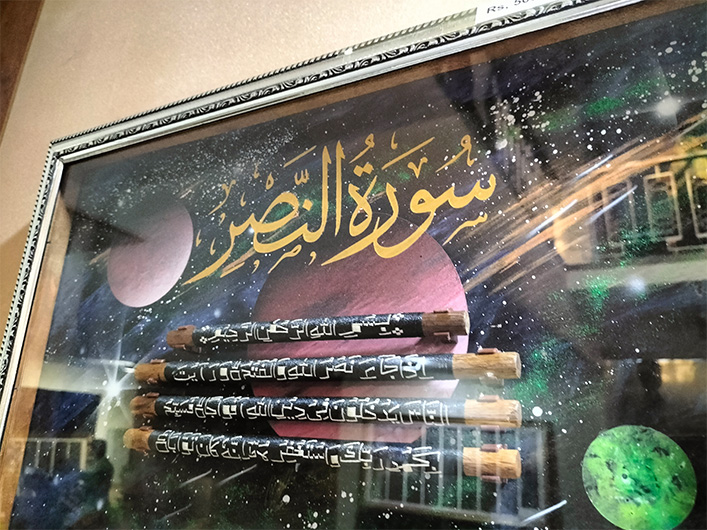
Surah Al-Nasr hand-knit by Khan Shahnawaz Malhi is on display at the National Museum of Pakistan in Karachi on March 12, 2022. (AN photo)
Malhi called the technique an “invention” in the calligraphy form: “In it, only thread and pencil are being used and the fingers have weaved it … You neither need an ink, nor a pen, or paper and nor a piece of cloth.”
The former policeman said he had been drawn to art since he was a school boy and nurtured the instinct through his life. In 2002, he wrote the names of Allah in calligraphy and exhibited the work at the Arts Council of Pakistan, Karachi.
He learnt the unique technique of writing words on pencils with thread from prison inmates and first wrote the word Bismillah, or In the Name of Allah, followed by Al-Fatiha, the first surah of the holy book. At one point ten years ago, as he was weaving some of the last paragraphs of the Qur’an, he decided he would use the technique to weave the entire book on pencils.
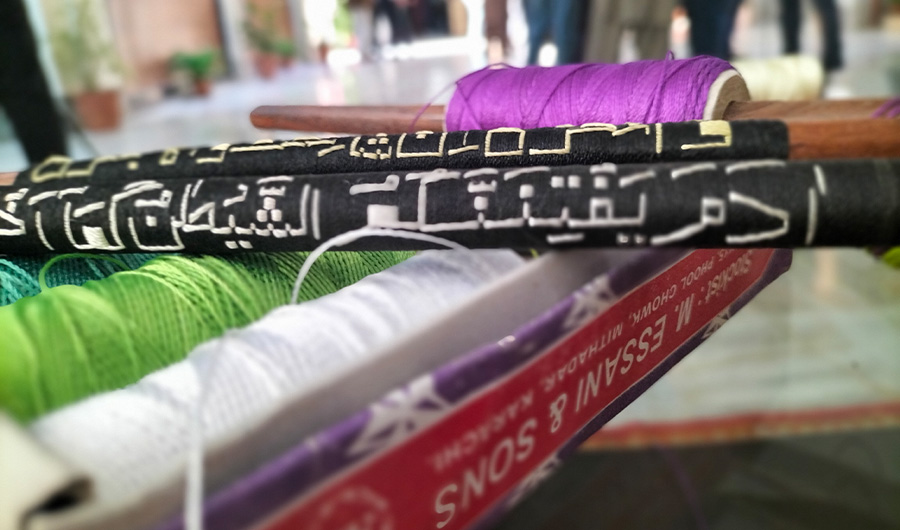
Arabic words are calligraphed with yarn on a pencil, showing the technique Khan Shahnawaz Malhi used to hand-knit the Qur'an, during his exhibition at the National Museum of Pakistan in Karachi on March 12, 2022. (AN photo)
The prisoners would write names in Latin script by intertwining yarn cast on pencils. Malhi, who earlier practiced calligraphy, tried to use the technique for Arabic words. And it worked.
“This is the first invention of its kind in the calligraphy form. Only thread and pencil are being used,” he said.
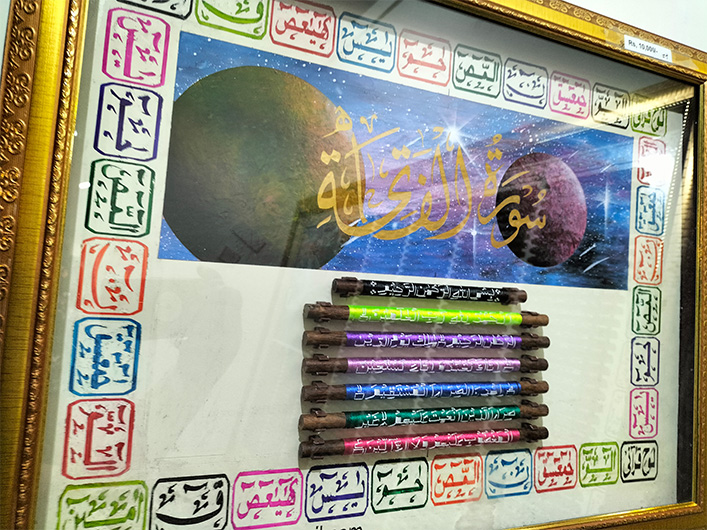
Surah Al-Fatiha hand-knit by Khan Shahnawaz Malhi is on display at the National Museum of Pakistan in Karachi on March 12, 2022. (AN photo)
Now, as his labor of love and time is on display in Karachi, Malhi hopes he can get sponsors and show it to the world.
“I wish it should be exhibited in Saudi Arabia, Dubai, Turkey and the US as well,” he said.
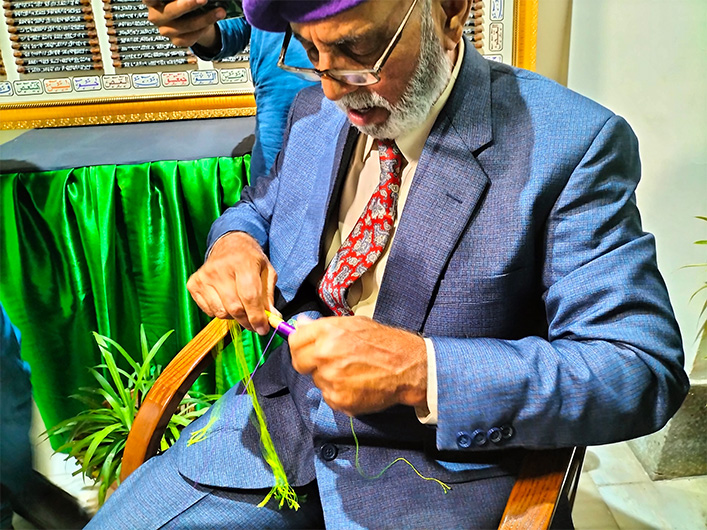
Khan Shahnawaz Malhi knits Qur'anic verses on the pencil in Karachi on March 12, 2022. (AN photo)
The exhibition also shows other works by Malhi, including a piece he calls “The Golden Rule,” with passages from scriptures central to 11 other religions, which the former policeman said all teach empathy and brotherhood, like Islam.
“The Qur’an says that you should like for your brother, what you want for yourself. This is also the teaching of Christianity, this also the teaching of Judaism, this is also the teaching of Hinduism, this is also the teaching of Sikhism, and this is also the teaching of Taoism,” he said.
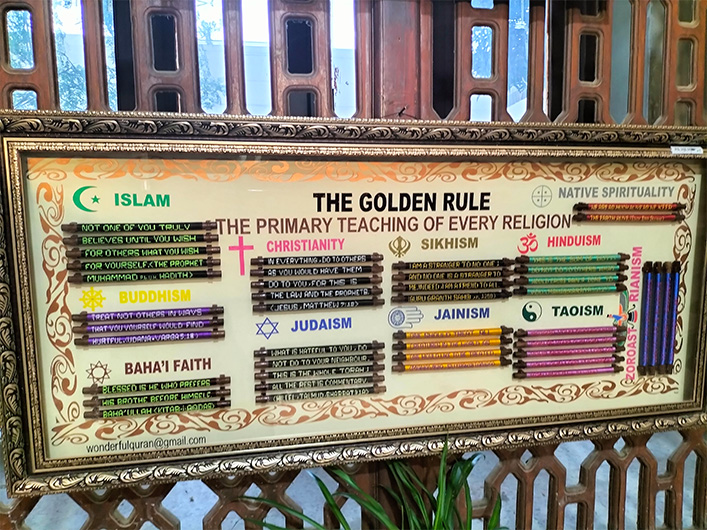
The Golden Rule, the principle of treating others as one wants to be treated, hand-knit by Khan Shahnawaz Malhi is on display at the National Museum of Pakistan in Karachi on March 12, 2022. (AN photo)
“I have gathered the goodness of all faiths in one frame [and] to express solidarity with all religions,” Malhi said. “(We should) highlight their goodness. It’s very essential for peace in the world.”


