

Deaf Pakistani engineer develops sign language app to bridge the hearing gap

Sakina Batool, a deaf ambassador for DeafTawk, communicates with her brother Ehtisham Hussain through sign language in Islamabad, Pakistan, on March 7, 2022. (AN Photo)
Short Url
Updated 12 March 2022
Follow

Deaf Pakistani engineer develops sign language app to bridge the hearing gap

  • DeafTawk has over 18,000 users and 1,100 interpreters globally, offers services in six language styles 
  • Subscribers can have two-person or group call round the clock to interact with anyone through interpreters

ISLAMABAD: Wamiq Hassan, Pakistan’s first deaf software engineer, was inspired by his disability to develop an app to help deaf and hard-of-hearing Pakistanis, especially women, communicate more easily in a country where there are approximately 10 million hearing impaired citizens.
The DeafTawk mobile phone app, available globally, aims to bridge the gap between hearing-impaired people and their respective communities by providing a “real-time sign-language solution at their fingertips.”
The assistive app allows deaf users to sign up, connect with qualified interpreters, and use the service to communicate with anyone, including doctors, teachers, cab drivers, and relatives.
The app currently has over 18,000 users and employs around 1,100 professional interpreters, offering services in six different language styles, including Pakistani, American, British, Chinese, Singaporean and Malay.
Founder Hassan told Arab News he moved to the United States around 15 years ago because it was difficult for a deaf person to access quality education services in Pakistan. In 2015, he returned to his home country as a trained software engineer, and in 2019 co-founded DeafTawk with friends Ali Shabbar and Abdul Qadeer, who are both visually-impaired.
“The basic inspiration behind the development of this app is to uplift the deaf community and make this world inclusive for all with the help of mobile technology,” Hassan said in an interview.
“From my personal experience I know that deaf people face extreme communication barriers in Pakistan and there must be a solution to it. So, we are trying to bridge this gap through this app.”
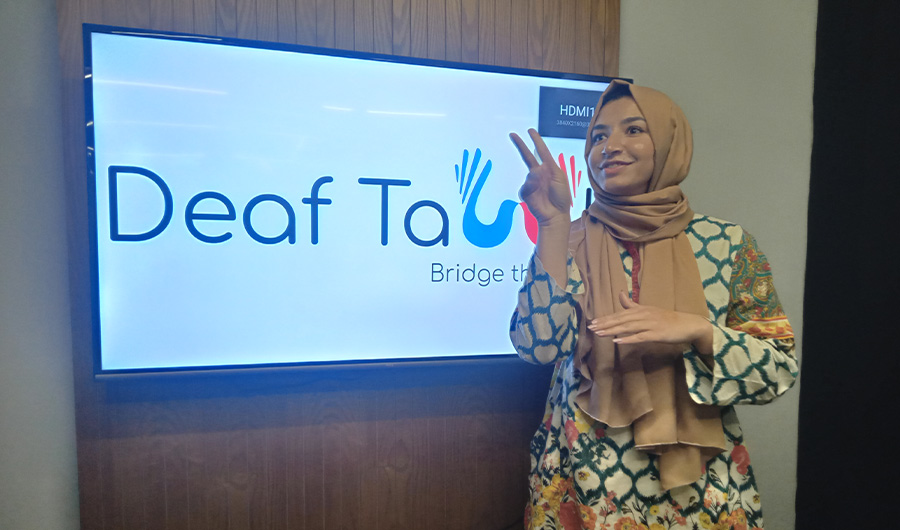


Sakina Batool, a deaf ambassador for DeafTawk, shares her life experiences and challenges through sign language in Islamabad, Pakistan, on March 7, 2022. (AN Photo)

DeafTawk recently launched live sign-language interpretation services for 446 million deaf people across the globe at the Mobile World Congress (MWC) Barcelona, an annual trade show primarily dedicated to the mobile communications industry.
People can avail the service by downloading the app on their mobile phones and paying for the subscription. Besides Pakistan, the service is also available in Denmark, Singapore and Puerto Rico.
Subscribers can have a two-person or group call round the clock to interact with anyone through an interpreter. The company is also working on the use of artificial intelligence (AI) to abolish the role of interpreters in the future.
“Our goal is to empower deaf people, especially women, to communicate with their communities, get education and enjoy all the festivities as a normal person,” Tehmina Zafar, a program manager for DeafTawk, told Arab News.
Sakina Batool, a deaf undergrad student of fashion design in Islamabad and an ambassador for DeafTawk, said the app was “nothing less than a revolution,” particularly for women in Pakistan.
“We’re a marginalized community, especially young girls, but DeafTawk has empowered us to not only communicate effectively but also participate in all activities without any hurdle,” she told Arab News, interacting with the help of her brother, Ehtisham Hussain, a computer science student who learnt sign language for his sister and is now a professional interpreter.
Batool, who teaches sign language to students, said she knew many deaf students who were using the app to communicate with teachers and fellow students at their respective institutes. Her own aim is to get higher education abroad, return to Pakistan and open an institution to help hearing-impaired people receive an education and plan careers.
“All human beings are born equal and no one should be discriminated against,” she said. “It is unfortunate that people with hearing impairment are victimized in education, jobs and public places.”
Her brother said Batool’s “biggest challenge” had been to get an education as a hearing-impaired person.
“But we challenged the myth that deaf people can’t do anything,” Hussain said, “and showed the world they can also lead a normal life.”


Pakistan to showcase BYD, Samsung, Google assembly push at ITCN Asia expo

Updated 6 sec ago
Follow

Pakistan to showcase BYD, Samsung, Google assembly push at ITCN Asia expo

  • STZA pavilion backed by SIFC highlights shift from tech services to manufacturing
  • Electric vehicles, electronics and data centers featured at Lahore exhibition

KARACHI: Pakistan will showcase electric vehicle and electronics assembly by global brands including BYD, Samsung and Google at ITCN Asia 2026, its largest tech expo, as the government seeks to signal a shift from technology consumption toward local manufacturing under its investment-led growth strategy.

The display will take place through a flagship national pavilion led by the Special Technology Zones Authority (STZA) at the three-day ITCN Asia exhibition beginning Jan. 17 at the Lahore Expo Center, with facilitation from the Special Investment Facilitation Council (SIFC), according to a statement issued on Thursday by the cabinet division. 

The move comes as Pakistan pushes to deepen industrial capacity and attract long-term foreign investment amid pressure to boost exports and reduce reliance on external financing. While Pakistan has traditionally positioned itself as a provider of IT services and outsourcing, officials have increasingly emphasized localized production in sectors such as electric vehicles, electronics, cloud infrastructure and data centers.

According to the statement, the STZA pavilion will be organized around three themes: “Manufactured in Pakistan,” “Powered by Pakistan,” and “Pakistan as a Tech Destination,” highlighting the country’s effort to integrate technology with manufacturing and physical infrastructure.

“Manufactured in Pakistan [is] a clear demonstration of Pakistan’s shift from technology consumption to localized production, featuring global brands manufacturing and assembling within STZA-notified zones for domestic and international Markets,” the press release by STZA said. 

“Exhibits include BYD Electric Vehicles, Google Chromebook Assembly through NRTC, and Samsung Electronics through Sapphire Group, underscoring Pakistan’s growing role in global manufacturing value chains.”

The digital infrastructure segment will showcase investments in data centers and computing capacity, with participation from firms including Multinet, a Pakistani telecom and data services provider, and Sky47, a local data center and cloud infrastructure operator, focusing on cloud services, connectivity and enterprise-grade digital platforms.

A third segment will highlight investment-ready technology zones, including Tech7 STZ and Winston STZ, privately developed Special Technology Zones that are building large-scale facilities such as offices, data centers and industrial space to support technology firms seeking to expand domestically and internationally.

STZA said it has notified 32 Special Technology Zones nationwide since its inception, hosting more than 250 technology enterprises and around 27,000 professionals across sectors including artificial intelligence, fintech, cloud computing, agritech, business process outsourcing and high-tech manufacturing such as drones, electronics and electric vehicles.

Under existing policy, technology firms operating within notified zones are eligible for income tax, customs duty and foreign exchange incentives until June 30, 2035, the statement said.

ITCN Asia is one of Pakistan’s largest annual technology exhibitions, drawing local and foreign investors, industry leaders and policymakers, and is being used this year to project Pakistan’s readiness for technology-driven manufacturing and infrastructure development.