PM Khan promises ‘sea of people’ in front of parliament a day before no-trust vote

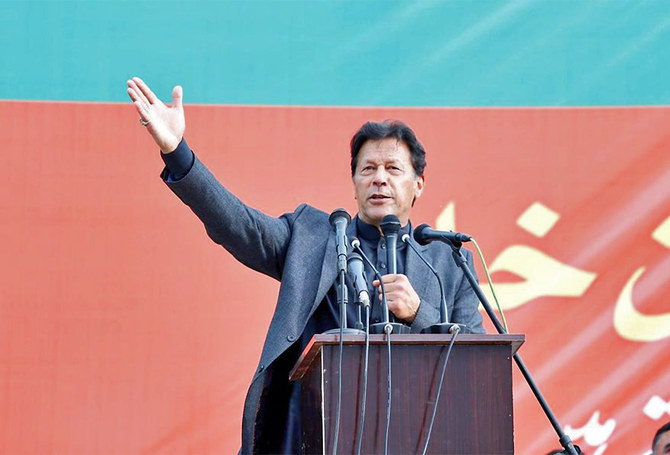
Prime Minister Imran Khan is addressing a public rally in Khyber Pakhtunkhwa’s Lower Dir region, Pakistan, on March 11, 2022. (@PTIOfficial/Twitter)
Short Url
Updated 11 March 2022
Follow

PM Khan promises ‘sea of people’ in front of parliament a day before no-trust vote

  • The prime minister calls heads of opposition parties ‘three stooges’ who plundered the nation
  • Head of the PDM opposition alliance tells Khan he has been ‘tried and exposed’ after the last elections

ISLAMABAD: Prime Minister Imran Khan on Friday promised to gather “a sea of people” in front of the parliament building in Islamabad one day ahead of the no-trust voting against him at the National Assembly while addressing a public rally in Khyber Pakhtunkhwa’s Lower Dir region.
The opposition submitted a no-confidence motion against Khan earlier this week while hoping to bring down his administration and take the country toward fresh general elections.
The prime minister held meetings with his coalition partners soon after the development, though his senior cabinet members maintained the government still had the majority in the house.
Addressing the gathering on Friday, the prime minister bitterly criticized top opposition leaders while saying they had plundered the country and stashed all their wealth abroad.
“The whole nation will witness a sea of people on D-Chowk [facing the parliament building] one day ahead of the no-confidence session,” he told a roaring crowd of his party followers.
While the no-trust motion has been initiated against the prime minister, the National Assembly session to process it has not been announced yet.
Referring to the heads of three opposition parties — the Pakistan Muslim League-Nawaz (PML-N), Jamiat-e-Ulama-e-Islam-Fazl (JUI-F) and Pakistan Peoples Party (PPP) — that filed the no-confidence motion, he said: “The reason why I am asking people to come out ahead of the no-trust voting is to show these three stooges that this nation is still alive.”
Khan added the people of Pakistan were capable of distinguishing between good and evil.
He even went on to say that he was praying to God for the opposition to bring the no-trust motion against him.
“Now I can make all three wickets fall with a single bowl,” the prime minister, a former cricket great, said amid a huge round of applause.
Responding to his speech, president of the opposition Pakistan Democratic Movement (PDM) alliance Maulana Fazlur Rehman asked the election commission how the prime minister could hold such public rallies when a no-confidence motion had been filed against him.
“He used to say ideal things [ahead of the last general elections],” he told a news conference in Islamabad. “Now his narrative is not going to work since he has been tried and exposed.”
Rehman also criticized the prime minister for using “coarse language” against him and other opposition leaders, saying a man like Khan did not deserve to be the prime minister of the country.


Pakistan urges concessional finance for developing nations to boost clean energy security

Updated 6 sec ago
Follow

Pakistan urges concessional finance for developing nations to boost clean energy security

  • Pakistan has emerged as one of world’s fastest growing solar markets, with 12GWs of off-grid and 6GWs of net-metered capacity in 2025
  • PM’s aide says Islamabad remains committed to Paris Agreement, looks for continued support in building a resilient and low-carbon future

ISLAMABAD: Pakistan has urged international partners to scale up concessional financing for developing countries, the country’s Press Information Department (PID) said on Sunday, citing an aide to Prime Minister Shehbaz Sharif.

The call was made by Sharif’s coordinator on climate change, Romina Khurshid Alam, while delivering Pakistan’s national statement at the 16th International Renewable Energy Agency (IRENA) Assembly in Abu Dhabi.

Pakistan has emerged as one of the world’s fastest growing solar markets, with 12 gigawatts (GWs) of off-grid and over 6GWs of net-metered solar capacity by the end of 2025. Last fiscal year, renewables accounted for a historic 53 percent of total electricity generation, according to Alam.

The prime minister’s aide stressed that affordable funding for developing nations is critical to accelerating their transition to clean energy and strengthening energy security amid rising climate and economic challenges.

“Alam reaffirmed Pakistan’s target of achieving 60 percent renewables in the power mix by 2030,” the PID said in a statement.

“In her call to action, she urged IRENA and Member States to increase concessional finance for developing nations, treat technologies such as energy storage and green hydrogen as global public goods, and strengthen regional cooperation for shared energy security.”

IRENA is a global intergovernmental agency for energy transformation that serves as the principal platform for international cooperation, supports countries in their energy transition, and provides state of the art data and analyzes on technology, innovation, policy, finance and investment. Its membership comprises 170 countries and the European Union (EU).

The 16th session of the IRENA Assembly is taking place on Jan. 10-12 in Abu Dhabi and focuses on the theme of “Powering Humanity: Renewable Energy for Shared Prosperity.” The session has gathered global leaders and energy decision-makers to discuss strategies and underline necessary actions for the acceleration of renewable energy across countries, regions, and the world, driving economic inclusion, equity, and human well-being.

Alam shared that Pakistan is taking action against energy poverty through initiatives like the Punjab Solar Panel Scheme 2026, which provides free or subsidized systems to low-income households.

She highlighted how distributed solar kits have restored power and livelihoods in flood-affected communities and offer a replicable model for climate-resilient recovery.

“Pakistan remains fully committed to the Paris Agreement and looks to IRENA for continued technical and financial support in building a resilient, inclusive, and low-carbon future,” Alam said.

Adopted in 2015 to combat climate change, the Paris Agreement binds nations to hold “the increase in the global average temperature to well below 2°C above pre-industrial levels” and pursue efforts “to limit the temperature increase to 1.5°C above pre-industrial levels.”