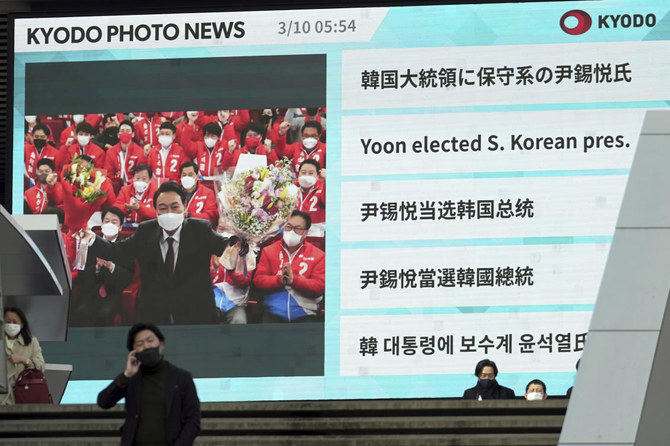
TOKYO/SEOUL: Japanese Prime Minister Fumio Kishida and South Korean president-elect Yoon Suk-yeol said they had agreed on Friday to ramp up three-way ties with the United States in responding to North Korea’s evolving military threat.
Kishida told reporters after a phone call with Yoon the two agreed to stay in close contact over North Korea and shared the view it would be good to meet as soon as possible.
North Korea recently used what would be its largest ever intercontinental ballistic missile (ICBM) system in two secretive launches, likely paving the way for a resumption of long-range tests, US and South Korean officials said on Friday .
Kishida said pretty much all diplomatic options are open in dealing with North Korea, possibly including sanctions, and that Japan will stay in close contact with the United States and South Korea on any response.
A spokeswoman for Yoon, who won Wednesday’s presidential election, said he expressed hopes for greater trilateral cooperation involving the United States in dealing with North Korea.
Relations between the two neighbors have been strained over issues stemming from Japan’s 1910-45 colonization over the Korean peninsula, including victims of Japan’s forced labor and mobilization of wartime brothels.
Good bilateral ties are essential and need to be advanced given the state of world affairs, Kishida said.
Yoon told Kishida it would be important to resolve bilateral pending issues in a “reasonable, mutually beneficial manner,” adding both sides have many areas of cooperation including regional security and the economy.
Yoon also shared condolences to the victims and the families of the 2011 earthquake that struck off the northeastern Japan, marking its 11th anniversary, she added.

Japan, South Korea leaders agree to boost ties with US to tackle North Korea
https://arab.news/wwj79
Japan, South Korea leaders agree to boost ties with US to tackle North Korea
- North Korea recently used what would be its largest ever intercontinental ballistic missile system in two secretive launches
Rubio says technical talks with Denmark, Greenland officials over Arctic security have begun
- US Secretary of State on Wednesday appeared eager to downplay Trump’s rift with Europe over Greenland
WASHINGTON: Technical talks between the US, Denmark and Greenland over hatching an Arctic security deal are now underway, Secretary of State Marco Rubio said on Wednesday.
The foreign ministers of Denmark and Greenland agreed to create a working group aimed at addressing differences with the US during a Washington meeting earlier this month with Vice President JD Vance and Rubio.
The group was created after President Donald Trump’s repeated calls for the US to take over Greenland, a Danish territory, in the name of countering threats from Russia and China — calls that Greenland, Denmark and European allies forcefully rejected.
“It begins today and it will be a regular process,” Rubio said of the working group, as he testified before the Senate Foreign Relations Committee. “We’re going to try to do it in a way that isn’t like a media circus every time these conversations happen, because we think that creates more flexibility on both sides to arrive at a positive outcome.”
The Danish Foreign Ministry said Wednesday’s talks focused on “how we can address US concerns about security in the Arctic while respecting the red lines of the Kingdom.” Red lines refers to the sovereignty of Greenland.
Trump’s renewed threats in recent weeks to annex Greenland, which is a semiautonomous territory of a NATO ally, has roiled US-European relations.
Trump this month announced he would slap new tariffs on Denmark and seven other European countries that opposed his takeover calls, only to abruptly drop his threats after a “framework” for a deal over access to the mineral-rich island was reached, with NATO Secretary-General Mark Rutte’s help. Few details of the agreement have emerged.
After stiff pushback from European allies to his Greenland rhetoric, Trump also announced at the World Economic Forum in Davos, Switzerland, last week that he would take off the table the possibility of using American military force to acquire Greenland.
The president backed off his tariff threats and softened his language after Wall Street suffered its biggest losses in months over concerns that Trump’s Greenland ambitions could spur a trade war and fundamentally rupture NATO, a 32-member transatlantic military alliance that’s been a linchpin of post-World War II security.
Rubio on Wednesday appeared eager to downplay Trump’s rift with Europe over Greenland.
“We’ve got a little bit of work to do, but I think we’re going to wind up in a good place, and I think you’ll hear the same from our colleagues in Europe very shortly,” Rubio said.
Rubio during Wednesday’s hearing also had a pointed exchange with Sen. Tim Kaine, D-Virginia, about Trump repeatedly referring to Greenland as Iceland while at Davos.
“Yeah, he meant to say Greenland, but I think we’re all familiar with presidents that have verbal stumbles,” Rubio said in responding to Kaine’s questions about Trump’s flub — taking a veiled dig at former President Joe Biden. “We’ve had presidents like that before. Some made a lot more than this one.”


