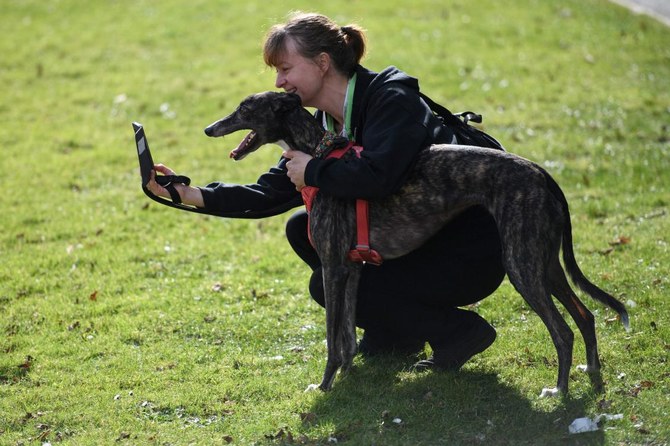
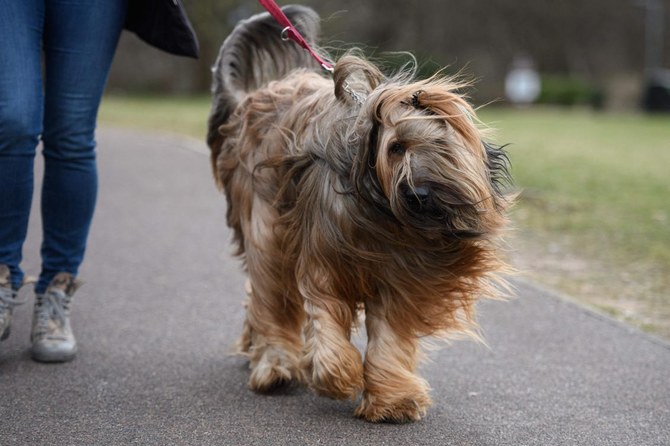
BIRMINGHAM, United Kingdom: Tens of thousands of dogs and their owners — minus Russians — flocked to the world’s biggest dog show on Thursday, as Crufts made a comeback after a two-year absence.
The last edition was in March 2020, just before Britain locked down as coronavirus swept the globe and before the country geared up to leave the European Union after Brexit.
This time round, the invasion of Ukraine hangs over the four-day event, after organizers The Kennel Club banned the attendance of Russian owners and their dogs.
Many owners sported ribbons in the yellow and blue colors of Ukraine’s flag as a show of support.
“It’s my way to show I’m thinking of the Ukrainians,” said Sara Davies, 63, from northeast England, who has entered Crufts for the first time with her black German shepherd, Laxi.
“I mean, it’s appalling. At least I can live my daily life normally. They can’t,” she told AFP as Laxi lay at her feet.
The Kennel Club’s decision affects about 30 Russian owners and breeders and 51 dogs that had been due to participate in the show, which was first held in 1891.
“In the light of rapidly evolving circumstances, it is with a heavy heart we have taken the decision not to allow exhibitors from Russia to compete at Crufts 2022,” it said.
“Our friends in Ukraine, and their dogs, are fearing for their lives and we will do all that we can to support them wherever possible.”
It is donating £50,000 (60,000 euros, $66,000) to help partner organizations in Ukraine, Poland and Hungary help breeders, owners and their dogs affected by the conflict.
Despite the conflict in Ukraine, the chief executive of The Kennel Club, Mark Beazley, said Crufts was “a little bit of joy in some pretty sad days for the world at the moment.”
Lockdown restrictions, which forced last year’s Crufts to be canceled, increased stress and isolation for both humans and their four-legged friends.
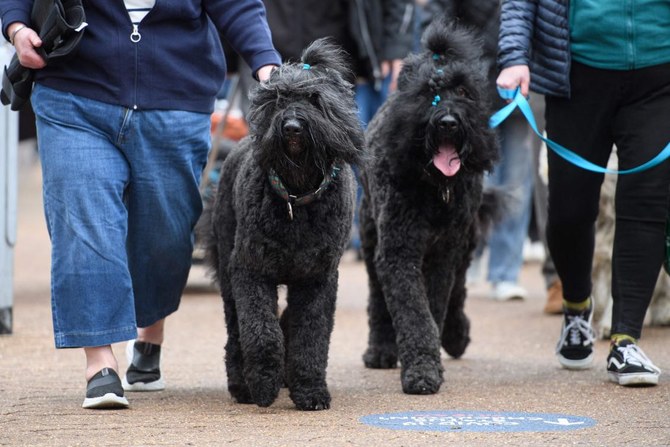
“The pandemic was very difficult,” said Stacie Young, from Kent, southeast England, as she sat with her imposing Newfoundland, Bumbee, taking part in her second Crufts.
“She used to socialize a lot with other dogs during shows. Suddenly there was nothing happening at all. When we were finally allowed to gather in a group of six, we would gather in the park with some friends to practice.”
The last coronavirus restrictions were lifted in England last month, and few people were seen wearing masks as they watched a parade of Cavalier King Charles Spaniels.
But organizers said it will take time for the show to get back to its previous level: in 2020, some 150,000 people attended.
Changes to pet travel after Brexit, as well as the pandemic, have hampered many Crufts regulars’ ability to travel this time.
More than 20,000 dogs are due to compete on looks, obedience and agility at the vast National Exhibition Center near Birmingham, in central England.
Some 16,000 dogs from 38 countries are in the running to bag seven spots for the prestigious “Best in Show” finale, which will be decided on Sunday evening.
Of those, just over 1,800 are from overseas — well down on the more than 3,000 foreign entrants in various competitions in the show two years ago.
Since the UK’s full departure from the EU in January last year, European visitors — and their pets — are subject to more stringent entry requirements.
The winner of the 2020 Best in Show was Maisie, a wire-haired dachshund.


Russian dogs absent as Crufts returns

https://arab.news/68f2w
Russian dogs absent as Crufts returns

- This time round, the invasion of Ukraine hangs over the four-day event, after organisers The Kennel Club banned the attendance of Russian owners and their dogs
- Many owners sported ribbons in the yellow and blue colours of Ukraine's flag as a show of support


Lunar New Year bowing service in China stokes controversy
- Customers could hire proxies to bow and show respect for family members
- Odd jobs app UU Paotui withdraws service after online outrage and mockery
BEIJING: A Chinese odd jobs mobile app has canceled a service that let users hire proxies to bow to their elderly relatives during Lunar New Year family visits, sparking scrutiny of China’s “hire-anyone-for-anything” service sector. Promotional images of the now-deleted service depicted an orange uniform-clad delivery worker on their knees bowing, forehead nearly on the floor, in front of a smiling elderly couple. Online responses ranged from outrage to mockery.
“Filial piety should not be commoditized,” one Weibo user said, referring to the culture of respect for and deference to older family members.
Visiting loved ones and offering good wishes are an important part of the traditional Lunar New Year holiday, although bowing is not widely practiced today.
“After careful consideration, we have voluntarily removed the services that caused controversy,” said odd jobs app UU Paotui, based in central China’s Henan, in a Wednesday WeChat post.
As of Friday, the app still offered a New Year greeter service — with immediate dispatch options — but the 999 yuan ($144.77), two-hour bowing-for-hire package was no longer visible.
Buyers of the now-deleted bowing package could hire gig workers to buy and send gifts, “perform traditional etiquette,” and offer “one minute of auspicious blessings” to loved ones, among other services. The services were meant to help people living far from their families and those with mobility issues maintain traditional customs, UU Paotui said, adding it would offer triple compensation to customers who had already booked.
People who have moved away for work typically return home to visit their families for the most important festival on the Chinese calendar, creating a travel rush commonly referred to as the world’s largest annual human migration. In a nod to the increasingly virtual nature of social life in China, UU Paotui suggested replacing the in-person visits with an app could help avoid awkward social interactions.
“If you don’t want to have social anxiety during the new year, the experience has to be online!” said a Monday Weibo post announcing the service.
Time-poor consumers boost proxy services
Proxy services are not uncommon in China, where labor costs are relatively low and convenience is at a premium for urban consumers.
Outside the holiday period, UU Paotui users can hire someone through the app to accompany them to hospital, feed their pets, or wait in queues at restaurants and other busy locations.
A Wednesday commentary in the People’s Daily, the Communist Party newspaper, called the bowing service “very awkward” and urged closer scrutiny of the proxy service industry.
“Real innovation should meet needs while also safeguarding values,” it said, pointing out that paying a proxy to cover work shifts, for example, could come with legal risks. The controversy comes amid increasing concern for China’s often overworked delivery workers, who can sometimes be seen sprinting through shopping malls and residential compounds to deliver an order on time.
President Xi Jinping met delivery workers on Wednesday to wish them a happy new year and acknowledge their hard work.
“The city couldn’t function without workers like you,” he said.


