

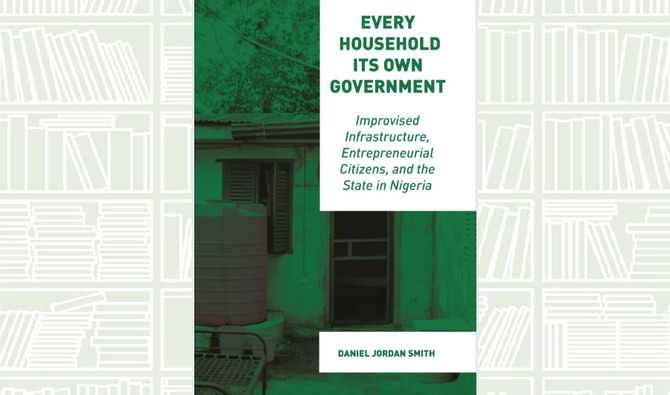
What We Are Reading Today: Every Household Its Own Government

Short Url
Updated 10 March 2022
Follow

What We Are Reading Today: Every Household Its Own Government

Author: Daniel Jordan Smith

When Nigerians say that every household is its own local government, what they mean is that the politicians and state institutions of Africa’s richest, most populous country cannot be trusted to ensure even the most basic infrastructure needs of their people.

Daniel Jordan Smith traces how innovative entrepreneurs and ordinary citizens in Nigeria have forged their own systems in response to these deficiencies, devising creative solutions in the daily struggle to survive.

Drawing on his three decades of experience in Nigeria, Smith examines the many ways Nigerians across multiple social strata develop technologies, businesses, social networks, political strategies, cultural repertoires, and everyday routines to cope with the constant failure of government infrastructure.

He describes how Nigerians provide for basic needs like water, electricity, transportation, security, communication, and education—and how their inventiveness comes with consequences.


What We Are Reading Today: Long Problems

Photo/Supplied
Updated 06 March 2026
Follow

What We Are Reading Today: Long Problems

  • In this pathbreaking book, Thomas Hale examines the politics of climate change and other “long problems”

Author: Thomas Hale

Climate change and its consequences unfold over many generations. Past emissions affect our climate today, just as our actions shape the climate of tomorrow, while the effects of global warming will last thousands of years.

Yet the priorities of the present dominate our climate policy and the politics surrounding it. Even the social science that attempts to frame the problem does not theorize time effectively. In this pathbreaking book, Thomas Hale examines the politics of climate change and other “long problems.”

He shows why we find it hard to act before a problem’s effects are felt, why our future interests carry little weight in current debates, and why our institutions struggle to balance durability and adaptability.