Central bank unveils new digital account to reach Pakistan’s unbanked women

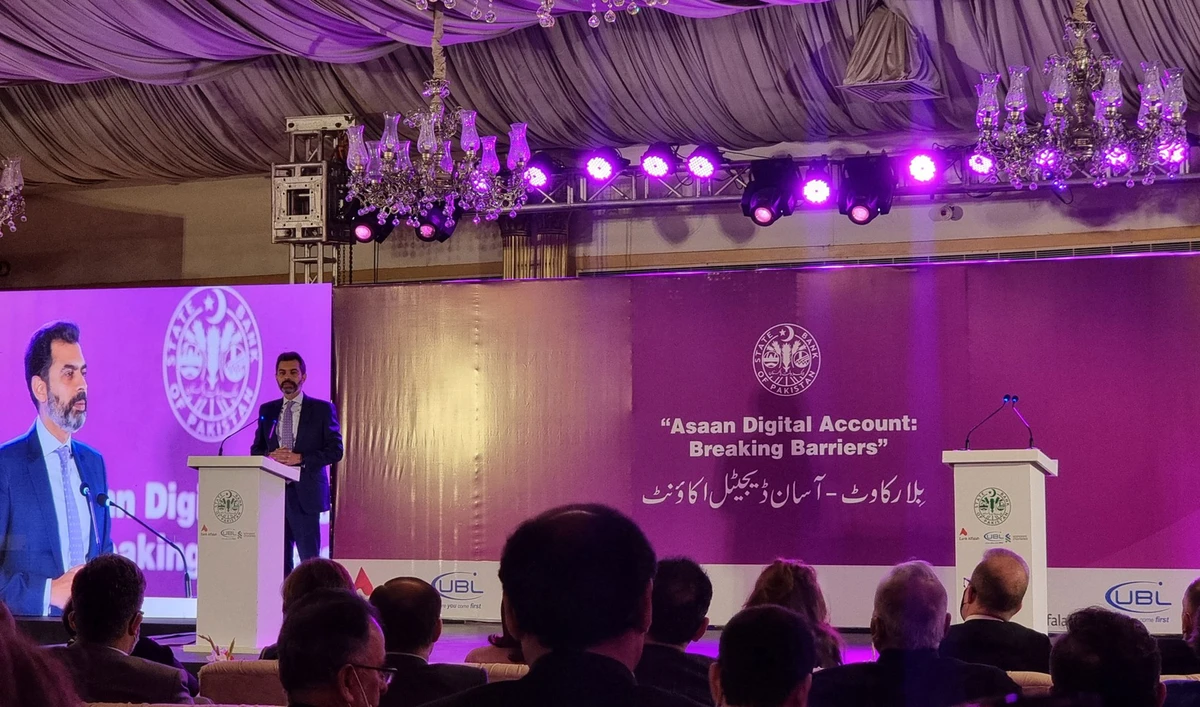
Governor of State Bank of Pakistan, Reza Baqir, speaks at the 'Asaan Digital Account: Breaking Barriers' event on March 7, 2022. (Photo courtesy: @AribaShahid/Twitter)
Short Url
Updated 08 March 2022
Follow

Central bank unveils new digital account to reach Pakistan’s unbanked women

  • Around 82% women in Pakistan do not have access to banking services, 100 million adults don’t have accounts
  • Women can now open ‘Asaan Digital Account' remotely using smartphones or computers with national ID cards

KARACHI: Pakistan’s central bank has launched a new product, the ‘Asaan (easy) Digital Account’, especially designed to enhance the financial inclusion of women as part of the bank's strategy to achieve the mandatory target of 20 million bank accounts for women by 2023.  

Pakistan has the third largest unbanked adult population globally with about 100 million adults without a bank account, according to the World Bank. Phone-based banking has proven a hit among the poor in other emerging markets such as China, India and Kenya. Those efforts have been driven by private sector companies that offer user-friendly, affordable apps.

Whether Pakistan's state system will prove as nimble and easy to use remains to be seen. And it will initially require help from the very same banks that for decades have shut out low-income Pakistanis, and women, with pricey fees.

Around 82 percent women in Pakistan do not have access to banking services.

The central bank aims to change this with the Asaan Digital Account, a fully digitized solution allowing women to open a full-service bank account from anywhere, at any time, through smartphones or computers. The only required documentation will be the computerized national identity card.

“To ensure enhanced financial inclusion of women, banks and financial institutions have been given mandatory targets to open 20 million women accounts by 2023 under a banking on equality strategy,” Central Bank Governor Dr Reza Baqir said on Monday at the launch event of the product ahead of International Women’s Day today, Tuesday.

“Banks have given a target that in their employment 20 percent should be women by 2023,” Baqir said. “By doing so we would be able to achieve the national objective of providing employment. On my part I have hired three deputy governors and one of them is a woman so I have achieved 33% of my target.”  

Last year Pakistan announced a new government-run instant digital payment system in a bid to boost financial inclusion and government revenue in the country where only a fraction of economic transactions occur on the books.

The new system, called “Raast” or “direct way,” is to be rolled out in three phases culminating in early 2022.

Developed through a multi-year collaboration between the State Bank of Pakistan and the Bill & Melinda Gates Foundation, with support from the World Bank, Britain and the United Nations, one goal for Raast is to boost involvement of women in the formal economy.

On Monday, state bank governor asked banks to play their role to promote the financial inclusion of women in the country, saying they should introduce incentives, including fee waivers, a simpler account opening process and higher value proposition, to promote banking for women.

Baqir said women’s participation in financial services had remained low due to persistent barriers such as cumbersome documentation requirements, lack of proximity to bank branches, unavailability of suitable products and constraining social and cultural norms.

Baqir said the bank's initiatives were already bridging gender gaps in the financial sector and services but more needed to be done.  

Sima Kamil, the first female deputy governor of the central bank, said the Asaan Digital Account was specially designed to encourage women to open accounts.

“This account is easy for women,” Kamil said at the event, “as they will not be required to declare their proof of income and their biometric verification can be done remotely without going to the bank.”
Pakistan arrests Daesh suspects, including Afghan ‘mastermind,’ after Islamabad mosque attack

Updated 6 sec ago
Follow

Pakistan arrests Daesh suspects, including Afghan ‘mastermind,’ after Islamabad mosque attack

  • Interior minister says attack was planned and suicide bomber trained in neighboring Afghanistan
  • Suicide bombing targeted worshippers on Islamabad’s outskirts, killing 32 and wounding over 150

ISLAMABAD: A police officer was killed and four suspects, including an Afghan national who worked for Daesh and masterminded a deadly suicide bombing in the Pakistani capital a day earlier, were arrested in overnight raids, according to Pakistan’s Interior Minister Mohsin Naqvi, who addressed a news conference on Saturday.

Officials have confirmed 32 deaths from Friday’s blast at the Qasr-e-Khadijatul Kubra mosque and imambargah in the Tarlai Kallan area on Islamabad’s outskirts, with more than 150 others injured.

The blast occurred during Friday prayers, when mosques around the country are packed with worshippers. A regional Daesh affiliate said one of its members had targeted the congregation by detonating an explosive vest.

“Immediately after the explosion, raids were carried out in Peshawar and Nowshera, and four of the facilitators [of the suicide bomber] were arrested,” Naqvi told the media in Islamabad. “The best thing that happened was that their mastermind, who is an Afghan affiliated with Daesh, was also apprehended.”

He confirmed that a Khyber Pakhtunkhwa police officer lost his life during a raid carried out at night, while a few others were also injured.

“The main mastermind is related to Daesh, and he is now under our custody,” he continued. “All the planning and training of this incident had been done by Daesh inside Afghanistan. These people are now with us, telling us all the details of how he [the bomber] was taken [to the neighboring country] and how he was trained there.”

Naqvi’s ministry also shared a brief statement on social media, saying that a breakthrough in the case was made through “technical and human intelligence” before coordinated raids were conducted to arrest the suspects.

“The nexus of terrorism under Afghan Taliban patronage remains a serious threat to regional peace,” it added.

The interior minister echoed the same concern while accusing India of bankrolling the militant operations against Pakistan.

“Now, you are taking the name of Daesh, or you are taking the name of Taliban,” he said while talking to journalists.

“They [the militants] are getting this funding from somewhere, someone is giving them this target.”

“I again want to tell you with clarity that all their funding is being given by India,” he added. “All their targets are being given by India.”

Islamabad has long accused Kabul of allowing its soil to be used by militant groups and New Delhi of backing their cross-border attacks against Pakistani civilians and security forces. However, the Afghan and Indian governments have consistently denied the allegations.

The police officer, who was killed in the shootout with militants in the northwestern district of Nowshera, was identified as Assistant Sub-Inspector Ejaz Khattak, Nowshera police spokesperson Turk Ali Shah told Arab News.

Friday’s mosque blast was the deadliest in Islamabad since a 2008 suicide bombing at the Marriott Hotel that killed 63 people and wounded more than 250. Last year in November, a suicide bomber struck outside a court in the capital, killing 12 people.

The latest attack comes as Prime Minister Shehbaz Sharif’s government deals with a surge in militancy across Pakistan. Pakistani officials have said the attacker was a Pakistani national who had recently traveled to Afghanistan.