

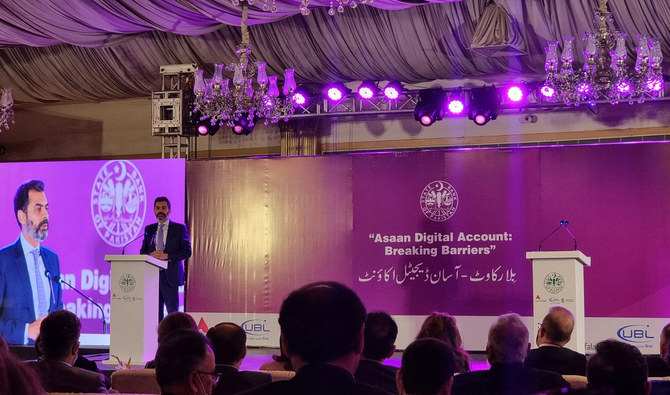

KARACHI: Pakistan’s central bank has launched a new product, the ‘Asaan (easy) Digital Account’, especially designed to enhance the financial inclusion of women as part of the bank's strategy to achieve the mandatory target of 20 million bank accounts for women by 2023.
Pakistan has the third largest unbanked adult population globally with about 100 million adults without a bank account, according to the World Bank. Phone-based banking has proven a hit among the poor in other emerging markets such as China, India and Kenya. Those efforts have been driven by private sector companies that offer user-friendly, affordable apps.
Whether Pakistan's state system will prove as nimble and easy to use remains to be seen. And it will initially require help from the very same banks that for decades have shut out low-income Pakistanis, and women, with pricey fees.
Around 82 percent women in Pakistan do not have access to banking services.
The central bank aims to change this with the Asaan Digital Account, a fully digitized solution allowing women to open a full-service bank account from anywhere, at any time, through smartphones or computers. The only required documentation will be the computerized national identity card.
“To ensure enhanced financial inclusion of women, banks and financial institutions have been given mandatory targets to open 20 million women accounts by 2023 under a banking on equality strategy,” Central Bank Governor Dr Reza Baqir said on Monday at the launch event of the product ahead of International Women’s Day today, Tuesday.
“Banks have given a target that in their employment 20 percent should be women by 2023,” Baqir said. “By doing so we would be able to achieve the national objective of providing employment. On my part I have hired three deputy governors and one of them is a woman so I have achieved 33% of my target.”
Last year Pakistan announced a new government-run instant digital payment system in a bid to boost financial inclusion and government revenue in the country where only a fraction of economic transactions occur on the books.
The new system, called “Raast” or “direct way,” is to be rolled out in three phases culminating in early 2022.
Developed through a multi-year collaboration between the State Bank of Pakistan and the Bill & Melinda Gates Foundation, with support from the World Bank, Britain and the United Nations, one goal for Raast is to boost involvement of women in the formal economy.
On Monday, state bank governor asked banks to play their role to promote the financial inclusion of women in the country, saying they should introduce incentives, including fee waivers, a simpler account opening process and higher value proposition, to promote banking for women.
Baqir said women’s participation in financial services had remained low due to persistent barriers such as cumbersome documentation requirements, lack of proximity to bank branches, unavailability of suitable products and constraining social and cultural norms.
Baqir said the bank's initiatives were already bridging gender gaps in the financial sector and services but more needed to be done.
Sima Kamil, the first female deputy governor of the central bank, said the Asaan Digital Account was specially designed to encourage women to open accounts.
“This account is easy for women,” Kamil said at the event, “as they will not be required to declare their proof of income and their biometric verification can be done remotely without going to the bank.”


