

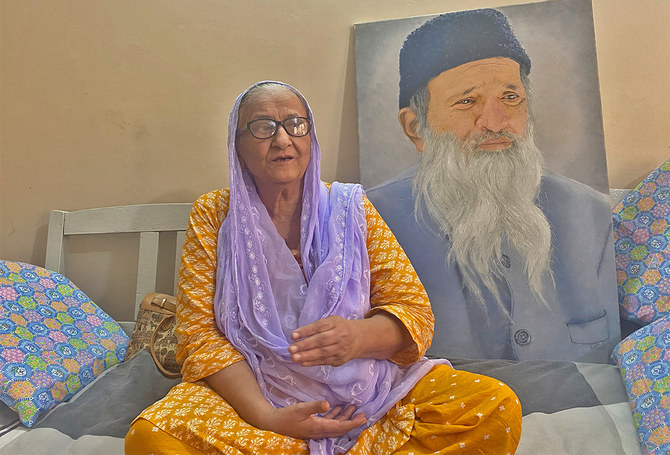

KARACHI: Bilquis Edhi was 17 years old when she joined a nursing home set up by Abdul Sattar Edhi, the Pakistani philanthropist whose name became synonymous with charitable causes and who achieved an almost saintly status in Pakistan.
At 19, Edhi, almost two decades her senior, proposed to Bilquis and the two were married in Karachi, kicking off a partnership of life and humanitarian work that lasted half a century.
Together, they worked closely running the Edhi Foundation, which Edhi single-handedly set up almost 60 years ago, starting with meagre resources and then expanding through private donations.
In the beginning, the foundation had one ambulance that Edhi drove himself. Today, the charity operates nursing homes, orphanages, soup kitchens and family planning centers — all free of charge — as well as Pakistan’s largest ambulance service.
Edhi, often called the “Father Teresa” of Pakistan, died in 2016, aged 88. He was survived by his wife, two sons and two daughters who carry on the Foundation’s work.
In a wide-ranging interview to Arab News, Bilquis, 74, described her late husband as a “liberal” and “open-minded” man who cared deeply about women’s welfare. One of the first charitable initiatives of his life was setting up a women’s nursing home.
“He first opened a nursing home,” Bilquis, a trained nurse and co-chair of the Edhi Foundation, said. ” [He used to say,] don’t beat them, don’t impose restrictions on them, if they have skills, let them work.”

The undated photo shows Bilquis Bano Edhi, co-chair of the Edhi foundation, working in an office in Mithadar, Karachi. (AN Grab from Edhi's family photo album)
Bilquis laughed as she spoke about her marriage to a man famous for his humble way of living, who thought sugar was an unnecessary expense, and was usually seen wearing an often-mended grey tunic.
People did not think the marriage would last longer than a few months, she said, since her tastes and habits were entirely different from her husband’s.
“I liked to go for outings, to watch movies,” she said, while Edhi was obsessed only with social work. She often made excuses, she said, to be able to go watch a movie while telling him she would be attending a funeral. The only film her husband had ever watched was Zarqa, a 1969 Pakistani movie based on the life a Palestinian dancer and activist, which Bilquis played for Edhi on a rented video player.
Ultimately, however, she said she embraced her husband’s lifestyle and then stood by him until his death.
“I never got scared,” she said. “I always accompanied him. He used to say I [Bilquis] was performing 70 percent of the work. There could not be anything bigger [than that compliment].”

In this undated photo shows Bilquis Edhi (left) posing for a picture with her husband Abdul Sattar Edhi. (AN Grab from Edhi family photo album)
Bilquis recalled how the Edhis’ work became more tedious during the 1965 India-Pakistan war when aerial bombardment left dead bodies on the ground, which she and her husband picked up with the help of a team of volunteers. They also removed the remains of abandoned babies, mostly born out of wedlock, from the trash and picked up corpses left behind on scenes of accidents and gang violence on the teeming alleyways of Karach. The Edhi ambulance service, with at least 1,500 vehicles, became grimly familiar in Pakistan, whether ferrying people maimed in terror attacks or carrying those injured in natural disasters.
“I never got scared, I would always accompany him [Edhi],” Bilquis said. “Even when there would be firing, we would go there and we would not get scared.”
Edhi, Bilquis said, had also saved the lives of thousands of abandoned newborns by placing cradles outside Edhi centers and other parts of Karachi and Pakistan.
“We would collect the dead bodies [of newborns] from the trash, from the street, and from any place where we would find them, we would pick them even if they had worms,” Bilquis said. “Then Edhi Sb said, ‘let’s place cradles [and said to people], don’t kill them, don’t commit sin, put them in the cradles, we will adopt them’.”
“So, we placed cradles and we faced opposition, we were called infidels ... atheists,” Bilquis said, adding that people said Edhi would go to hell for raising children born without wedlock.
“But he was not scared of anyone,” Bilquis said. “Allah helped us progress because we would protect innocent children and hand them over to someone who could not have children.”

Bilquis Bano Edhi, the 74-year-old widow of Abdul Sattar Edhi, speaks to Arab News in Karachi, Pakistan, on March 5, 2022. (AN Photo)
Today, Bilquis said, children raised at Edhi centers or adopted from there by families had become doctors, engineers and scholars and many lived in foreign countries such as the United States, Britain and Ireland. For the kids who could not be adopted, the Edhis opened schools at all centers established by the Foundation. Girls at the centers would be married off by Bilquis herself, with proposals painstakingly assessed to ensure the men had stable jobs, owned homes and were not addicted to alcohol or drugs.
In 2015, a deaf-mute Indian girl stranded in Pakistan for 13 years after wandering over one of the world’s most militarised borders was reunited with her family in India by the Edhis who had cared for her during her time in Pakistan.
Geeta was brought to the Edhi home for lost and abandoned children by Pakistani soldiers.
“I had first named her Fatima as the helpless girl couldn’t speak and there was no sign which could recognize [her identity],” Bilquis said.
When the girl repeatedly put her hands together to greet the Edhis and others and touched their feet, a common custom in India when meeting elders, Bilquis said she realized she was a Hindu and must be from neighboring India. The Edhis thus helped her remain connected to her religion, celebrating Hindu festivals such as Holi and buying her new clothes and bangles for Diwali.
“We would become Hindus [with her] and would do whatever she would do,” said Bilquis, who still remains in touch with her adopted daughter via Zoom.
Today, in a country where government-run services have been glaringly ill equipped to deal with humanitarian crises, the Edhis’ social welfare system has become a trusted household name. And though there is a drop in donations since Edhi’s death, Bilquis said she would carry on her husband’s legacy, taking guidance from the lessons he had taught her in his lifetime.
“If you remove Edhi from me, then I am nothing,” she said. “Edhi trained me, he taught me wisdom.”


