

‘Did you write letter to India?’ Khan asks EU envoys for demanding Pakistan condemn Russia

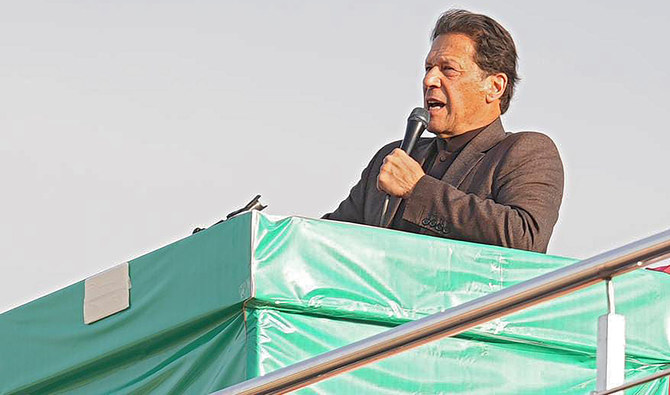
Pakistan Prime Minister Imran Khan speaks to supporters during a rally in Mailsi, Pakistan, on March 6. 2022. (Photo courtesy: Pakistan Tehreek-e-Insaf)
Short Url
Updated 06 March 2022
Follow

‘Did you write letter to India?’ Khan asks EU envoys for demanding Pakistan condemn Russia

  • Representatives of 22 countries, including European Union commission, called on Pakistan to condemn Russia’s 'unprovoked attack' on Ukraine
  • Islamabad has repeatedly called for an end to violence and the use of diplomacy, but it has stopped short of condemning Moscow

ISLAMABAD: Prime Minister Imran Khan on Sunday responded to a letter written by representatives of the European Union (EU), in which they asked Pakistan to condemn Russia’s “unprovoked attack” on Ukraine, by asking them whether they had written a similar letter to India. 

Representatives of 22 countries, including the European Commission, in Islamabad last week wrote a letter, calling on Pakistan to condemn Russia for its invasion of Ukraine.  

Islamabad has repeatedly called for an end to violence and emphasized the use of diplomacy to resolve the crisis. It has, however, stopped short of condemning Russia. 

“I ask the ambassadors of the European Union did you write a letter to India too?” the Pakistan PM said at a public rally in Punjab. 

PM Khan reminded the attendees how Pakistan had aided the North Atlantic Treaty Organization (NATO) in its “war on terror” after the September 11, 2001 attacks. Pakistan suffered 80,000 casualties because of the war and its tribal areas were devastated, he noted.   

“So, I ask the ambassadors of the European Union did you thank us,” he questioned. “Did you say that we supported you during the war? Did you appreciate us?”   

PM Khan said it was regrettable that some Western countries blamed Pakistan for losing the war in Afghanistan.   

“When India violated international laws in Kashmir and the United States Security Council Resolutions, did any of you [EU ambassadors] criticize India,” he asked.   

“Did you break off ties with India? Or suspend trade with them?” 

In August 2019, New Delhi stripped India-controlled Kashmir of its autonomy and divided it into two federally-administered territories. 

The Himalayan valley is claimed in full by both India and Pakistan. The two countries have gone to war thrice over it, and both rule parts of it.  

“So, what are we to you, slaves, who will do as you tell us to,” the Pakistani premier asked, to loud cheers from the attendees. 

PM Khan lashed out at Pakistani opposition party leaders, former prime minister Nawaz Sharif and ex-president Asif Ali Zardari, accusing them of turning a blind eye to US drone attacks that had taken place in Pakistan. 

He lamented that relatives of those killed in drone attacks took up arms against Pakistan, saying they were aware that such attacks were taking place because the Pakistani governments at the time had “permitted” them. 

“Has a drone attack taken place [in Pakistan] since Imran Khan became prime minister,” he asked. “Neither did it take place; and let me tell you that if anyone tries to conduct a drone attack [in Pakistan], I will order the Pakistan Air Force to shoot that drone down,” he said. 

PM Khan said Pakistan was friends with the US, Russia, China and Europe. Pakistan was not in favor of war and hoped that one day, the South Asian nation would help resolve the crisis in Ukraine through dialogue, he said.


Pakistan nears $1.5 billion deal to supply weapons, jets to Sudan

Updated 09 January 2026
Follow

Pakistan nears $1.5 billion deal to supply weapons, jets to Sudan

  • Deal may include drones, air defense systems and Karakoram-8 aircraft, with possible JF-17 fighters
  • The sale is expected to bolster Sudan’s army in the ongoing civil war with the Rapid Support Forces

ISLAMABAD: Pakistan is in the final phases of striking a $1.5-billion deal to supply weapons and jets to Sudan, a former top air force official and three sources said, promising a major boost for Sudan’s army, battling the paramilitary Rapid Support Forces.

Their conflict has stoked the world’s worst humanitarian crisis for more than 2-1/2 years, drawing in myriad foreign interests, and threatening to fragment the strategic Red Sea country, a major gold producer.

The deal with Pakistan encompasses 10 Karakoram-8 light attack aircraft, more than 200 drones for scouting and kamikaze attacks, and advanced air defense systems, said two of the three sources with knowledge of the matter, who all sought anonymity.

It was a “done deal,” said Aamir Masood, a retired Pakistani air marshal who continues to be briefed on air force matters.

Besides the Karakoram-8 jets, it includes Super Mushshak training aircraft, and perhaps ‌some coveted JF-17 ‌fighters developed jointly with China and produced in Pakistan, he added, without giving figures ‌or ⁠a delivery ‌schedule.

Pakistan’s military and its defense ministry did not immediately respond to requests for comment.

A spokesman for Sudan’s army did not immediately respond to a message requesting comment.

Assistance from Pakistan, especially drones and jets, could help Sudan’s army regain the air supremacy it had toward the start of its war with the RSF, which has increasingly used drones to gain territory, eroding the army’s position.

PAKISTAN’S DEFENSE AMBITIONS

The deal is another feather in the cap for Pakistan’s growing defense sector, which has drawn growing interest and investment, particularly since its jets were deployed in a conflict with India last year.

Last month, Islamabad struck a weapons deal worth more than $4 billion with the Libyan National Army, officials said, for one of the South Asian nation’s largest arms sales, which includes JF-17 fighter jets and training aircraft.

Pakistan has also held talks with Bangladesh on a defense deal that could includes the Super Mushshak training jets and JF-17s, as ties improve ties with Dhaka.

The government sees Pakistan’s burgeoning industry as a catalyst to secure long-term economic stability.

Pakistan is now in a $7-billion IMF program, following a short-term ‌deal to avert a sovereign default in 2023. It won IMF support after Saudi Arabia and other Gulf allies provided financial and deposit rollovers.