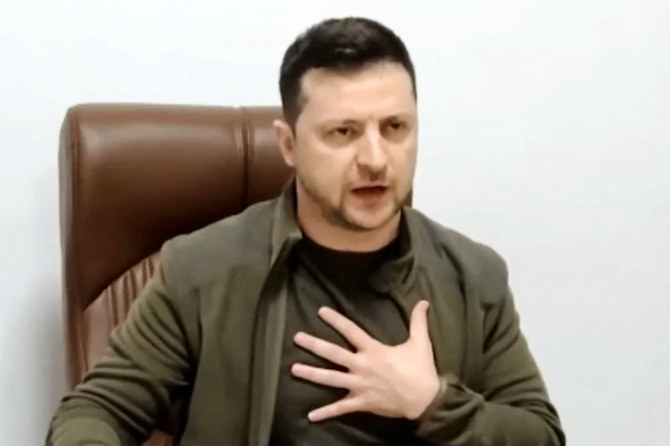
KYIV: Ukrainian President Volodymyr Zelensky said on Sunday he spoke by phone with his US counterpart Joe Biden to discuss financial support and sanctions against Russia as his country faces an intensifying onslaught.
“As part of the constant dialogue, I had another conversation with @POTUS,” Zelensky tweeted. “The agenda included the issues of security, financial support for Ukraine and the continuation of sanctions against Russia.”
In a readout on the half-hour call, the White House said Biden had emphasised steps his administration and allies have taken “to raise the costs on Russia for its aggression in Ukraine.”
He also highlighted efforts by private companies, such as payment giants Visa and MasterCard, to freeze out Moscow by suspending operations in the wake of the February 24 invasion.
Hours earlier, the Ukrainian leader had addressed US lawmakers by video call, pleading for further assistance to his besieged country and a blacklisting of Russian oil imports.
The American legislators promised an additional $10 billion aid package, but the White House has so far ruled out an oil ban, fearing it would ratchet up prices and hurt US consumers already stung by record inflation.
Weapons, ammunition and funds have poured into Ukraine from Western allies, which have also imposed sweeping sanctions on Moscow.
Washington last week authorized $350 million of military equipment for Kyiv — the largest such package in US history.
While visiting Ukrainian refugees on the Polish border over the weekend, US Secretary of State Antony said that Washington was seeking $2.75 billion to help address the humanitarian crisis unfolding as nearly 1.4 million civilians flee.

Ukraine’s Zelensky asks Biden for more support
https://arab.news/rz7pj
Ukraine’s Zelensky asks Biden for more support
- The American legislators promised an additional $10 billion aid package, but the White House has so far ruled out an oil ban, fearing it would ratchet up prices and hurt US consumers already stung by record inflation
US senators visit key Ukrainian port city as they push for fresh sanctions on Russia
- The visit and the push for Congress to take up sanctions on Russia come at a crucial moment in the conflict
WASHINGTON: A delegation of US senators was returning Wednesday from a trip to Ukraine, hoping to spur action in Congress for a series of sanctions meant to economically cripple Moscow and pressure President Vladimir Putin to make key concessions in peace talks.
It was the first time US senators have visited Odesa, Ukraine’s third-most populous city and an economically crucial Black Sea port that has been particularly targeted by Russia, since the war began nearly four years ago. Democratic Sens. Jeanne Shaheen, Chris Coons, Richard Blumenthal and Sheldon Whitehouse made the trip. Republican Sen. Thom Tillis had planned to join but was unable to for personal reasons.
“One of the things we heard wherever we stopped today was that the people of Ukraine want a peace deal, but they want a peace deal that preserves their sovereignty, that recognizes the importance of the integrity of Ukraine,” Shaheen said on a phone call with reporters.
The visit and the push for Congress to take up sanctions on Russia come at a crucial moment in the conflict. Delegations for the two sides were also meeting in Switzerland for two days of US-brokered talks, but neither side appeared ready to budge on key issues like territory and future security guarantees. The sanctions, senators hoped, could prod Putin toward settling for peace, as the US has set a June deadline for settlement.
“Literally nobody believes that Russia is acting in good faith in the negotiations with our government and with the Ukrainians,” Whitehouse said. “And so pressure becomes the key.”
Still, legislation to impose tough sanctions on Russia has been on hold in Congress for months.
Senators have put forward a range of sanction measures, including one sweeping bill that would allows the Trump administration to impose tariffs and secondary sanctions on countries that purchase Russia’s oil, gas, uranium and other exports, which are crucial to financing Russia’s military. The Senate Foreign Relations Committee has also advanced a series of more-targeted bills that would sanction China’s efforts to support Russia’s military, commandeer frozen Russian assets and go after what’s known as Moscow’s “shadow fleet” of oil tankers being used to circumvent sanctions already in place.
Republican Sen. Lindsey Graham, who has co-sponsored the Senate’s sweeping sanctions and tariff legislation, also released a statement during the Munich Security Conference this weekend saying that Senate Majority Leader John Thune had committed to bringing up the sanctions bill once it clearly has the 60 votes needed to move through the Senate.
“This legislation will be a game changer,” Graham said. “President Trump has embraced it. It is time to vote.”
Blumenthal, who co-sponsored that bill alongside Graham, also said there is bipartisan support for the legislation, which he called a “very tough sledgehammer of sanctions and tariffs,” but he also noted that “we need to work out some of the remaining details.” Democrats, and a handful of Republicans, have been opposed to President Donald Trump’s campaign to impose tariffs around the world in an effort to strike trade deals and spur more manufacturing in the US
In the House, Democrats are opposed to the tariff provisions of that bill. Instead, a bipartisan group of lawmakers, led by Republican Rep. Brian Fitzpatrick, has proposed separate legislation that makes it more difficult for Trump to waive sanctions, but does away with the tariff provisions.
A separate bill, led by the top Democrat on the House Foreign Affairs Committee, Rep. Gregory Meeks, would bolster US military support for Ukraine by $8 billion. Democrats currently need one more Republican to support an effort to force a vote on that bill.
Once they return to the US, the senators said they would detail how US businesses based in Ukraine have been attacked by Russia. The Democrats are also hoping to build pressure on Trump to send more US weapons to Ukraine. “Putin understands weapons, not words,” Blumenthal said.
Still, the lawmakers will soon return to a Washington where the Trump administration is ambivalent about its long-term commitments to securing peace in Ukraine, as well as Europe. For now, at least, they were buoyed by the conversations from their European counterparts and Republican colleagues.
“We and the Republican senators who were with us in Munich spoke with one voice about our determination to continue to support Ukraine,” Coons said.


