ISLAMABAD: Pakistan’s embassy in Ukraine said on Saturday it was facing immense difficulties in sustaining itself and Pakistani nationals trapped in Ukraine, where airstrikes continued amid Russia’s invasion.
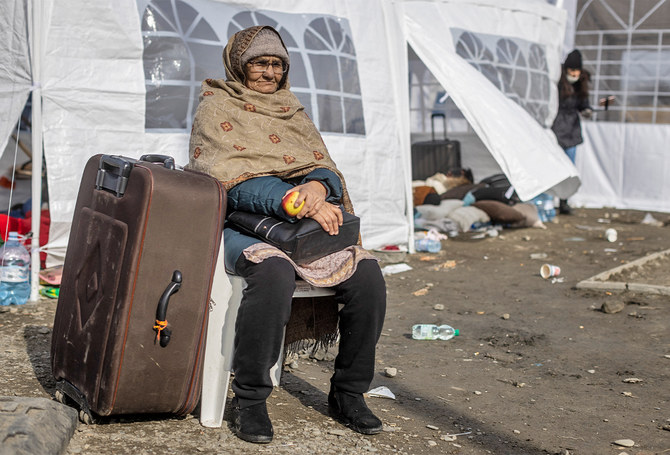
Russia launched a multipronged assault on Ukrainian territory and major cities, including the capital, Kyiv, on Feb. 24. Air, sea, and ground attacks, have since intensified, forcing 1.2 million people to flee to neighboring European countries in just over a week.
Pakistan’s embassy has evacuated nearly 1,500 Pakistani nationals since the beginning of the invasion, but dozens still remain trapped in several Ukrainian cities.
“Air and Missile strikes continued and no city is safe in Ukraine. Food and Petrol are scarce, Pakistanis and the Mission is facing immense difficulties in sustaining themselves,” the embassy said in a statement.
It said that 35 Pakistani nationals remained in Kyiv, Kharkiv, Sumy, Kherson, Mariupol, and Volyn.
Foreign Office spokesperson Asim Iftikhar told Arab News that authorities were coordinating with Pakistani missions in Poland, Romania and Hungary to complete the evacuation.
“Our ambassadors were on border continuously for days, overseeing these efforts, talking to the host authorities, coordinating visas and accommodations and other arrangements,” he said.
“Especially our four missions in Ukraine, Poland, Romania and Hungary are working with complete coordination. Those who remain will be evacuated soonest.”
After two rounds of negotiations between Russian and Ukrainian officials, Moscow declared a partial cease-fire on Saturday to allow humanitarian corridors out of the Ukrainian cities of Mariupol and Volnovakha.
According to the Pakistani embassy in Kyiv, the details of the establishment of the corridors will be decided in the third round of negotiations.
“After this we will be able to evacuate Pakistanis stuck in Mariupol, Sumy and Kherson,” the embassy said. “Humanitarian Corridor is being provided in Mariupol and it is expected that nine Pakistanis will leave today.”


![]()

'No city safe': Concerns rising for Pakistanis trapped in Ukraine amid Russian invasion
Short Url
https://arab.news/m3366
'No city safe': Concerns rising for Pakistanis trapped in Ukraine amid Russian invasion
- Moscow declared a partial cease-fire on Saturday to allow humanitarian corridors out of Mariupol and Volnovakha
- Embassy says 35 Pakistani nationals remained in Kyiv, Kharkiv, Sumy, Kherson, Mariupol, and Volyn
Latest updates


© 2026 SAUDI RESEARCH & PUBLISHING COMPANY, All Rights Reserved And subject to Terms of Use Agreement.