



JEDDAH: Saudi Arabia has answered the call of the wild by releasing some of its most revered endangered native species into their ancestral home at AlUla’s Sharaan Nature Reserve.
The 20 Arabian oryx, 50 sand gazelles and 10 Nubian ibex were released by the Royal Commission for AlUla to mark World Wildlife Day on Thursday.
Commenting on the animal release program, Amr Al-Madani, the commission’s CEO, said that by sustaining ecosystems and wildlife, “our teams are unleashing the power of nature.”
He added that the program is a living example of the commission’s commitment to Saudi sustainability goals, as well as those of the Saudi Green Initiative and the Middle East Green Initiative.

Saudi Arabia declared Feb. 10 ‘Arabian Leopard Day’ in a bid to raise awareness of the endangered big cat. (SPA)
In line with global conservation guidelines, the commission will monitor the animals with satellite tracking collars, camera trapping and other high-tech tools.
Ahmed Al-Malki, the commission’s director of nature reserves, said that the release program will be expanded in coming years as part of a long-term goal to reintroduce 12 native species by 2035.
The Sharaan Nature Reserve is located in the eastern part of AlUla governorate. In all, the commission is creating six reserves covering about 12,400 square kilometers.
HIGHLIGHTS
• The 20 Arabian oryx, 50 sand gazelles and 10 Nubian ibex were released by the Royal Commission for AlUla to mark World Wildlife Day on Thursday.
• The Sharaan Nature Reserve is located in the eastern part of AlUla governorate.
• Princess Reema bint Bandar, Saudi Arabia’s ambassador to the US, launched the nonprofit foundation Catmosphere to raise awareness of the many endangered cat species around the world, including the Arabian leopard.
It is also collaborating with the International Union for Conservation of Nature to develop a “protected area network” plan for the reserves to ensure sustainable adaptive management, enable movement of species and enhance climate change resilience.
Saudi animal reserves where endangered animals, such as the Arabian oryx, are being sheltered include Prince Saud Al-Faisal Center for Wildlife Research in Taif and Prince Mohammed Al-Sudairy Center for the Breeding of Reem Gazelles in Al-Qassim.
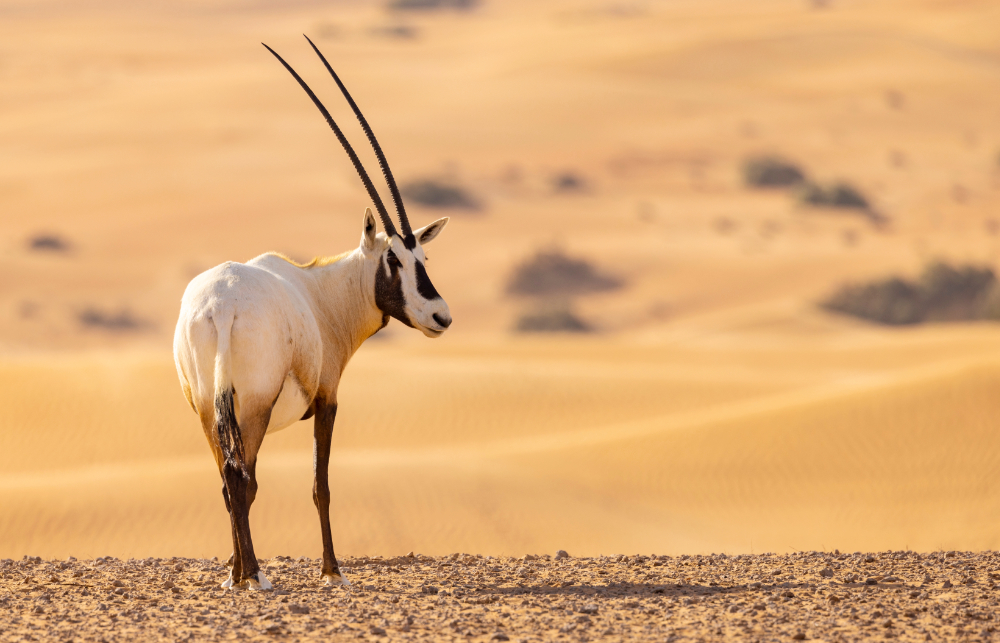
Twenty Arabian oryx were released by the Royal Commission for AlUla into Sharaan Nature Reserve. (Shutterstock)
The Prince Saud Al-Faisal center was established more than 35 years ago on an area of about 35 square kilometers. Today the desert-like nature reserve is fenced off, and surrounded by Talh trees and wild herbs. Houbara and Arabian oryx, two important endangered species, are cared for at the center.
The Saudi minister of environment, water and agriculture and CEO of the National Center for Wildlife Development, Abdul Rahman Al-Fadhli, last month inspected the King Khalid Wildlife Research Center in Al-Thumama to check on progress of the breeding and resettlement programs for endangered native species.
He also inaugurated a new veterinary clinic and research laboratory after attending a presentation about the center. The minister’s tour included antelope breeding units, oryx and mountain ibex units, and a review of a rehabilitation area. He also released 20 goitered antelopes in the rehabilitation area.
In December 2020, Minister of Culture and Governor of the Royal Commission for AlUla Prince Badr bin Abdullah bin Farhan established a global fund to protect the Arabian leopard from extinction, with the aim of sustaining the leopard population and its prey, and protect its natural habitat in the Sharaan Nature Reserve.
Princess Reema bint Bandar, Saudi Arabia’s ambassador to the US, launched the nonprofit foundation Catmosphere to raise awareness of the many endangered cat species around the world, including the Arabian leopard.
The Kingdom also works closely with Panthera, which is devoted to the conservation of the world’s wild cat species.
Last month, Saudi Arabia declared Feb. 10 “Arabian Leopard Day” in a bid to raise awareness of the endangered big cat.
The move, which was announced by the Council of Ministers last month, is part of the Kingdom’s efforts to protect the species, now classed as critically endangered, from extinction.
The Arabian leopard is the chief predator in Saudi Arabia and plays a major role in the Kingdom’s culture. But overhunting and a lack of natural prey means there are now fewer than 200 left in the wild.
Meanwhile, 10 billion mangrove trees will be planted across Saudi Arabia as part of the Saudi Green Initiative launched last year with the aim of tackling climate change, reducing carbon emissions and improving the environment.
The initiative is expected to “turn the desert green” and rehabilitate 40 million hectares of land in coming decades.
A study is underway to develop a masterplan for planting the trees, which will help to improve air quality, reduce sandstorms, combat desertification and lower temperatures in nearby areas.
Saudi Arabia is also helping the Middle East region and Africa to protect the environment, reduce emissions and raise regional coordination.
Following an invitation by Crown Prince Mohammed bin Salman, Middle Eastern and African leaders, along with international officials in the environment and climate change sector, gathered last year for the inaugural Middle East Green summit in the Saudi capital.
The forum reviewed several targeted programs and projects announced by the Kingdom to help achieve the Middle East Green Initiative’s goals.
Ambitious green plans will support efforts and cooperation in the region to reduce and eliminate carbon emissions through natural solutions and adaptations.
This includes the planting of 50 billion trees in the region, equivalent to 5 percent of the global target for afforestation and the most extensive program of its kind worldwide, according to a Middle East Green Initiative summit statement.



