Specter of Chernobyl looms large over UN Security Council meeting

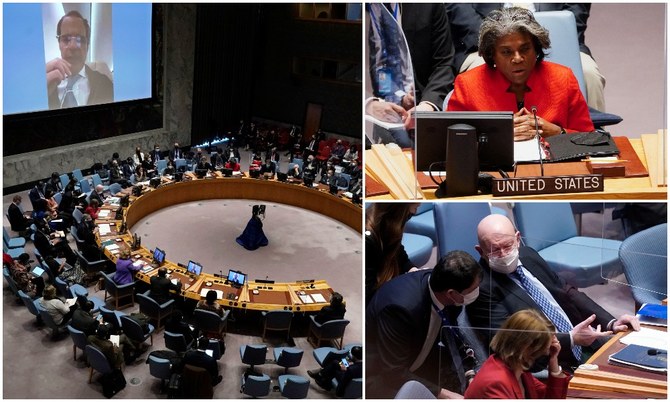
The UN Security Council met to discuss the danger to the Zaporozhzhia nuclear power plant in Ukraine. (AP/Reuters)
Short Url
Updated 05 March 2022
Follow

Specter of Chernobyl looms large over UN Security Council meeting

  • US envoy said a catastrophe was narrowly avoided in Ukraine ‘by the grace of God’ after a Russian attack sparked a fire at Europe’s largest nuclear power plant
  • Russia’s ambassador described the incident and the meeting as another attempt by the West to create hysteria over Ukraine as part of a campaign of disinformation

NEW YORK: “By the grace of God, the world narrowly averted a nuclear catastrophe last night,” Linda Thomas-Greenfield, the permanent US representative to the UN, told the Security Council on Friday.

“We all waited to exhale as we watched the horrific situation unfold in real time.”

She was speaking during an emergency meeting of the council that was called by the UK to discuss a fire that broke out the night before at the Zaporizhzhia nuclear power plant in Ukraine as Russian troops attacked and seized control of the facility.

The envoy said the attack on Europe’s largest nuclear power plant was “incredibly reckless and dangerous” and had put it “at grave risk.”

The fire was extinguished early on Friday. It caused damage to a training facility at the plant but did not affect any of its six reactors.

Rafael Grossi, director general of the International Atomic Energy Agency, confirmed that none of the nuclear reactors or other essential equipment were damaged and radiation levels remain normal. The Ukrainian staff at the plant continue to run it, and safety systems are functioning, he added.

The incident triggered condemnation worldwide, along with warnings of the potentially catastrophic consequences of such an attack for the Ukrainian people and populations across the region.

Rosemary DiCarlo, the UN’s under-secretary-general for political and peacebuilding affairs, said the people of Ukraine are all too aware of the devastation nuclear accidents can cause.

“The Chernobyl disaster in 1986 stands as a lasting example of why it is vital to ensure all nuclear power plants have the highest standards of safety and security,” she told the council.

She added that UN Secretary-General Antonio Guterres has followed “with great alarm” the reports of fighting around the plant.

“Military operations around nuclear sites and other critical civilian infrastructure are not only unacceptable but highly irresponsible,” DiCarlo said. “Every effort should be made to avoid a catastrophic nuclear incident.”

Thomas-Greenfield joined other council members in calling on Russia to withdraw its troops from the plant “to permit medical treatment for injured personnel, to ensure operators have full access to the site,” and to halt any further use of force that might put at risk the 15 operable nuclear reactors across Ukraine.

Directly addressing Vassily Nebenzia, her Russian counterpart on the council, Thomas-Greenfield said: “This Council needs answers. We need to hear you say this won’t happen again.

“We call on you to withdraw your troops and weaponry from Ukraine. We call on you to respect Ukraine’s borders, its people, and the UN Charter.

We call on you to respect your own troops enough not to send them into an unjust war — or on a suicide mission against a nuclear power plant.”

She added: “(Russian President Vladimir) Putin must stop this madness and he must stop it now. Cooler heads must prevail.”

In response, Nebenzia said: “Today’s meeting is another attempt by Kyiv authorities to spread artificial hysteria around what is taking place in Ukraine and they are being assisted by their Western backers.”

The Russian envoy said news reports about the incident at Zaporizhzhia were false and “part of an unprecedented campaign of lies and disinformation against Russia.”

He said the fire was not caused by Russian shelling and instead accused Ukrainian “saboteurs” of causing it by shooting at a Russian patrol. He added that forces from his country now control the power plants at both Zaporizhzhia and Chernobyl, to prevent them falling into the hands of “Ukrainian terrorists.”

Nebenzia dismissed what he described as an attempt by his “dear Western colleagues” to turn the incident on Thursday into a global scandal.

“Ukrainian nationalists are now under your protection and have carte blanche from you,” he added.

Lana Nusseibeh, the UAE’s permanent representative, and president of the Security Council this month, said another Chernobyl must be prevented, as the dire consequences would affect not only Ukraine but the entire region.

“Nuclear safety is a critical issue for my country and we will continue every possible effort to maintain nuclear safety,” she said.

Nusseibeh joined the other ambassadors in welcoming a second round of talks between Russia and Ukraine which resulted in a preliminary agreement for the opening of humanitarian corridors so that people fleeing the war can leave safely.

She added that the UAE calls for an immediate end to hostilities and for the conflict to be resolved through dialogue and diplomacy.


Bitter pill: Taliban govt shakes up Afghan medicine market

Updated 3 sec ago
Follow

Bitter pill: Taliban govt shakes up Afghan medicine market

  • Afghanistan’s decision to overhaul its medicine market was meant to improve quality and boost domestic production, but industry specialists say the swift changes have led to a litany of problems
KABUL: Afghanistan’s decision to overhaul its medicine market was meant to improve quality and boost domestic production, but industry specialists say the swift changes have led to a litany of problems.
The Taliban authorities announced in November that the decades-long dependency on medicine imports from Pakistan would soon end, a step taken after deadly border clashes with their neighbor.
After the ban came into effect this month, finance ministry spokesman Abdul Qayoom Naseer told AFP that the government urged all importers to find “alternative and legal” sources to replace Pakistani supplies.
Despite a three-month grace period to end existing contracts and clear customs, the shift presents a huge challenge for a country which had imported more than half its medicine from Pakistan.
“Some of the prices have increased, some of them are short (unavailable), it has created a lot of problems for people,” said Mujeebullah Afzali, a pharmacist in the capital, Kabul.
Drugs now have to come from elsewhere, increasing transit time and transport costs, and adding logistical complexities.
The pharmacist said he had begun importing medicine through the Islam Qala crossing on the Iranian border, “which increased the transportation fee 10 to 15 percent.”
Transport costs used to account for six to seven percent of total spending on medicine, but this has now risen to 25 to 30 percent, said a person directly involved in the pharmaceutical industry, speaking to AFP on condition of anonymity due to security concerns.
He estimated that the overall losses to business owners had already reached millions of dollars.
“If a medicine was short in the market before, a call was made to Pakistan, and the medicine was delivered in two to three days,” he said.
Whether legally or not, it was “delivered quickly,” he added.
‘Fill the gap’
The illicit trade in pharmaceuticals was a key driver for the overhaul, according to the health ministry.
“The biggest problem with Pakistani medicine was that we used to receive counterfeit and fake medicines,” ministry spokesman Sharafat Zaman told AFP.
He acknowledged it will take some time to shift the market, saying that officials were working with Iran, India, Bangladesh, Uzbekistan, Turkiye, China and Belarus to source medicine.
“India was second in the market, which means that now, through Indian medicines, we can cover the percentage needed,” Zaman said.
And domestic production of 600 medicines has “solved the problems” of many patients, he said.
Afghanistan already produces a variety of serums including antibiotics, according to manufacturer Milli Shifa Pharmaceutical.
The company makes 100,000 bottles daily and “can double the capability” if demand merits, CEO Nasar Ahmad Taraki told AFP.
While Afghanistan has significantly expanded its pharmaceutical sector, domestic output still only meets a small fraction of the overall demand.
The industry source told AFP that the need to import raw materials, the high energy costs and limited infrastructure mean the country cannot be entirely self-sufficient in medicine production.
“If we are provided with the facilities, then we would be able to fill the gap created by Pakistan’s situation,” he said.
Shortages and higher costs
But reshaping an industry nationwide takes more than three months.
Some drugs made in Afghanistan have proven more expensive than those imported from Pakistan, which over the years have gained consumers’ trust.
Some people believe that “if they use Pakistani medicine, they will be cured” — but not if it came from India “or any other country,” the industry source said.
Physicians, meanwhile, are also struggling, a health care provider in Kabul told AFP.
Doctors “must change prescriptions, find suitable alternatives, and spend additional time adjusting treatment plans,” he said, requesting anonymity for security reasons.
The shake-up, which ultimately is meant to end reliance on Pakistan, is complicating care in the short term and could delay treatment, he warned.
“Patients face medicine shortages, frequent switches to alternative products, and sometimes higher costs.”