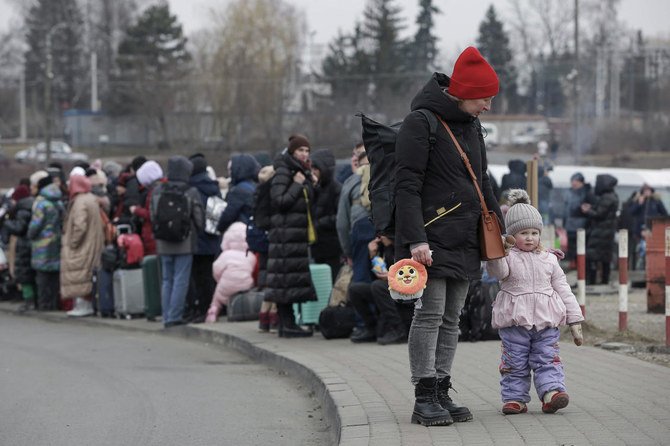
MEDYKA, Poland: Walking the final 14 miles to Ukraine’s border and to safety, Ludmila Sokol was moved by the mounds of clothes and other personal effects that many others discarded as they fled the fighting before her.
“You should have seen things scattered along the road,” said the gym teacher from Zaporizhzhia. “Because the farther you carry things, the harder it is.”
Like more than 1 million others, she’s grappling with the pain of leaving everything behind.
Sokol has found a home in Paris with her former gymnastics coach, a “second mother” whom she first met as a child. “I don’t know what will happen tomorrow, but the only thing I know is that everything will be fine because Victoria Andreevna is nearby.”
Her host tied a homemade Ukrainian flag to a fishing rod to wave in a small gesture of defiance over Russia’s invasion.
The number of refugees who have fled Ukraine has now reached 1.2 million, the International Organization for Migration said Friday. This could become the “biggest refugee crisis this century,” the UN has said, predicting that as many as 4 million people could leave. The European Union decided Thursday to grant people fleeing temporary protection and residency permits.
Gestures of generosity abound. At a refugee camp in Siret, Romania, volunteers and emergency workers paused to hold a birthday party for a 7-year-old girl from Ukraine, complete with cake, balloons and song.
The UN children’s agency said a half-million children in Ukraine had to flee their homes in the first week of Russia’s invasion, though it didn’t say how many left the country.
In the small village of Uszka in Hungary, pastor Edgar Kovacs opened the only room of his church to refugees. It was quickly filled with 29 members of a Roma family from Didova, Ukraine. “I have a big family, so when we heard on the news what happened next door, our hearts began beating faster. And my whole family and I tried to help,” the pastor said.
Some Ukrainians had little but grief. “My colleague was shot by Russian soldiers when she tried to go out of Kyiv to Zhytomyr. And she was shot, she is dead now, unfortunately,” said Vladislav Stoyka, a doctor from Kyiv who had been in Slovakia for vacation when he woke up the day of Russia’s invasion to find himself a refugee. Now he seeks to move on to Germany or the Czech Republic, part of a growing wave westward.
“Many people are also going to Bratislava, to Prague, to Germany,” said Mihail Aleksa, a Slovak volunteer with the Red Cross. “Very important thing is that if they have passports, you know, they can get nearly everywhere in Europe now for free.”
In the Netherlands, 50 refugees arrived Friday in Waddinxveen where Mayor Evert Jan Nieuwenhuis told local broadcaster Omroep West he was glad the town could help, “even if it is just a drop in the ocean.”
But many are finding new homes far from Europe. After a 23-hour flight, more than 80 people, including Ukrainian family members, arrived in Mexico City early Friday.
“It’s a sense of security, of relief, but at the same time, we have mixed feelings, and we even feel a bit guilty that we are OK when we know that our relatives are in a bunker right now,” said one evacuee, Alba Becerra. “My son’s father is in a cellar, my daughter-in-law’s parents are also in a bunker, all in Ukraine.”
Some who left are choosing to return. At the Medyka border post with Poland, 65-year-old Katarzyna Gordyczuk boarded a bus preparing to cross back again. She had come with her grandchildren but was going back to join the rest of her family.
“I left my farm, my husband, my children who are still in Ukraine,” she said. “I am worried. I am worried.”
Her bus home was nearly empty.


![]()

As Ukrainians flee, ‘we even feel a bit guilty we are OK’
Short Url
https://arab.news/ctuqe
As Ukrainians flee, ‘we even feel a bit guilty we are OK’
- The number of refugees who have fled Ukraine has now reached 1.2 million
- This could become the “biggest refugee crisis this century,” the UN has said, predicting that as many as 4 million people could leave


Latest updates



Recommended


© 2026 SAUDI RESEARCH & PUBLISHING COMPANY, All Rights Reserved And subject to Terms of Use Agreement.