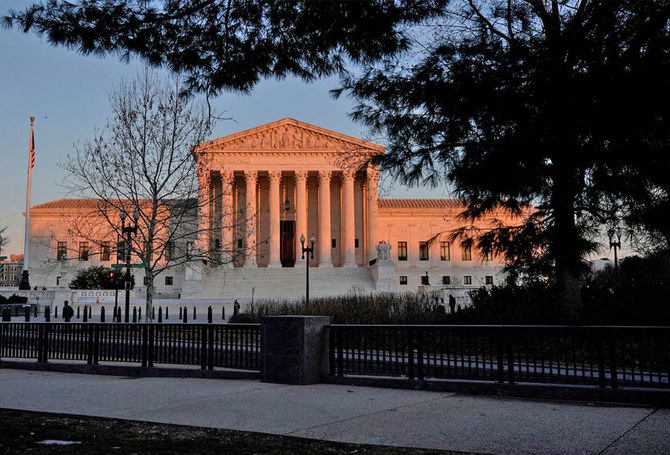
WASHINGTON: The US Supreme Court on Thursday ruled that due to national security concerns two former CIA contractors cannot be questioned in a Polish investigation into the treatment of Abu Zubaydah, a suspected high-ranking Al-Qaeda figure who was repeatedly subjected to a type of torture called waterboarding.
The justices ruled 6-3 that Central Intelligence Agency contractors James Elmer Mitchell and John Bruce Jessen cannot be subpoenaed under a US law that lets federal courts enforce a request for testimony or other evidence for a foreign legal proceeding. Abu Zubaydah, 50, is one of 39 remaining detainees at the US naval base at Guantanamo Bay, Cuba.
The court found that the government could assert what is called the “state-secrets privilege” to prevent the contractors from being questioned in the Polish criminal investigation about their role in interrogating Abu Zubaydah because it would jeopardize US national security.
Poland is believed to be the location of a “black site” where the CIA used harsh interrogation techniques against him. Abu Zubaydah lost an eye and underwent waterboarding — a form of simulated drowning — 83 times in a single month while held by the CIA, according to US government documents.
The contractors’ testimony “would be tantamount to a disclosure from the CIA itself,” Justice Stephen Breyer wrote in the ruling.
“For these reasons, we conclude that in this case the state secrets privilege applies to the existence (or nonexistence) of a CIA facility in Poland,” Breyer added.
The justices were divided on what exactly should happen, with six justices saying Abu Zubaydah’s request should be dismissed. Conservative Neil Gorsuch and liberals Sonia Sotomayor and Elena Kagan said the case should be sent back to lower courts.
Gorsuch wrote a strongly worded dissenting opinion joined by Sotomayor saying that much of what the government claims to be a state secret is already widely known.
“There comes a point where we should not be ignorant as judges of what we know to be true as citizens,” Gorsuch wrote.
“Ending this suit may shield the government from some further modest measure of embarrassment. But respectfully, we should not pretend it will safeguard any secret,” Gorsuch added.
Abu Zubaydah, who is Palestinian, was captured in 2002 in Pakistan and has been held by the United States since then without charges. He has spent more than 15 years detained at Guantanamo.
David Klein, Abu Zubaydah’s lawyer, said that although the court ruled against his client, it left the door open to him filing an amended request that would not require disclosure of the site’s location. That means “there is a pathway for him to finally uncover the truth about what happened to him at the hands of the CIA during a critical part of his detention,” Klein added.
The Justice Department declined to comment.
At the case’s October oral arguments, some justices asked why the government would not let Abu Zubaydah himself be questioned. The Justice Department later told the court it would agree to Abu Zubaydah sending a declaration that could be used in the Polish investigation, although it would have to be reviewed first. Abu Zubaydah’s lawyers called that approach unacceptable.
Abu Zubaydah was “an associate and longtime terrorist ally of Osama bin Laden,” the leader of the Al-Qaeda Islamist militant group killed by US forces in Pakistan in 2011, according to a Justice Department filing.
The justices have turned away multiple cases brought by Guantanamo detainees challenging their confinement. Abu Zubaydah’s own case has been pending in lower courts for more than a decade.
The US government has disclosed that Abu Zubaydah was held overseas and interrogated using “enhanced interrogation techniques” but has not revealed locations. The European Court of Human Rights determined that Abu Zubaydah was held in Poland in 2002 and 2003.
The San Francisco-based 9th US Circuit Court of Appeals ruled in 2019 that Mitchell and Jessen could be subpoenaed, prompting the Justice Department to appeal to the Supreme Court.
Details of CIA activities were confirmed in a 2014 US Senate report that concluded that the interrogation techniques were more brutal than originally disclosed and that the agency misled the White House and public about its torture of detainees captured overseas after Al-Qaeda’s Sept. 11, 2001, attacks on the United States.


![]()

US Supreme Court nixes CIA contractors’ testimony on Guantanamo detainee arrested in Pakistan
Short Url
https://arab.news/rbc42
US Supreme Court nixes CIA contractors’ testimony on Guantanamo detainee arrested in Pakistan
- Suspected Al-Qaeda figure Abu Zubaydah is one of 39 remaining detainees at Guantanamo Bay, was subjected to waterboarding
- Abu Zubaydah, who is Palestinian, was captured in 2002 in Pakistan and has been held by the United States since without charges
Latest updates


© 2026 SAUDI RESEARCH & PUBLISHING COMPANY, All Rights Reserved And subject to Terms of Use Agreement.