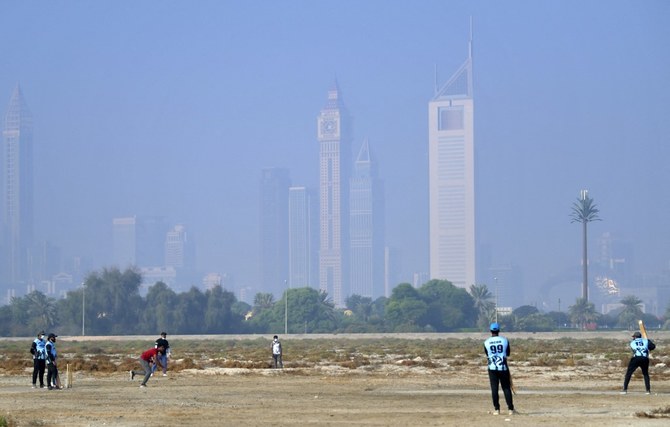

In last week’s final of the International Cricket Council Men’s T20 World Cup 2022 qualifying tournament in Oman, the UAE beat Ireland.
Since, by virtue of winning their semi-finals two days earlier, both teams had qualified for the finals in Australia, it could be argued that this was an insignificant match. However, apart from the prestige of becoming the tournament winner, the result contributes to future ICC rankings.
The other significance of the match was the margin of the UAE’s victory. This was by eight wickets, with Muhammad Waseem scoring 112 runs, following his 70 in the semi-final.
Waseem was spotted in 2017 while playing in Lahore and took up the offer of a residency visa to join a company in Dubai. He became eligible to represent the UAE in April, after completing his three-year residency requirement, as per ICC regulations.
Under these rules, a player can participate in an international match or an ICC event for a national cricket federation when at least one of three criteria has been met. These require that the player was born in the country, able to demonstrate they were a national of the country or had been a resident of the country for the immediately preceding three years prior to a submission being lodged.
In the team which beat Ireland in the final, six players had been born in Pakistan and four in India, arriving in the UAE at differing stages of their lives. Only the captain was born in the Emirates. Qualification for the ICC T20 World Cup represents a dramatic turnaround in fortunes for UAE cricket, which failed to qualify for the 2019 tournament, during which process the team unraveled.
This was caused by the revelation of match-fixing by some of the players. Three players, including the captain, were suspended before the tournament on suspicion of corrupt conduct, which involved trying to influence the outcome of a match in return for money provided by an Indian bookmaker.
In March 2021, after investigation by the ICC, two of them received eight years banishment from the game and one a five-year ban. Later, another two were suspended on suspicion of attempting to influence the course of a qualifying game and others of doing the same in matches between the UAE and the Netherlands and Zimbabwe. In April and July, bans of five and eight years were imposed on these players.
The reported amount of money involved seemed quite small, around $4,000. This has to be placed within the context of the players’ part-time status as cricketers, under which they had to juggle work commitments with their cricket. A number of them played for their company’s team in domestic competitions and were reliant on the company providing leave time to allow participation with the national team.
Given the suspensions of key players and the impact on morale, it is little wonder that the team floundered in its 2019 qualification bid. Recovery from this low point has been astounding.
A change in selection policy has seen the introduction of young players. One example is wicket-keeper batsman, Vriitya Aravind. Aged 19 and still at school in Dubai, he was called into the 2019 T20 World Cup qualifying team to replace the former wicket keeper who had absconded during the tournament. Aravind’s progress since that time has been stellar.
In this year’s ICC T20 World Cup qualifying tournament, the UAE was beaten by Bahrain in the group stage. This meant that each team had two wins and equal points, but the UAE progressed on net run rate. Chasing 173 to win, the UAE needed to reach 158 in order to achieve a superior net run rate. This target was reduced to 32 runs required from 16 deliveries and then 12 from the final over.
This was achieved, quite sensationally by Aravind as, with wickets falling regularly at the other end, he pummeled a series of sixes to not only reach 158 but also to bring his team to within two runs of victory.
There is more young talent available to the selectors. Apart from Aravind, who is now studying in the UK, there are two others, who have played for the national team, who are doing the same.
Previously, only players living and playing their cricket in the UAE were considered for selection. This is no longer the case and young players who move to study abroad may no longer be lost to UAE cricket. It is further hoped that there will be progression to the senior team by players from the under-19s who on Jan. 31 won the U19 World Cup Plate competition.
Another notable advance was the move by the Emirates Cricket Board in December 2020 to extend the number of central contracts to 20, equally divided between full and part-time. Seven of the latter were given to players aged 22 or under.
Young players also featured in the UAE women’s team which won all of its five matches in the Asia qualifying group in November. In the final match against Nepal, Samaira Dharnidharka, 14, bowled a spell of four overs in which she claimed four wickets and conceded only five runs.
These victories claimed a place for the UAE in the ICC Women’s T20 global World Cup Qualifier that will determine the remaining places for the finals of the competition due to be held in South Africa in February 2023.
As a result, UAE cricket is making its presence felt on three fronts, internationally. The shock surrounding the suspension and banning of seven experienced players from the national squad between October 2019 and December 2021 has been addressed.
Both the Emirates Cricket Board and the players have shown impressive resilience to emerge out of the crisis. A new set of selection policies and a trust in youth have earned the right to be pitched on the global stage against the world’s top teams in October.