

Bangladesh sets target to send 1 million workers abroad in 2022

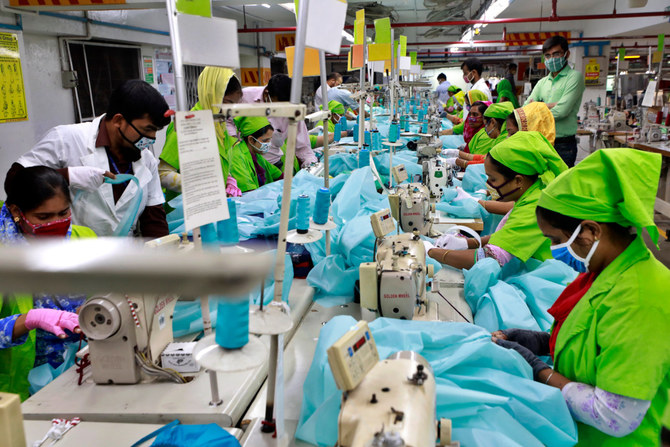
More than 10 million Bangladeshis are living and working abroad, according to the country's Bureau of Manpower Employment and Training. (Shutterstock image)
Short Url
Updated 02 March 2022
Follow

Bangladesh sets target to send 1 million workers abroad in 2022

  • Authorities hopeful to reach target as 70% of Bangladeshis should be fully vaccinated against COVID-19 in April 
  • Over 10 million Bangladeshis are living and working abroad, mainly in the Middle East

DHAKA: Bangladesh is seeking to send 1 million workers abroad this year and diversify labor migration destinations, a top overseas employment official has said, as the country ramps up its COVID-19 vaccination campaign to reach the target.

Over 10 million Bangladeshis are living and working abroad, mainly in the Middle East. They are the second largest contributor of the country’s foreign remittances after the garment sector. Last year alone, they sent over $22 billion back home, according to Bureau of Manpower Employment and Training data.

“We have a plan to export 1 million migrant workers to different countries around the world, and we are working to explore every possibility in this regard,” Mohammed Abdul Kader, additional secretary of employment, policy and research at the Ministry of Expatriates Welfare and Overseas Employment, told Arab News earlier this week.

The government’s target nearly doubles the number of workers Bangladesh exported last year, when COVID-19 restrictions limited travel across the world.
Authorities are hopeful they will be able to reach the target as most of the country’s population has already been vaccinated against the virus.

“At present, there is no country in the world that accepts migrants without having both doses of the vaccine. Since we have reached the vaccination milestone set by the World Health Organization, it will surely keep us ahead in sending migrant workers to the world market, compared with our neighbors,” Kader said.

The WHO has urged countries to push for 70 percent vaccine coverage to stop the rapid spread of COVID-19.

With a population of around 170 million, Bangladesh has already administered around 210 million doses of the COVID-19 vaccines. As it ramped up the drive last month, health officials estimate that 70 percent of Bangladeshis will be fully vaccinated — with two vaccine doses — by early April.

Kader said that with most of its people vaccinated, the Bangladeshi government is planning to expand its labor migration to European countries.

“In early February, we signed a memorandum of understanding with Greece to send migrant workers over, which is a real breakthrough in our manpower exporting sector,” he added. “Now we are trying to open a new window with other European countries also.”

The diversification of destinations would come as Bangladesh’s main labor market — Saudi Arabia, which hosts over 2.5 million Bangladeshi workers and last year admitted nearly 75 percent of the country’s overall migrant manpower — is becoming increasingly competitive, with workers from other countries also seeking opportunities in the Kingdom.

“We have huge human resources, which many other countries in the world don’t have. To maximize the advantage, we need to create more skilled workers and provide training to migrants according to the needs of the receiving countries,” Ali Haider, former secretary-general of the Bangladesh Association of International Recruiting Agencies, told Arab News.

Shariful Hasan, head of the migration program at BRAC, the largest development organization based in Bangladesh, said that in the post-COVID-19 scenario, more jobs will be available for medical technologists and caregivers, and the government should focus on training in these sectors.

“We are much ahead now in terms of COVID-19 vaccination, and there is huge demand in the world market,” he added. “We should seize the opportunities.”


Moderate candidate wins emphatically over a populist in Portugal’s presidential runoff

Updated 5 sec ago
Follow

Moderate candidate wins emphatically over a populist in Portugal’s presidential runoff

LISBON: Center-left Socialist candidate António José Seguro recorded a thumping victory over hard-right populist André Ventura in Portugal’s runoff presidential election Sunday, according to official results with 99 percent of votes counted.
Seguro won a five-year term in Lisbon’s riverside “pink palace” with 66.7 percent of votes, compared with 33.3 percent for Ventura.
The ballot was an opportunity to test the depth of support for Ventura’s brash style, which has struck a chord with voters and helped make his Chega (Enough) party the second-biggest in the Portuguese parliament, as well as gauge the public appetite for Europe’s increasing shift to the right in recent years.
European Commission President Ursula von der Leyen congratulated Seguro and said on social media that “Portugal’s voice for our shared European values remains strong.”
Seguro, a longstanding Socialist politician, positioned himself as a moderate candidate who will cooperate with Portugal’s center-right minority government, repudiating Ventura’s anti-establishment and anti-immigrant tirades.
He won the backing of other mainstream politicians on the left and right who want to halt the rising populist tide.
In Portugal, the president is largely a figurehead with no executive power. Traditionally, the head of state stands above the political fray, mediating disputes and defusing tensions.
However, the president is an influential voice and possesses some powerful tools, being able to veto legislation from parliament, although the veto can be overturned. The head of state also possesses what in Portuguese political jargon is called an “atomic bomb,” the power to dissolve parliament and call early elections.
In May, Portugal held its third general election in three years in the country’s worst bout of political instability for decades, and steadying the ship is a key challenge for the next president.
Ventura, an eloquent and theatrical politician, rejected political accommodation in favor of a more combative stance.
Ventura said he will keep working to bring about a political “transformation” in Portugal.
“I tried to show there’s a different way … that we needed a different kind of president,” he told reporters.
Making it through to the runoff was already a milestone for Ventura and his party, which have recalibrated Portuguese politics.
One of Ventura’s main targets has been what he calls excessive immigration, as foreign workers have become more conspicuous in Portugal in recent years.
“Portugal is ours,” he said.
During the campaign, Ventura put up billboards across the country saying, “This isn’t Bangladesh” and “Immigrants shouldn’t be allowed to live on welfare.”
Although he founded his party less than seven years ago, its surge in public support made it the second-largest party in Portugal’s parliament in the May 18 general election.
Seguro will next month replace center-right President Marcelo Rebelo de Sousa, who has served the constitutional limit of two five-year terms.