



KARACHI: Pakistani actor and director Mohib Mirza, whose upcoming action romcom film has created a media frenzy ahead of its release on Thursday, told Arab News this week Indian movies should once again be screened in Pakistan but in limited numbers to encourage “healthy competition.”
Pakistan first banned Indian movies in 1965 when the two countries went to war. The ban lasted over four decades before the country’s former military ruler General (r) Pervez Musharraf allowed Bollywood flicks in local cinemas once again.
The newly available Indian films drew hundreds of thousands of viewers, and multiplexes were built to meet the demand. Today, Pakistan has more than 100 movie theaters, according to the Cinema Owners Association.
“I think they should bring back Indian films because that will help Pakistani cinema grow side by side,” Mohib Mirza told Arab News in a wide-ranging interview this week, ahead of the release of kung-fu comedy, “Ishrat Made in China,” the actor’s directorial debut.
However, he urged government officials and other policymakers to import Indian content in a manner that the local film industry was not “completely hammered and destroyed.”
“I think healthy competition should be there,” he said.

The picture shows the movie poster of ‘Ishrat Made in China.’ (Photo courtesy: Social media)
Mirza said there wasn’t a sizeable market for Pakistani films in India, though he acknowledged a growing appetite across the border for drama serials and content produced on online streaming websites like Zee5, which has recently picked up Pakistani productions.
“It should be a mutual exchange rather than a one-sided bombardment of content in our country,” Mirza said.
Speaking about his upcoming film, Mirza said it covered several genres: “It is a romantic comedy. There are seven songs which are linked to different situations … So, it is also a musical that is fun-filled romcom and action-packed.”
“Almost 650 shots were made on the storyboard and to execute them we had to bring in a team from Thailand,” he said. “It was all new to us to rehearse action … We had to learn a lot and to understand how to get action sequences right.”
Asked about the title of the big screen production, Mirza laughed and said it had nothing to do with the multibillion-dollar China-Pakistan Economic Corridor project.
“’Made in China’ is an everyday term … not only in Pakistan but also globally,” he said. “Ishrat’s perception of ‘Made in China’ will be revealed in the film.”
Popular actress Sanam Saeed, who is playing the lead in the film alongside Mirza, told Arab News she wanted to challenge herself and shock the audience by taking up a “different” role in the new film.
Born in the United Kingdom, Saeed is a film graduate who made her television debut in 2010 before signing up her first film with Mirza six years later. Her work has earned her several accolades over the years, including the Lux Style Award for Best Television Actress.
“I had a very different character from the characters I usually play,” she said in an exclusive interview on Monday. “I think people are mostly used to seeing me in more serious, straightforward, simple roles. This time, it was very different, a different avatar that I’ve played. I think I wanted to shock the audience and challenge myself and see if I can do any kind of role.”
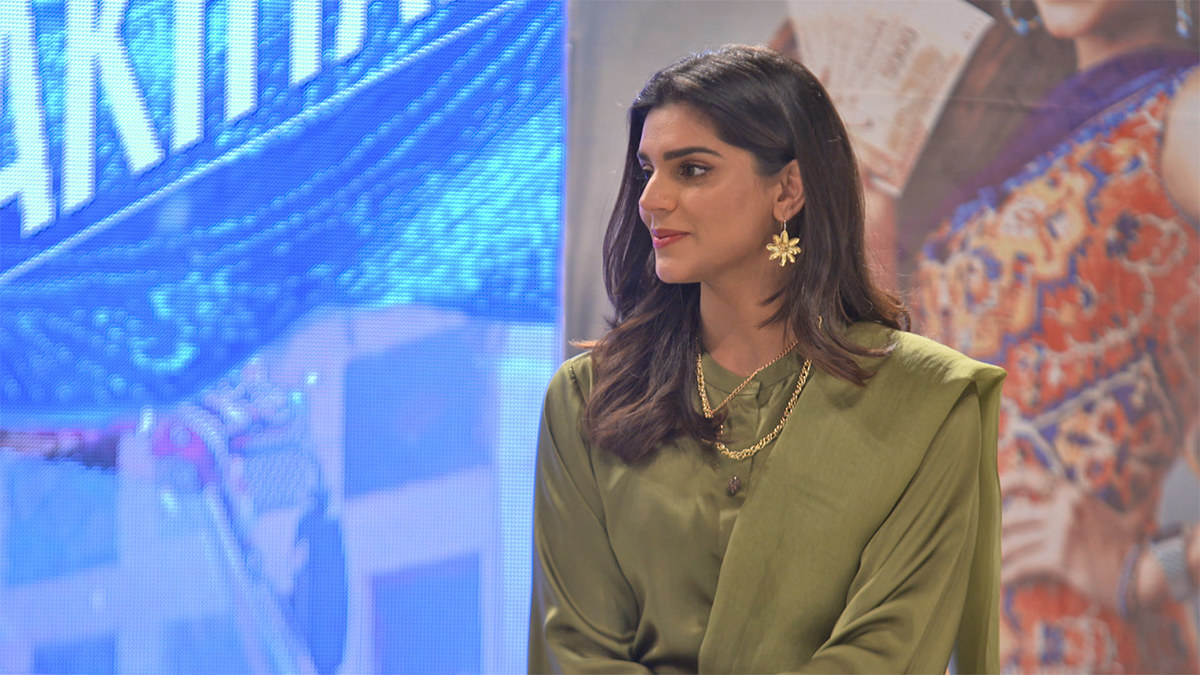
Lead actress of the film ‘Ishrat Made in China,’ Sanam Saeed speaks to Arab News in Karachi, Pakistan, on February 28, 2022. (AN Photo)
Saeed said Ishrat’s shooting in China concluded with the sudden outbreak of COVID-19 in Wuhan.
“As soon as COVID started, the airlines shut down and we were stuck in our location, but I think we were safe and kind of in our own bubble,” she added. “We weren’t sure when we would see our families again … A lot of people had a sick parent or their children or someone at home who needed them.”
“It was scary for the producers, scary for the actors, scary for the crew,” the actress said. “There was a lot of confusion but Alhamdulillah, we made it through that time also.”
Asked if the coronavirus was going to negatively affect the screening of the film, she said COVID-19 was no longer an excuse for people to miss out on watching films.
“I think, personally, I would feel safer going to a cinema house than going anywhere else in public,” Saeed said. “So, I think now the public is ready. They just need a good enough reason to come out to cinemas to take that risk. It’s not really a risk anymore for them.”
The actress said “Ishrat Made in China” was not a film “you’ve seen before in Pakistan”:
“Its cinematography is very different. Its acting is very different. Everyone has really done something out of their comfort zone. The action scenes are very experimental, very daring, very exciting.”


