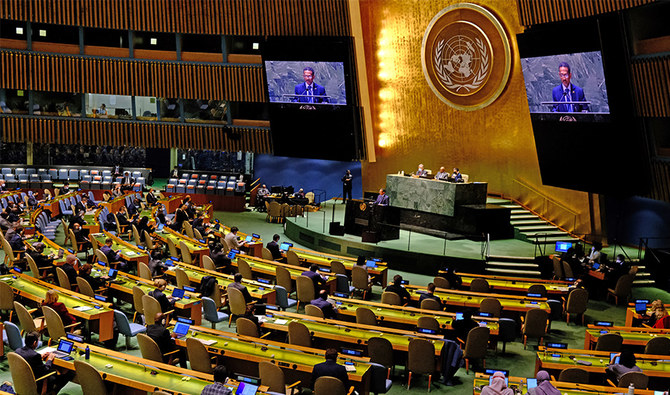
ISLAMABAD: Pakistan allowed its turn to pass as the United Nations General Assembly on Tuesday continued debating a resolution demanding the immediate withdrawal of Russian troops from Ukraine.
The 193-member UNGA will this week vote on a resolution condemning Moscow’s actions, similar to one vetoed by Russia in the Security Council on Friday. The resolution needs two-thirds support to be adopted.
“Pakistan, which is trying not to take sides on this issue, stayed away from both sessions,” Dawn reported. “As a UN member, Pakistan can participate in the UNGA debate, which entered its second day on Tuesday, but so far it has avoided doing so.”
“Indications are that Pakistan wants to avoid getting involved in the dispute which places it in an uncomfortable position,” Dawn said.
Pakistan has repeatedly called for de-escalation of “tensions” between Russia and Ukraine but stopped short of either condemning the Russian invasion or showing explicit support to Kyiv.
Russia last week vetoed a draft UN Security Council resolution that would have deplored Moscow’s invasion of Ukraine, while China abstained from the vote — a move Western countries view as a win for showing Russia’s international isolation.
The United Arab Emirates and India also abstained from the vote on the US-drafted text. The remaining 11 council members voted in favor. The draft resolution is now being taken up by the UN General Assembly.

Pakistan stays away from UNGA debate on Russian withdrawal from Ukraine
https://arab.news/bhfej
Pakistan stays away from UNGA debate on Russian withdrawal from Ukraine
- 193-member UNGA will this week vote on a resolution condemning Moscow’s actions
- The resolution needs two-thirds support to be adopted
Pakistan says responding to Afghan ‘offensive operations’ after border fire as tensions escalate
- Afghan Taliban spokesperson says “large-scale offensive operations” launched against Pakistani military bases
- Pakistan says Afghan forces opened “unprovoked” fire across multiple sectors along shared border
ISLAMABAD: Afghanistan’s Taliban authorities said on Thursday they had launched “large-scale offensive operations” against Pakistani military bases and installations, prompting Pakistan to say its forces were responding to what it described as unprovoked fire along the shared border.
The escalation follows Islamabad’s weekend airstrikes targeting what it said were Tehreek-e-Taliban Pakistan (TTP) and Daesh militant camps inside Afghanistan in response to a wave of recent bombings and attacks in Pakistan. Islamabad said the strikes killed over 100 militants, while Kabul said dozens of civilians were killed and condemned the attacks as a violation of its sovereignty.
In a post on social media platform X, Afghan government spokesperson Zabihullah Mujahid said Afghanistan had launched “large-scale offensive operations” in response to repeated violations by the Pakistani military.
Pakistan’s Ministry of Information said Afghan forces had initiated hostilities along multiple points of the frontier.
“Afghan Taliban regime unprovoked action along the Pakistan–Afghanistan border given an immediate, and effective response,” the ministry said in a statement.
The statement said Pakistani forces were targeting Taliban positions in the Chitral, Khyber, Mohmand, Kurram and Bajaur sectors, claiming heavy Afghan casualties and the destruction of multiple posts and equipment. It added that Pakistan would take all necessary measures to safeguard its territorial integrity and the security of its citizens.
Separately, security officials said Pakistani forces had carried out counterattacks in several border sectors.
“Pakistan’s security forces are giving a befitting reply to the unprovoked Afghan aggression with full force,” a security official said, declining to be named.
“The Pakistani security forces’ counter-attack destroyed Taliban’s hideouts and the Khawarij fled,” they added, referring to TTP militants.
The claims from both sides could not be independently verified.
Cross-border violence has intensified in recent weeks, with Pakistan blaming a surge in suicide bombings and militant attacks on militants it says are based in Afghanistan. Kabul denies providing safe havens to anti-Pakistan militant groups.
The clashes mark the third major escalation between the neighbors in less than a year. Similar Pakistani strikes last year triggered weeklong clashes before Qatar, Türkiye and other regional actors mediated a ceasefire in October.
The 2,600-kilometer (1,600-mile) frontier, a key trade and transit corridor linking Pakistan to landlocked Afghanistan and onward to Central Asia, has faced repeated closures amid tensions, disrupting commerce and humanitarian movement. Trade between the two nations has remained closed since October 2025.


