

Singapore court reserves ruling over appeal of disabled man on death row

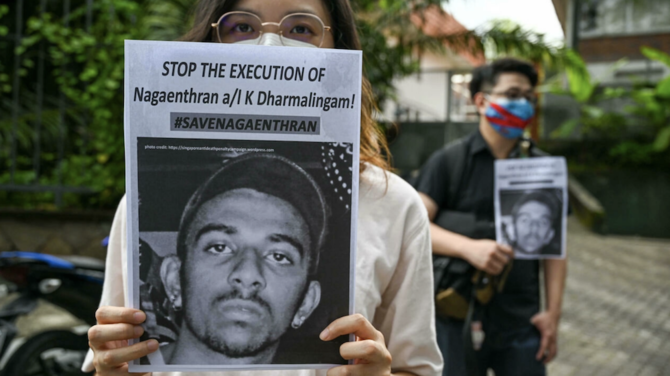
Activists hold placards before submitting a memorandum to parliament in protest of the impending execution of Nagaenthran K. Dharmalingam, sentenced to death for trafficking heroin into Singapore, in Kuala Lumpur. (AFP)
Short Url
Updated 02 March 2022
Follow

Singapore court reserves ruling over appeal of disabled man on death row

  • Nagaenthran K. Dharmalingam arrested in 2009 for trafficking nearly 43 grams of heroin into Singapore
  • Malaysia’s highest officials have pleaded with Singaporean government to grant him clemency

KUALA LUMPUR: The Singapore Court of Appeal on Tuesday reserved a ruling on Nagaenthran K. Dharmalingam, a Malaysian national on death row, in a case that has drawn international attention over the man’s mental disability.

The 34-year-old was arrested in 2009 for trafficking nearly 43 grams of heroin into Singapore, which has some of the world’s strictest anti-drug laws. He was sentenced to death in 2010.

After losing several appeals, Dharmalingam was to be executed by hanging in November. The execution was stayed amid pressure from international rights groups, Malaysia’s prime minister, and the EU, as the defense filed another appeal.

During Tuesday’s proceedings, Dharmalingam’s Singaporean counsel, Violet Netto, pleaded with the judges to show “mercy” and allow him to undergo an independent psychiatric assessment.

His Malaysian lawyer, N. Surendran, told Arab News that the judgment was likely to be “in the upcoming days.”

He said: “The lawyers put up a good submission. Of course, you can’t execute someone who is mentally challenged. (It’s) a total breach of Singapore’s procedures and own law.

“We hope they make the right decision and not proceed with the execution,” he added.

Dharmalingam was allegedly coerced into the crime and his lawyers argued that with an IQ of 69 — a level recognized as a disability — he is not capable of making any intellectual decision. He was arrested at 21, after the bundle of heroin equivalent to about three tablespoons was found strapped to his thigh.

The case put a spotlight on Singapore’s use of capital punishment, which triggered international condemnation. If Dharmalingam was hanged, it would be the first execution in Singapore since 2019.

An online petition urging the Singaporean president to pardon Dharmalingam has gathered more than 101,000 signatures, with petitioners highlighting that executing mentally disabled people was prohibited under a UN convention the country was a signatory of.

Zaid Malek of Lawyers for Liberty, a Malaysian human rights and law reform NGO, which has also urged Singapore to reconsider its decision, told Arab News that capital punishment for mentally disabled people was against international human rights.

“We hope for the (Singapore Courts) to have a proper consideration of Dharmalingam’s current mental state,” he said.

“Our position is that a person with mental disabilities cannot be sentenced to death.”

Filipinos worry about future as Manila posts worst economic growth in 15 years

Updated 4 sec ago
Follow

Filipinos worry about future as Manila posts worst economic growth in 15 years

  • Philippine economy slowed to weakest pace last quarter, with only 3.0 percent growth
  • Filipinos struggle with high prices, increased business cost, reduced savings 

MANILA: Over ten years ago, when Fatima Macud brought home roughly 30,000 pesos ($509) a month, the money was enough to cover her expenses and still leave room for savings.

Though she now earns 45,000 pesos, Macud finds herself unable to save any money as she struggles with rising prices to cover daily spending. 

“Yes, I got a salary increase, but the thing is, the cost of living here in the city also increased,” the 52-year-old resident of Metro Manila told Arab News on Saturday.

“Now for me, it barely covers my basic needs because the price of commodities just keeps rising — goods, services, everything … Everything feels way too expensive … Now, I can’t save money at all. It’s not enough.” 

The Philippine economy has slowed to the weakest pace in nearly 15 years outside of the pandemic, with data from the Philippines Statistics Authority showing just 3.0 percent growth in October to December, compared with 5.3 percent from the same period a year earlier. 

The full-year growth in 2025 settled at 4.4 percent, below the 5.7 percent posted in 2024 and lower than the government’s revised target of at least 4.8 percent. 

It was the result of “several converging factors,” Economic Planning Secretary Arsenio Balisacan told reporters earlier this week. 

“These include the adverse economic effects of weather and climate-related disruptions. Admittedly, the flood control corruption scandal also weighed on business and consumer confidence,” he said. 

But on the ground, Filipinos were more concerned about their day-to-day lives, and the state of the economy has begun to spark new worries about the future. 

“I am worried about my future,  especially my retirement. If the government is in a bankruptcy state or ends up in financial trouble, will they be able to pay my pension? Can I still avail the free health services with full benefits?” Macud said. 

“I’m also worried about my family’s future; the rising cost of living and the lack of employment opportunities.”

Olga Resureccion, a 52-year-old worker in Manila, is among those who believes the government has been “trying its best,” and is keeping her hopes alive. 

“You can’t lose hope,” she said. “Most people are still able to provide for themselves and their family. Like (me), I’m able to provide. You just really need to work hard.” 

Yet for entrepreneurs such as John Paul Maunes, the economic slowdown was taking a toll on his small restaurant in Cebu City, as he struggled with increasing prices of supplies, taxes and cost of government permits. 

“I think people from the ground, especially business owners, are really struggling right now. Particularly those who are SMEs (small and medium enterprises),” Maunes said. 

“We cannot increase our prices the way we want it because we’ll lose our customers. And at the same time, we are also struggling on how we can cope with the rising prices of commodities. Plus, the government permits and taxes are increasing every year.” 

Over the years, the 41-year-old has had to lay off employees to survive, while hoping for more government support and opportunities through economic growth. 

“We have this fear of impending doom as small business owners … With the increasing prices and economic impact on us on the ground, it’s a huge challenge,” he said.

 “We’re just hoping that better things will come for our government, for our economy.”