

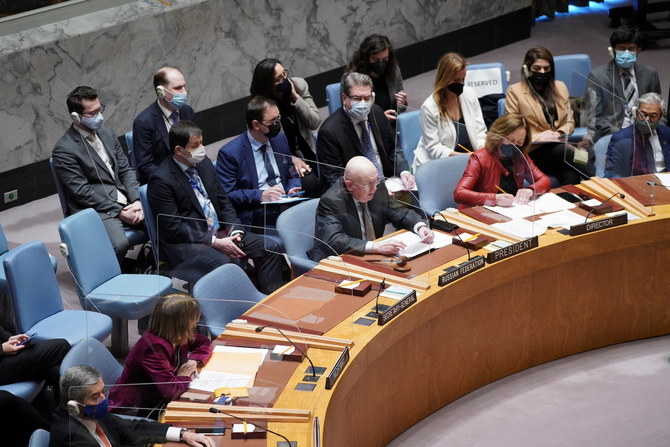


NEW YORK: The UN Security Council on Sunday voted on a draft resolution deciding to convene an emergency special session of the General Assembly to recommend collective action on the situation in Ukraine, two days after a similar resolution, sponsored by 81 nations, was shot down at the council on Friday by the Russian veto.
Possible action could include the use of armed force, but this has never happened in the history of the UN.
This is the first time in 40 years that a decision to hold an emergency special session of the 193-member GA has been made, and only the 11th time since the UN’s inception.
The draft resolution was tabled by the US and Albania, the two co-penholders on Ukraine. It is a so-called “Uniting for Peace” resolution, which allows a deadlocked council to refer the situation in question to the General Assembly.
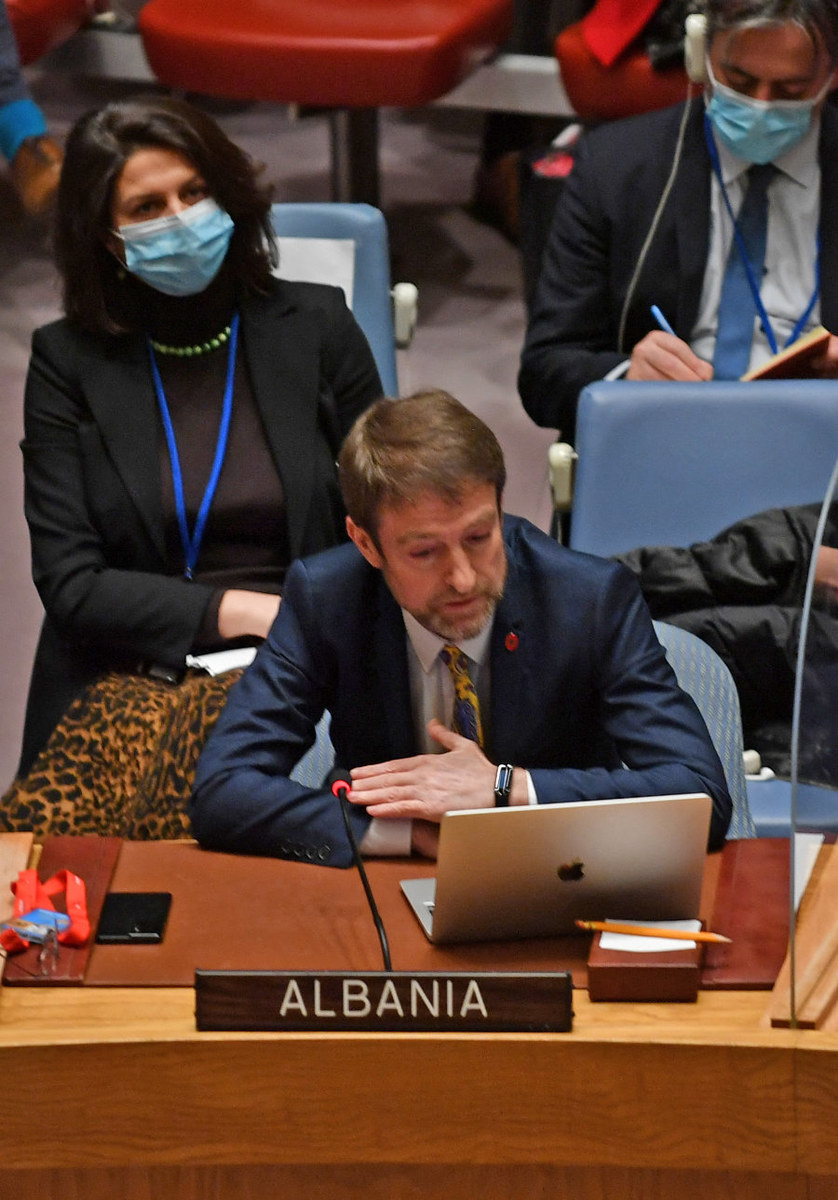
Albania's Ambassador Ferit Hoxha addresses the UN Security Council meeting in New York City on Feb. 27, 2022. (Andrea Renault/AFP)
The vote would require a two-thirds majority of UN member states and the affirmative vote of only nine security council members. Such GA resolutions have then historically been adopted despite a negative vote by a permanent member.
The resolution argues that the lack of unanimity among the Security Council’s permanent members on the Ukraine crisis has prevented the UN’s most important body from exercising its primary responsibility for the maintenance of international peace and security.
A total of 11 council members voted in favor, with China, UAE and India abstaining. Russia vetoed it.
Sunday’s vote took place amid a large-scale attack by Russian military forces on major cities in Ukraine, including the capital Kyiv, with hundreds of deaths and injuries reported.
This morning there were reports that Russia and Ukraine had agreed to hold direct talks on the border of Belarus.
The UAE’s deputy permanent representative to the UN, Mohamed Abushahab, welcomed such an announcement, and reiterated his call for a cessation of hostilities and for dialogue as the only way forward.
Abushahab stressed that the protection of civilians in Ukraine should remain a top priority.
“Civilians trying to reach safety must be able to leave unhindered,” he said, adding that it was of paramount importance for aid to reach those in need.
In her explanation of the vote, US Ambassador to the UN Linda Thomas-Greenfield said that council members who support the resolution recognize that this is “no ordinary moment,” one that calls for “extraordinary actions to meet this threat to our international system and do everything we can to help Ukraine and its people.”
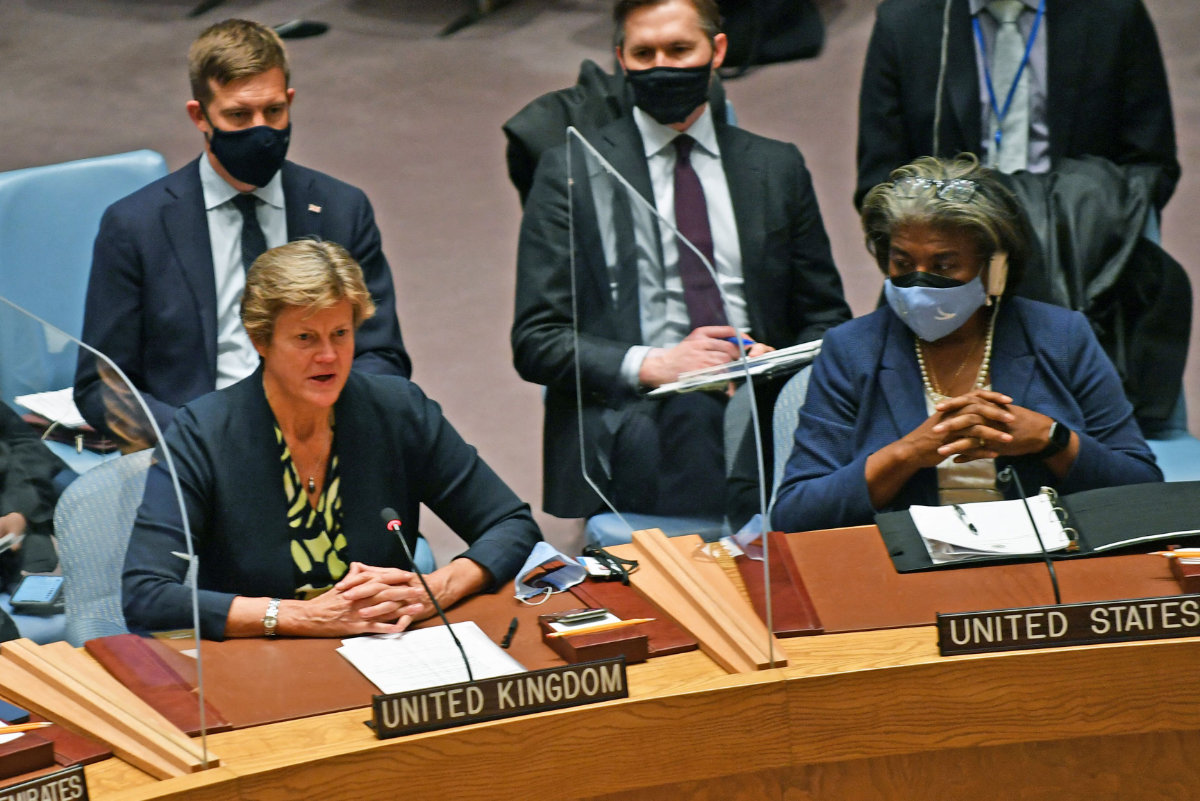
US Ambassador Linda Thomas-Greenfield (R) listens as Britain's Ambassador Barbara Woodward addresses the UN Security Council meeting in New York City on Feb. 27, 2022. (Andrea Renault/AFP)
Thomas-Greenfield told fellow ambassadors: “Those of us here, safely sitting in this hallowed hall, have a moral responsibility to respond to Russia’s desecration of human life.”
She said that the response includes both humanitarian aid for millions of Ukrainians in need and military support, and “holding the sole aggressor, Russia, accountable for its actions.” She vowed to “not let atrocities slide.”
Thomas-Greenfield called on council members to be inspired by Ukrainians’ courage and to look for Ukrainian people’s resilience “in the face of Russian guns and soldiers and bombs and rockets.”
She also welcomed the Ukrainians’ “courage to sit down and talk (and) their continued willingness to participate in peace talks.”
Russia’s Ambassador to the United Nations Vassily Nebenzia told the council that Western attempts to disregard his country’s security concerns regarding NATO’s expansion are against the UN Charter.
He said the current crisis broke out not as a result of the launch of military operations in Ukraine but eight years ago when “you turned a blind eye to Ukrainian nationalists’” activities in the Eastern Donbas region.
“Russia does not shell civilians or civilian infrastructure. The threat to civilians is posed by Ukrainian nationalists,” Nebenzia added, accusing so-called “nationalists” of following the same tactics as Daesh, using civilians as human shields, and releasing criminals from jail and providing them with weapons.
Ukraine’s UN Ambassador Sergiy Kyslytsya said it was extremely alarming that Russian President Vladimir Putin “has resorted today to open nuclear blackmail,” and urged the world to take Putin’s threat “very seriously.”
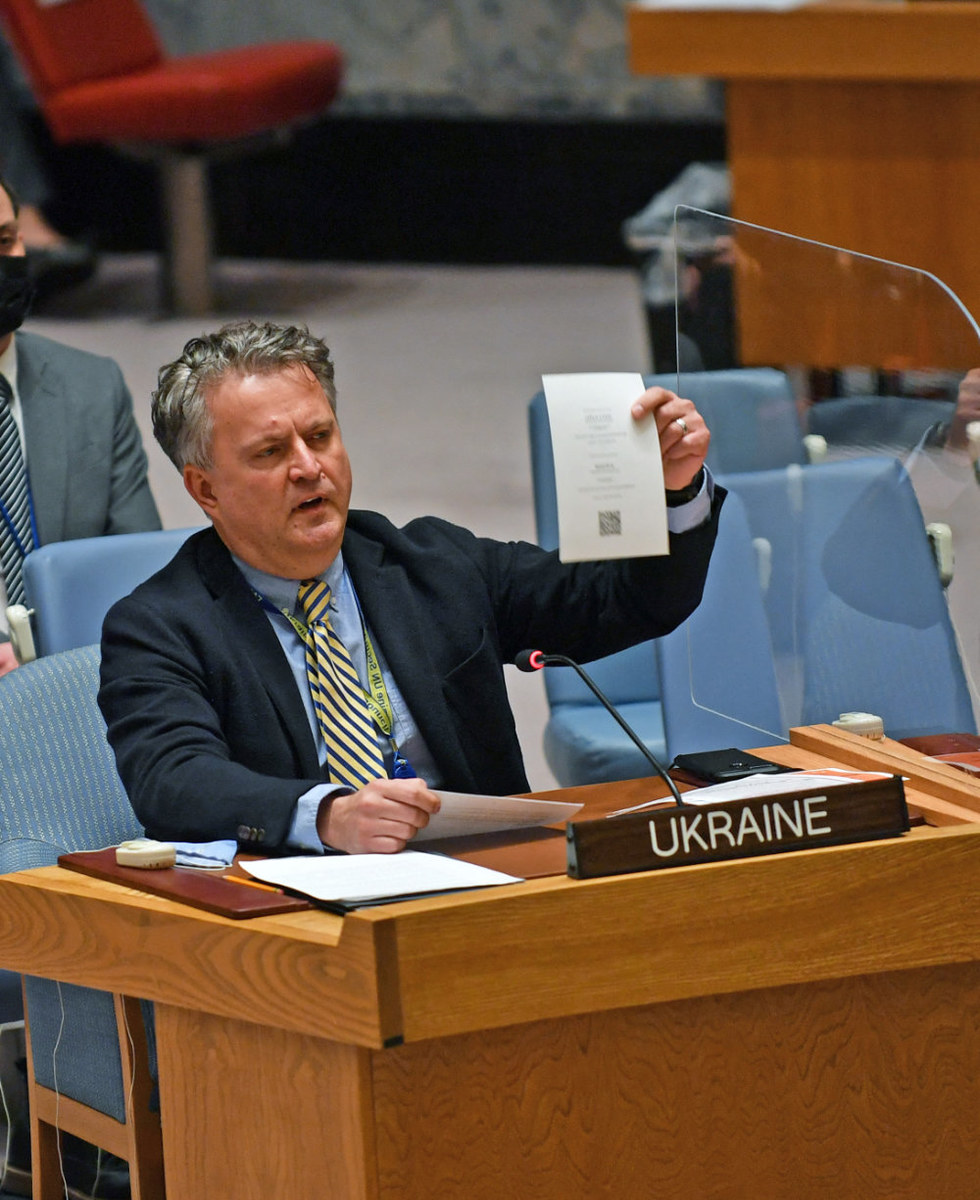
Ukraine's Ambassador Sergiy Kyslytsya addresses the UN Security Council meeting on Feb. 27, 2022. (Andrea Renault/AFP)
Kyslytsya said that Russians so far had lost 4,300 personnel with more than 200 taken as prisoners of war.
He added his government has created a hotline — “Come Back Alive from Ukraine” — for relatives of Russian soldiers who are not aware of their whereabouts. He accused Russia of not admitting these losses.
India’s Permanent Representative T. S. Tirumurti reiterated his call for an immediate cessation of violence. “There is no other choice but to return to dialogue,” he said as he called for respecting territorial integrity of “all states.”
China’s UN Ambassador Zhang Jun said that the top priority now is for “all parties to exercise restraint to prevent the situation from getting worse.”
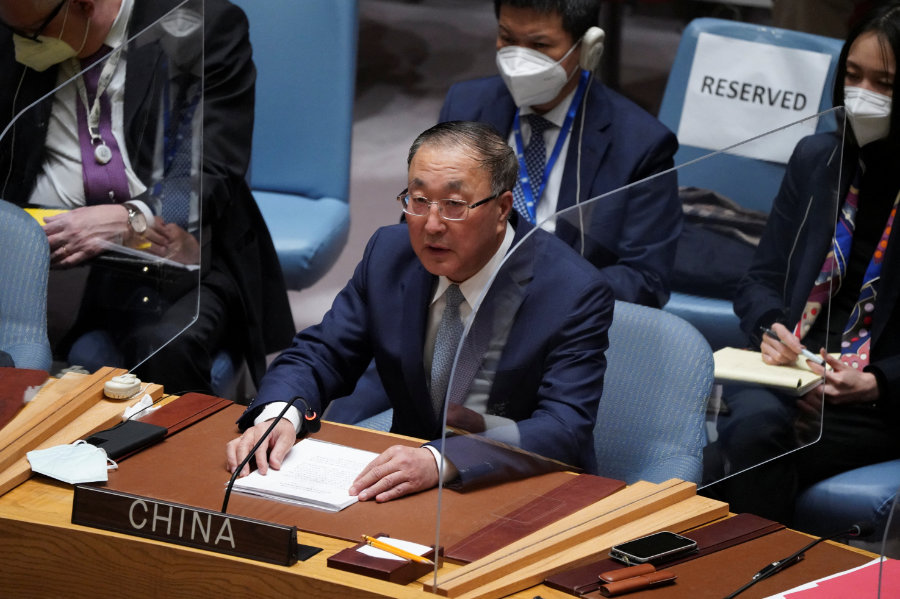
China's Ambassador Zhang Jun speaks as the UN Security Council meeting in New York on Feb. 27, 2022. (REUTERS/David 'Dee' Delgado)
Zhang welcomed the announcement of possible talks between Russia and Ukraine on the Belarus border, and also expressed China’s support for “equal-footed dialogue between the EU and Russia.”
Monday's session is scheduled to start at 10 a.m. in New York (1500 GMT) and is expected to last at least all day.
On Monday, the Security Council is scheduled to hold at 5 p.m. an emergency meeting on the humanitarian situation in Ukraine.
It was requested by French President Emmanuel Macron and will feature officials from the UN's humanitarian affairs and refugee agencies, according to diplomats.


