Progress toward Iran nuclear deal, but issues remain: US official

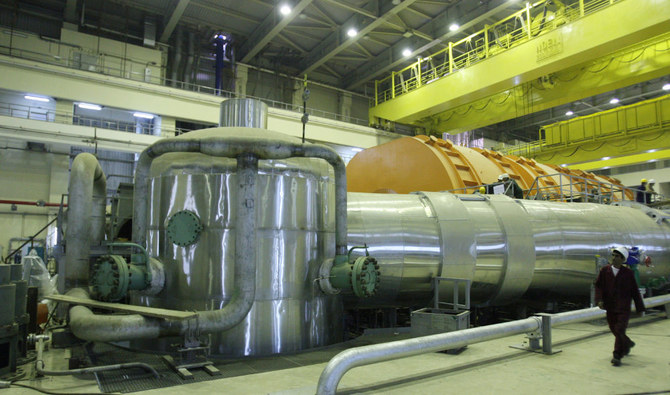
A file photo taken on October 26, 2010 shows the inside of reactor at the Russian-built Bushehr nuclear power plant in southern Iran, 1200 Kms south of Tehran. (AFP)
Short Url
Updated 27 February 2022
Follow

Progress toward Iran nuclear deal, but issues remain: US official

  • Iranian activist goes missing after criticizing proposed bill by hard-liners to implement highly restrictive internet policies
  • ‘So we are in a better position than we have been. But at the same time it’s important to note that very serious issues remain’

WASHINGTON: Negotiators have made significant progress in the last week or so on an agreement to revive the 2015 Iran nuclear deal but very tough issues remain, a senior US State Department official has said.
“There’s been significant progress over the last week or two. We have significantly narrowed the areas that still need to be resolved. And so, in that sense, there has been progress that has been moving toward a potential deal,” he told reporters.
“So we are in a better position than we have been. But at the same time it’s important to note that very serious issues remain.”
The aim of the negotiations is to return to the original 2015 bargain of lifting sanctions against Iran, including ones that have slashed its oil sales, in exchange for restrictions on its nuclear activities that extend the time Tehran would need to make enough enriched uranium for an atomic bomb if it chose to.
Iran’s lead negotiator, Ali Bagheri Kani, has gone back to Tehran and the senior US official said he hoped the Iranian official would return to Vienna, where the talks are held, in a positive frame of mind. However, he said that there would still be some issues to settle even after Bagheri Kani’s return.
The US official also said that there has not been any deal reached in separate negotiations about the release of four US citizens whom the US believes have been wrongfully detained by Iran.
Meanwhile, an Iranian activist went missing after criticizing a proposed bill by hard-liners to implement highly restrictive internet policies, his family said on Saturday.
Hossein Ronaghi, a blogger and free-speech activist, disappeared Wednesday after he criticized a bill in parliament to limit internet access in the country, known as the “Users Protection Bill.” The proposal has been criticized by many Iranians on social media.
There was no information on Ronaghi’s location or condition.
Iran’s supreme leader Ayatollah Ali Khamenei, who has final say on all state matters, said in March last year that social media in Iran is “unbridled” and it should not be “surrendered to the enemy.”
In a recent tweet, Ronaghi said: “The Protection Plan was a decision made by the entire system based on the demand from the Islamic Republic’s leader who had stated: ‘Virtual space must be controlled.’“
Ronaghi’s brother, Hassan, who also is an activist, said in a tweet that Hossein was kidnapped. He said his brother had received several anonymous phone calls in the days leading up to his disappearance.
Hassan Ronaghi also said his brother needs medical care because he is suffering from diseases affecting several of his organs, including his kidneys.
“Anything that happens to Hossein is the responsibility of the Supreme Leaders’ office, the (Revolutionary Guard), and the judiciary.”
Reza Ronaghi, the father of the two brothers, said in an interview with Iranian foreign-base media on Wednesday that Khamenei was directly responsible for his son’s life.
A day after the first reports surfaced of his disappearance, human rights activists claimed that security forces came into Hossein Ronaghi’s home and took a laptop and notebooks.
The language in the proposed internet legislation has yet to be finalized. But if implemented in its current form, it could lead to the disruption of international internet services and websites — like Instagram — that have not yet been blocked.
Under pressure from hard-liners, the Iranian government has long blocked access to many websites and social media platforms, from YouTube and Facebook to Twitter and Telegram.
Many Iranians, especially youths, access social media through VPNs and proxies. Instagram and WhatsApp remain unblocked.


Aoun reassures Lebanon that risk of war is ‘fading’ in year-end message

Addressing Internal Security officials, Aoun said that the “situation is among the best.”
Updated 10 sec ago
Follow

Aoun reassures Lebanon that risk of war is ‘fading’ in year-end message

BEIRUT: Lebanese President Joseph Aoun on Wednesday sought to reassure citizens in his year-end address, saying “the overall atmosphere remains positive and the risk of war is fading,” amid widespread concern over a possible Israeli escalation against Hezbollah.

Fear of renewed attacks followed Israeli criticism of a Lebanese Army weapons-confiscation operation that is set to enter its second phase at the start of the 2026. The plan include the expansion from areas north of the Litani River to the Awali River, after the first phase was completed south of the Litani.

President Aoun cautioned that this does not mean “completely eliminating the risk of war,” stressing that “work is underway with various friendly and brotherly countries to completely neutralize the threat of war.”

Addressing Internal Security officials, Aoun said that the “situation is among the best,” noting that this assessment has been echoed by foreign visitors to Lebanon, despite the strain caused by large numbers of Syrian and Palestinian refugees.

He added that security forces were fully carrying out their duties and solving crimes with notable speed, pointing to the successful visit of Pope Leo XIV earlier this year as further evidence of progress.

On Monday, Egyptian Ambassador to Lebanon Alaa Moussa stressed during a Beirut press conference that implementing “international agreements and resolutions, foremost among them the Nov. 27, 2014 agreement and Resolution 1701, constitutes the fundamental approach to sparing Lebanon further security tensions,” speaking of “dire consequences that could result from continued escalation.”

The Egyptian diplomat indicated that “there are no hidden warnings or threats directed at Lebanon, but rather a clear commitment to the agreements signed by the concerned parties, which must be fully implemented by everyone.”

The ambassador stated that his country, under the directives of President Abdel Fattah El-Sisi, is “exerting intensive efforts to reduce tensions in southern Lebanon and the region in general, through active diplomatic contacts led by the Minister of Foreign Affairs Badr Abdelatty with relevant regional and international parties.”

Israeli military spokesman Avichai Adraee published on Wednesday a summary of Israeli attacks on Hezbollah in Lebanon in 2025.

“The Army targeted approximately 380 armed operatives, including Ali Tabatabai (chief of staff), Hassan Kamal (responsible for anti-tank missiles on the southern front), Abbas Hassan Karky (logistics officer in the southern command), and Khodr Saeed Hashem (commander of the naval force in the Radwan Unit),” he said.

“It also attacked approximately 950 military targets, including 210 launch sites and weapons depots, 140 military buildings, and about 60 tunnel entrances,” Adraee added.

In the statement, he accused Hezbollah of committing about 1,920 ceasefire violations and said the military would continue its raids and targeting operations in the new year.

UNIFIL Com. Gen. Diodato Abagnara said in his end-of-the-year message that “UNIFIL will continue to support Lebanon and Israel in implementing their obligations under Resolution 1701, building on the stability achieved in 2025 and strengthening efforts toward a lasting peace.”

As part of the weapons restriction plan, on Tuesday, the Fatah movement — the Palestinian National Security Forces in Lebanon — handed over a new batch of heavy and medium weapons from the Ain Al-Hilweh Palestinian refugee camp to the Lebanese Army in four trucks, away from the media.

This is the second batch of weapons to be handed over from the camp, which is the largest Palestinian refugee camp in Lebanon. It represents the fifth phase of the Palestinian weapons handover process in the camps, four of which were completed between Aug. 21 and Sept. 13, 2025, encompassing nine camps, including Ain Al-Hilweh.

The handover follows and implements an agreement reached between Aoun and Palestinian President Mahmoud Abbas after the latter’s visit to Lebanon in May.

Abbas had announced “the Palestinian Authority’s support for the Lebanese state’s plan to extend its authority over all Lebanese territory, including the Palestinian camps.”

Hamas continues to refuse to hand over its weapons to the Lebanese Army, while Hezbollah maintains its weapons north of the Litani River.

The Lebanese Army implemented “exceptional security measures in various Lebanese regions on New Year’s Eve, with the aim of maintaining security.”

It called on citizens to “cooperate with the security measures taken to maintain public safety and prevent incidents,” warning of the consequences of firing weapons, which will be prosecuted as it poses a threat to public safety.

In another measure, authorities announced that gun licenses and traffic permits will be suspended until Jan. 2, 2026.

In Beirut’s southern suburbs, residents signed a pledge as part of an Internal Security Forces campaign against celebratory gunfire on New Year’s Eve, committing not to fire weapons in public and to report violations with photos or videos.