

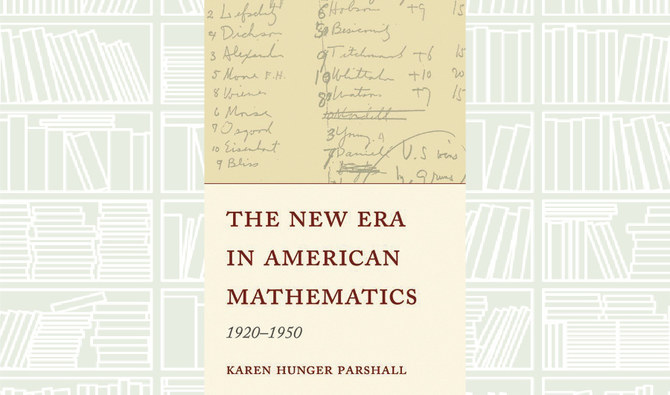
What We Are Reading Today: The New Era in American Mathematics

Short Url
Updated 26 February 2022
Follow

What We Are Reading Today: The New Era in American Mathematics

Author: Karen Hunger Parshall

As the Roaring Twenties lurched into the Great Depression, to be followed by the scourge of Nazi Germany and World War II, American mathematicians pursued their research, positioned themselves collectively within American science, and rose to global mathematical hegemony. How did they do it? The New Era in American Mathematics, 1920–1950 explores the institutional, financial, social, and political forces that shaped and supported this community in the first half of the 20th century. In doing so, Karen Hunger Parshall debunks the widely held view that American mathematics only thrived after European emigres fled to the shores of the US.
Drawing from extensive archival and primary-source research, Parshall uncovers the key players in American mathematics who worked together to effect change and she looks at their research output over the course of three decades. She highlights the educational, professional, philanthropic, and governmental entities that bolstered progress.
And she uncovers the strategies implemented by American mathematicians in their quest for the advancement of knowledge. Throughout, she considers how geopolitical circumstances shifted the course of the discipline.



What We Are Reading Today: Three Roads Back by Robert D. Richardson

Updated 06 March 2026
Follow

What We Are Reading Today: Three Roads Back by Robert D. Richardson

In “Three Roads Back,” Robert Richardson, the author of magisterial biographies of Ralph Waldo Emerson, Henry David Thoreau, and William James, tells the connected stories of how these foundational American writers and thinkers dealt with personal tragedies early in their careers. 
For Emerson, it was the death of his young wife and, 11 years later, his five-year-old son; for Thoreau, it was the death of his brother; and for James, it was the death of his beloved cousin Minnie Temple. 

Filled with rich biographical detail and unforgettable passages from the journals and letters of Emerson, Thoreau, and James, these vivid and moving stories of loss and hard-fought resilience show how the writers’ responses to these deaths helped spur them on to their greatest work, influencing the birth and course of American literature and philosophy.
As Richardson shows, all three emerged from their grief with a new way of seeing, one shaped by a belief in what Emerson called “the deep remedial force that underlies all facts.”