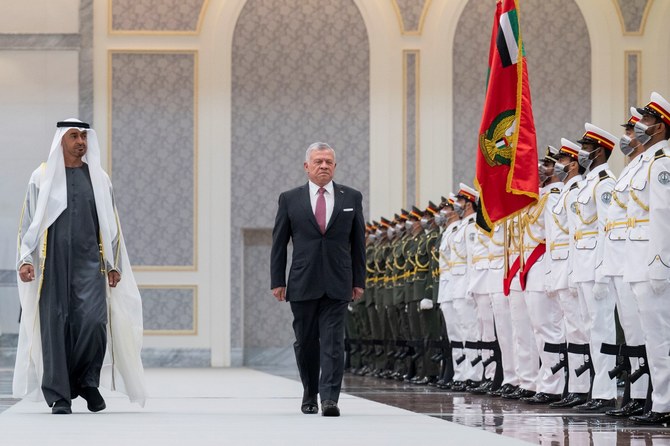
Abu Dhabi crown prince, Jordan’s king discuss regional, international developments

1 / 2
Abu Dhabi Crown Prince Sheikh Mohammed bin Zayed receives Jordan’s King Abdullah II in the UAE capital. (WAM)
2 / 2
Abu Dhabi Crown Prince Sheikh Mohammed bin Zayed receives Jordan’s King Abdullah II in the UAE capital. (WAM)
Short Url
Updated 26 February 2022
Follow

Abu Dhabi crown prince, Jordan’s king discuss regional, international developments

RIYADH: Abu Dhabi Crown Prince Sheikh Mohammed bin Zayed on Friday reiterated his thanks and appreciation for Jordan’s strong stance in condemning the terrorist attacks on the UAE and the its solidarity with the Emirates, state news agency WAM reported.
Speaking during a meeting with King Abdullah II, who is on a visit to the UAE capital, Sheikh Mohammed congratulated him and his wife, Queen Rania, on receiving the Zayed Award for Human Fraternity, in recognition of their regional and international efforts and initiatives on supporting peace and values ​​of tolerance and coexistence.
King Abdullah said he takes pride in the “strong, historical fraternal relations that bind the two countries and their peoples,” Jordan’s Petra news agency said.
He added that Jordan stands with the UAE in the face of all threats to its security and stability, reiterating condemnation of the Houthi attacks on the UAE, and stressing that the security of the UAE and Jordan is indivisible.
The two sides discussed prospects for developing bilateral relations and exchanged views on regional and international developments.


Somali UN envoy slams Israeli recognition of Somaliland, rejects Palestinian displacement

Updated 4 sec ago
Follow

Somali UN envoy slams Israeli recognition of Somaliland, rejects Palestinian displacement

  • Abukar Dahir Osman: Such measures would infringe Somalia’s sovereignty, unity, territorial integrity
  • World ‘must stand together against any attempt to alter the demographic composition of the Palestinian territories’

NEW YORK: Somalia has strongly condemned Israel’s recognition of its northwestern region of Somaliland as independent, as well as alleged plans to forcibly transfer Palestinians to Somali territory.

Addressing the UN Security Council, Somali Ambassador Abukar Dahir Osman said such measures would blatantly infringe his country’s sovereignty, unity and territorial integrity, and risk entangling the Horn of Africa in the destabilizing dynamics of the Middle East conflict.

He warned that any effort to impose such political realities on the African continent would undermine core principles of international law and set a dangerous precedent.

Osman also categorically rejected any proposals for the forced displacement of Palestinians, whether within or beyond their territories, calling such actions a grave violation of international law amounting to ethnic cleansing.

“The international community must stand together against any attempt to alter the demographic composition of the Palestinian territories by force or coercion,” he said, adding that humanitarian operations in Gaza under the fragile ceasefire are under severe strain, underscoring the need for sustained international support and respect for international law.