

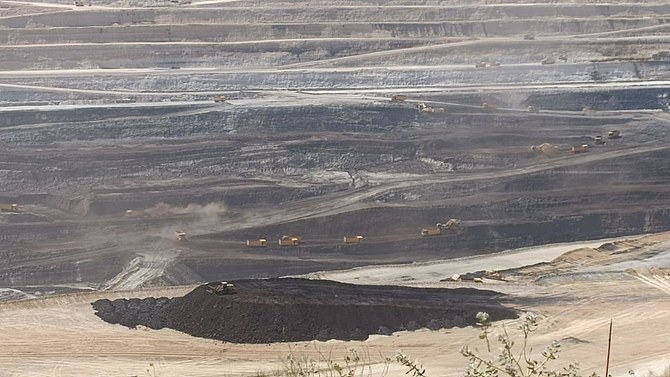

KARACHI: Officials at a major Pakistani coal mining company operating in the desert region of Thar has said the firm would seek guidance from the foreign office on launching exports to India as Pakistan scales up its mineral extraction activity in an area that holds over 95 percent of the country’s known coal reserves.
According to the China-Pakistan Economic Corridor’s Energy Planning Report, Pakistan has 186 billion tons of coal deposits of which 175 billion tons are in the remote Thar region in the country’s southern Sindh province. In terms of energy, these coal deposits are equivalent to 50 billion tons of oil — more than Saudi and Iranian oil reserves combined.
India and Pakistan both share the Thar region. The Indian side started power generation back in the 1950s and utilized all its reserves, which were equivalent to eight percent of Pakistan’s total Thar coal deposits. But while Pakistan’s Thar reserves were discovered in 1980, they continue to remain largely untapped.
Pakistani mining companies are now weighing multiple options to utilize the coal reserves, including their conversion into gas and liquid fuels and export to other countries.
“Across the border, India has installed some 8,000-megawatt power plants that are designed to use the same coal,” Ahmed Muneeb, general manager administration and external affairs at Sindh Engro Coal Mining Company (SECMC) said this week while briefing a group of journalists in Thar. “India is importing coal, which can be supplied from Pakistan.”
However, he said that the company would abide by the country’s foreign policy stance.
“We will seek guidance from the foreign office and our leadership before exporting Thar coal to India,” Muneeb said. “The whole thing depends on our foreign policy orientation.”
Trade and diplomatic relations between the two South Asian nuclear armed rivals deteriorated after India revoked the special status of Jammu and Kashmir in August 2019 and Pakistan responded by downgrading its diplomatic ties with New Delhi and suspending all kinds of trade. The administration in Islamabad later allowed the import of life saving drugs from India.
Last week, Pakistan’s commerce chief Abdul Razak Dawood raised his voice in favor of trading with the neighboring state, calling it the “need of the hour and beneficial for both countries.”
“As far as the Ministry of Commerce is concerned, its position is to do trade with India,” he told a group of reporters in Lahore. “My stance is that we should do trade with India and it should be opened now.”
However, the government’s spokesperson rejected the statement and described it as the commerce chief’s personal view that did not reflect Pakistan’s official policy.
While Muneeb ruled out an immediate plan to export coal from Pakistan to India, he said the country’s coal deposits could meet its electricity demand for several centuries.
“The entire stock of coal will not be burned to produce power,” he said. “There are many other uses of these deposits including their conversion into gas and liquid fuels [like diesel]. Work on the production of syngas [synthesis gas] from coal is already underway by a consortium which also includes Engro Corporation.”
Pakistan is currently generating some 660 megawatts of electricity from Thar coal under the China-Pakistan Economic Corridor (CPEC) framework which is expected to increase by about 2,000 megawatts by next year.
The coal mining company has already achieved 3.8 million tons per annum of production rate and is in the process of increasing it to 7.6 million tons per annum in the second phase.
Pakistan has divided Thar in 13 blocks for coal extraction, and only the first two blocks are operational.
Sindh Engro Coal Mining Company is operating in Block-II while Shanghai Electric has started mining Block-I where the first layer of a 3 billion ton of deposit was unearthed by the end of January 2022.
Pakistan is also expected to supply coal to local power stations in the future after making slight modifications to the existing designs of these plants.
“Thar coal can be supplied to local power plants which are currently utilizing imported coal,” Muneeb said. “We are already supplying coal from Thar to Lucky group’s power project that is located in Karachi.”
Pakistan’s power generation is continuously increasing, going up by 8.9 percent to 11,824 megawatts during January 2022 as compared to 10,859 megawatts generated a year before. During the last month, the fuel cost for power generation increased by 102 percent to Rs12.22 kilowatt per hour.
Power generation through coal remained the top source with 2,917 megawatts which is 14 percent higher than last year.


