
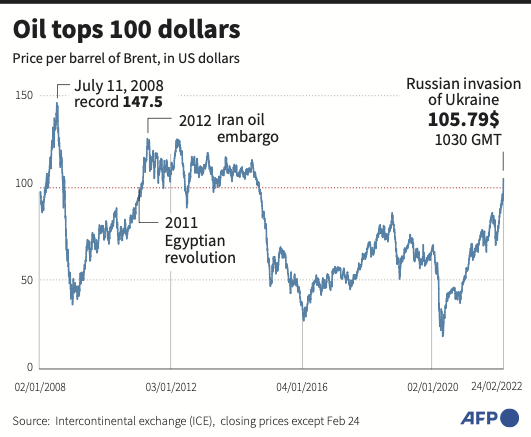
RIYADH: As Russia officially launched military actions against Ukraine, oil prices soared on Thursday with Brent and US benchmark crude WTI both surging at the highest levels since 2014.
Brent crude rose to as much as $105.13 a barrel, up 8.56 percent. US WTI crude futures jumped $7.6 to reach $99.7 a barrel. At one point, WTI was elevated to $100 a barrel.
Cryptocurrencies —Bitcoin and Ether — sank sinking as Russia moved troops into Ukraine, sparking concerns that a war in Europe could disrupt global energy supplies.
Russia is the world’s second-largest oil producer, which mainly sells crude to European refineries, and is the largest supplier of natural gas to Europe, providing about 35 percent of its supply.
At least three major buyers of Russian oil have been unable to open letters of credit from Western banks to cover purchases on Thursday, four trading sources said according to Reuters.
Shipping group Maersk has halted all port calls in Ukraine until the end of February as a consequence of the conflict, a company spokesperson said on Thursday.
Russian President Vladimir Putin authorized a military operation in eastern Ukraine on Thursday in what could be the start of war in Europe over Russia’s demands for an end to NATO’s eastward expansion.
Here is how the invasion is affecting the markets and trading across the globe.
Rouble trading suspended
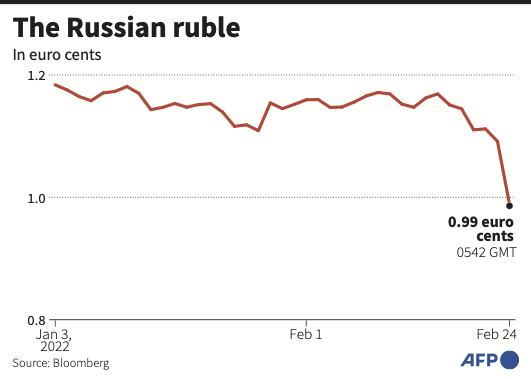
The rouble plunged to its lowest since early 2016 on Thursday after President Vladimir Putin ordered Russian forces to invade Ukraine, a move which led the Moscow Exchange to suspend trading.
Russian forces fired missiles at several Ukrainian cities and landed troops on its south coast on Thursday, officials and media said, after Putin authorised what he called a special military operation in the east.
The rouble has slumped 3.6 percent against the dollar to 84.0750, minutes after opening at 0400 GMT and slid 3.9 percent to a record low 95.2425 versus the euro, before trading was swiftly halted.
"Trading on all markets has been suspended. The resumption will be announced later," MOEX Group, which runs the Moscow Exchange, said in a statement at 0452 GMT.
Bitcoin plunged more 7% in 24 hours as Russian President Vladimir Putin announced a "special military operation" in Ukraine, and threatened dire consequences for any outside interference, the New York Times reported.@GregAhl reports.https://t.co/n0w0iZpPMX
— CoinDesk (@CoinDesk) February 24, 2022
Markets
Dow futures lost nearly 700 points on Thursday, by 2 percent. Nasdaq futures dropped by 2.7 percent.
Bharat Petroleum, Petronet fall up to 6 percent as Brent hits $100 mark.
London-listed Russian companies plummet. Sberbank has lost 75 percent and VTB fell almost 22 percent. Rosneft is down 23 percent, while Gazprom has tumbled nearly 36 percent.
Aluminum prices in London hit a record high, as investors worried about supplies from Russia and a negative impact on production due to high energy prices. Russia produces over 6 percent of the world's aluminum.
Banks
Banks with big operations in Russia are facing setbacks.
An index of European banking stocks was down 6.1 percent before midday GMT, steeper than a 4 percent fall in the Euro Stoxx index.
Banks with significant operations in Russia were particularly hard hit, with Austria's Raiffeisen Bank International down 16 percent and Societe Generale losing 8.6 percent.
Shares in UniCredit, whose Russian arm is one of the largest lenders in the country, fell as much as 9 percent, before triggering an automatic trading suspension.
Cryptocurrency
Cyrptocurrency markets saw a sell-off, pushing Bitcoin down 7.8 percent to $35,084, reaching its lowest prices since July 20, when its price fell below $30,000, according to data collected by the firm CoinGecko.
Ethereum, the second largest crypto by market value, fell 9.7 percent to $2,396.93, its lowest price since July 19, when it fell to $1,824.93.
Tomorrow, I will be meeting with the Leaders of the G7, and the United States and our Allies and partners will be imposing severe sanctions on Russia.
We will continue to provide support and assistance to Ukraine and the Ukrainian people.
— President Biden (@POTUS) February 24, 2022

Gold Up
Gold prices on Thursday jumped over 2 percent to their highest in more than a year as investors rushed to safe havens after Russian forces invaded Ukraine in what could be the start of war in Europe.
Spot gold jumped 1.9 percent to $1,943.86 per ounce by 0428 GMT, its highest level since early Jan. 2021. US gold futures climbed 2 percent to $1,949.20.
Gold has risen about 8 percent in February so far and is set for its best monthly gain since July 2020.
Spot silver gained 1.6 percent to $24.91 per ounce, platinum rose 0.5 percent to $1,097.01 and palladium jumped 2 percent to $2,530.42.
"President Putin, in the name of humanity, bring your troops back to Russia.
This conflict must stop now."
-- @antonioguterres on the developments regarding Ukraine. https://t.co/QYDflm1Co5 pic.twitter.com/s3aWCHWHYZ
— United Nations (@UN) February 24, 2022
Anaylsts Reactions
ING: “Russia’s announcement of a special military operation into Ukraine has pushed Brent to the $100/bbl mark,” said Warren Patterson, head of ING’s commodity research, adding that the oil market will nervously be awaiting what further action Western nations take against Russia.
“This growing uncertainty during a time when the oil market is already tight does leave it vulnerable, and so prices are likely to remain volatile and elevated,” he added.
Western nations and Japan on Tuesday punished Russia with new sanctions for ordering troops into separatist regions of eastern Ukraine and threatened to go further if Moscow launched an all-out invasion of its neighbor. So far, there are no sanctions on energy trade yet.
Japan and Australia said on Thursday they were prepared to tap their oil reserves, together with other International Energy Agency member countries, if global supplies were hit by hostilities in Ukraine.
OANDA: “One factor that could act as a temporary brake on prices is the Iran nuclear deal with rumors swirling around that a new agreement could be announced, possibly as early as this week,” said Jeffrey Halley, senior market analyst at OANDA.
“However Ukraine fears, and their wider ramifications will continue to support oil prices which remain a solid buy on dips.”
“Gold is coming back into its own as a haven asset and I do not rule out new all-time highs in prices in the weeks ahead,” said Jeffrey Halley, a senior market analyst at OANDA in a note.
Global stocks and US bond yields dived, while the dollar and oil prices rocketed higher.
City Index: “Any sanctions the West puts in place aren’t really going to affect Russia in the way the West is hoping ... the West is on the back foot here and that’s another good reason why gold is rising because it’s a true risk-off environment,” said Matt Simpson, senior market analyst at City Index.
Dow futures sink nearly 700 points, oil prices spike as Russia attacks Ukraine https://t.co/2IN6IEnziT
— MarketWatch (@MarketWatch) February 24, 2022
Other factors affecting oil
The US and Iran have been engaged in indirect nuclear talks in Vienna, in which a deal could lead to the removal of sanctions on Iranian oil sales and increase global supply.
Iran on Wednesday however urged Western powers to be “realistic” in talks to revive the 2015 nuclear deal, and said its top negotiator was returning to Tehran for consultations, suggesting a breakthrough in its discussions is not imminent.
Additionally, US crude stockpiles rose 6 million barrels last week while distillate stocks fell, according to market sources who were citing American Petroleum Institute figures late on Tuesday.
Ahead of government data on Thursday, analysts forecast a 400,000-barrel build in crude and a drawdown in fuel stockpiles.
Gasoline inventories rose by 427,000 barrels and distillates stockpiles fell by 985,000 barrels, the API data showed according to the sources, who spoke on condition of anonymity.