

Iranian prisoner dies of heart attack after death penalty retracted

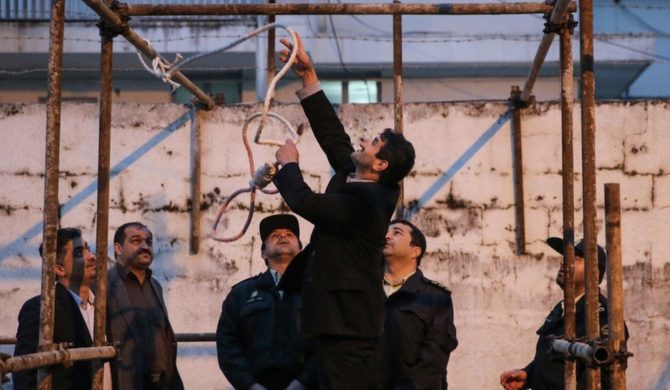
Iranian officials prepare a noose in 2017 (file photo). The country is believed to execute most people per capita, with Iran Human Rights Monitor reporting that 365 prisoners were executed in 2021 alone. (AFP/File Photo)
Short Url
Updated 23 February 2022
Follow

Iranian prisoner dies of heart attack after death penalty retracted

  • 55-year-old was told family of victim he murdered 18 years ago had forgiven him

LONDON: A 55-year-old Iranian convict died from a heart attack after being informed that his death penalty sentence was being retracted for a murder he committed 18 years ago because the victim’s family forgave him.

Iranian newspaper Hamshahri said the man, Akbar, had been detained along with four others for premeditated murder.

He was convicted along with another man, Davood, who had reportedly already been executed for his involvement in the murder.

A dispute-resolution board mediated between the victim’s family and Akbar. The family initially resisted granting clemency, but eventually gave their support after hearing of his poor health. 

But as the family experienced a change of heart, Akbar’s failed, with the overjoyed prisoner dying before he could taste freedom.  


Sudan army breaks RSF siege on southern city Dilling

Updated 3 sec ago
Follow

Sudan army breaks RSF siege on southern city Dilling

  • Army says its forces 'succeeded in opening the Dilling road after carrying out a successful military operation'
  • Victory comes as the military attempts to stem a sweeping paramilitary advance across the wider Kordofan region
KHARTOUM: The Sudanese army said on Monday it had broken a long-running siege of Dilling, a city in the country’s south, where paramilitary forces had choked off access for more than a year and a half.
Since April 2023, Sudan has been engulfed in a conflict between the army and the paramilitary Rapid Support Forces (RSF) that has killed tens of thousands of people.
The war has also left 11 million people displaced and triggered what the UN describes as the world’s largest displacement and hunger crises.
In its statement, the army said its forces “succeeded in opening the Dilling road after carrying out a successful military operation,” claiming they had inflicted “heavy losses” on the RSF.
If confirmed, the advance would secure the army’s hold over both the northern and southern approaches to Dilling, located in South Kordofan state.
The city lies halfway between Kadugli — the besieged state capital — and El-Obeid, the capital of neighboring North Kordofan, which the RSF has sought to encircle.
Videos shared on social media showed army forces, said to be in Dilling, celebrating atop pick-up trucks as people ululated and cheered alongside them.
AFP could not independently verify the army’s claim or the footage, and the RSF has not yet commented.

- Sweeping offensive -

The push around Dilling comes as the army attempts to stem a sweeping paramilitary advance across the wider Kordofan region.
Since seizing the army’s last stronghold in western Darfur last October, the RSF has shifted its focus eastward, aided by its local allies, namely the Sudan People’s Liberation Movement-North faction led by Abdelaziz Al-Hilu.
Since then, the paramilitary group has tightened its grip on West Kordofan, taken Heglig — home to Sudan’s largest oil field — and intensified its siege of Kadugli.
A UN-backed assessment last year already confirmed famine in Kadugli, which has been under RSF siege for more than a year and a half.
The assessment said conditions in Dilling were likely similar, but security issues and a lack of access have prevented a formal declaration.
The UN has repeatedly cautioned that atrocities similar to those reported during the RSF offensive in El-Fasher — including mass killings, sexual violence, abductions and widespread looting — could spread into Kordofan.
More than 65,000 people have fled the Kordofan region since October, according to the latest UN figures.
Those escaping, particularly from South Kordofan, face “long and uncertain journeys” lasting up to 30 days and sleep “wherever they can,” according to Mercy Corps, one of the few aid groups operating there.