- PM Imran Khan is expected to have ‘wide ranging’ discussions with President Vladimir Putin
- This is the first visit of a Pakistani prime minister to Russia since 1999
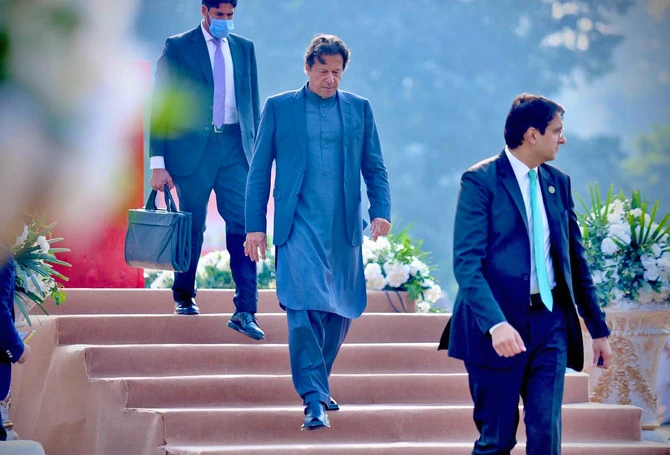
ISLAMABAD: Pakistani Prime Minister Imran Khan’s visit to Moscow on Wednesday put the South Asian country on a “tightrope” as the first meeting between the two nations in over two decades takes place amid an escalating standoff between Russia and Ukraine.
Khan will have “wide-ranging” discussions, including on energy cooperation, with Russian President Vladimir Putin during the two-day visit, according to a statement from Pakistan’s Foreign Ministry.
His visit, the first of a Pakistani prime minister to Russia since 1999, comes as much of the West aligns against Russia amid increasing fears of an invasion of Ukraine.
Ahead of the trip, the Pakistani leader expressed hope for a peaceful resolution of the conflict, but said his trip was unrelated to the crisis.
“This (Ukraine crisis) does not concern us. We have a bilateral relationship with Russia, and we really want to strengthen it,” Khan said in an interview with Russia’s state-owned television network RT.
“Now, what we want to do is not become part of any bloc. We want to have trading relations with all countries,” he added.
Uzair Younus, director of the Pakistan Initiative at the Washington-based Atlantic Council advocacy group, said this week’s visit puts Khan on a tightrope between Russia and the West.
“Pakistani leaders must walk a tightrope that balances the emerging Russia relationship with its historical and economically vital relations with the West,” Younus told Arab News.
He said Khan must only focus on Pakistan-Russia ties, and “refrain from inserting Pakistan into the Russia-Ukraine tensions.”
He added: “The PM and his team must remain cognizant of the fact that Pakistan’s core economic interests are aligned with Western powers.”
Annual exports to the US, UK and EU combined amounted to over $12 billion, Younus said, while exports to Russia amounted to $163 million.
Faisal Karim Kundi from the opposition Pakistan Peoples Party (PPP) fears that Khan’s Moscow visit will affect trade relations with the US and Europe.
“Unfortunately, we cannot afford (that) at this time when our economy is already very fragile and under pressure,” Kundi said.
Experts said the visit should be viewed in its bilateral context, especially when such high-level meetings were planned in advance.
Former prime minister Shahid Khaqan Abbasi said it “should not be a problem for any other country.”
“What is happening in Ukraine is a separate issue and should be dealt with in different United Nations forums,” Abbasi said.
Abdul Basit, a research fellow at S. Rajaratnam School of International Studies, Singapore, said it was an important visit for Pakistan, though there was a chance that it could be misconstrued at the international level.
“This can take Pakistan’s relations with Russia from defense ties to trade level ties and also fulfill Pakistan’s growing energy needs,” Basit told Arab News.
Former foreign secretary Tehmina Janjua said the US and other western countries would understand that such a bilateral visit was not related to the Ukraine crisis.
“Pakistan and Russia have been working on this visit since 2020,” she told Arab News. “We should also not worry that it will have an adverse impact on Pakistan’s relations with the US and other western countries.”