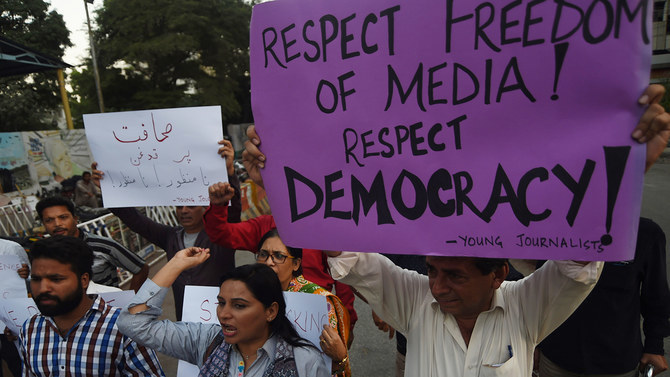

KARACHI: The Pakistan Federal Union of Journalists (PFUJ) and two major opposition parties on Monday said they were considering to move the court against a proposed law that criminalizes sharing “defamatory” and “fake” content on social media, but is widely viewed as a tool to silence critics of the government.
The government of Pakistan has previously tried to roll out new Internet rules that critics say will give the government wide powers of censorship. The government denies it wants to censor the press or political opponents.
The new ordinance introduces an amendment to section 20 of the Prevention of Electronic Crimes Act (PECA) 2016, which was passed by the former Pakistan Muslim League-Nawaz (PML-N) government.
The new amendment increases the jail term for defaming any person or institution on social media from two years to five years, according to the Pakistani information minister. It makes it mandatory for courts to decide cases within six months, and has made the offense non-bailable.
Information Minister Chaudhry Fawad Hussain didn’t respond to requests for a comment despite repeated attempts.
PFUJ President Shehzada Zulfiqar said the new amendments were clearly aimed at suppressing the freedom of speech and press, which had already got setbacks over the last few years. “We will take every measure, including challenging this draconian law, in the court of law,” he said.
Zulfiqar said the new legislation would defame Pakistan, where the electronic media had already come under the control of the government. “The mainstream media has already been controlled by the government. It now wants to control the digital media.”
He said the PFUJ was not against legislation to deal with the issue of “fake news,” but this should be done in consultation with the stakeholders and only after all agree to it.
“We will consult bars, HRCP (Human Rights Commission of Pakistan) and the civil society for a joint struggle,” the PFUJ president said.
A PFUJ statement said it was “alarming” that instead of reforming existing laws to enforce constitutional guarantees of freedom of expression and right to information, the laws were being amended further to make them more coercive, aimed at eroding these rights.
“All the stakeholders, including the media community and civil society have been agitating for and demanding withdrawal of black clauses in PECA 2016 that are against civil liberties and basic human rights ensured in both the UN charter and the constitution of Pakistan, but it appears that the government is now making the laws more regressive in the name of dignity and security of institutions,” it read.
The statement said it appeared the government was driven by “mala fide intentions” as the proposed amendments, especially without any parliamentary inputs, were “designed to further shrink the space for freedom of press and expression which is already deeply compromised as evinced by various media freedom indexes.”
Rizwan Bhatti, secretary of the Karachi Press Club, said the new law would be resisted.
“Journalists will not accept this draconian law, which is aimed at completely suppressing freedom of speech, but journalists across Pakistan will resist it like they have been fighting against censorship and black laws in the past,” Bhatti said.
Shazia Marri, a lawmaker from the opposition Pakistan Peoples Party (PPP), called the legislation an “attack on our freedoms and human rights,” saying her party was considering challenging it in the court.
“PPP has constantly fought against tyranny and suppression. We believe the recent amendment to PECA law through an ordinance is yet another attempt to suppress the people of Pakistan,” she said.
“We are on record for opposing the PECA bill, but the PML-N was adamant to pass it. PECA law is already a black law that is being used to suppress dissent. This new amendment to PECA law is going to further allow government to go after their critics and people who disagree with their actions.”
Shehbaz Sharif, the PML-N president and opposition leader in the National Assembly, said the amendment to PECA, promulgated by a presidential ordinance, showed the real “fascist face” of the ruling clique.
“After imposing curbs on mainstream media, they are out to muzzle social media,” he said in a Twitter post. “But can they go against the currents of time? Can truth be hidden?“
Muhammad Zubair, a senior PML-N figure, acknowledged the passage of the PECA law by his party’s government was a “wrong thing.”
“I’m on the record to have said that we should not have brought this law in the first place,” Zubair told Arab News. “Prime Minister Imran Khan is also on the record. He opposed it when we brought it in 2016, but instead of abolishing it, his government is bringing draconian amendments to it.”
The PML-N leader said the proposed changes to the law would be used to “target” the opposition. Such an important law, which affects the entire population, should not be brought without a debate in parliament, he added.
“The PMLN strongly rejects it,” he added.