

Pakistan hopes to achieve 6 percent GDP growth this fiscal year — finance ministry

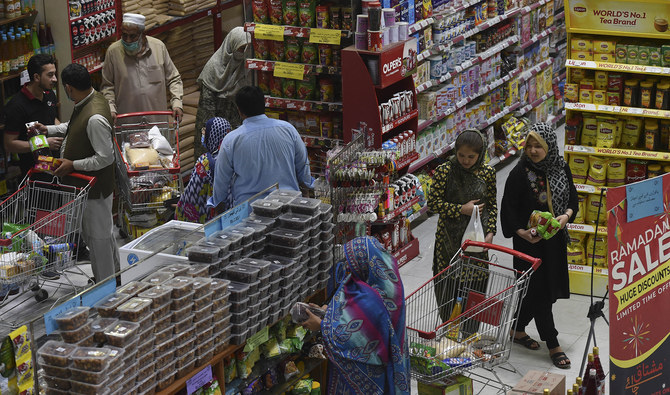
People buy grocery items at a store in Peshawar, Pakistan, on April 5, 2021. (AFP/File)
Short Url
Updated 21 February 2022
Follow

Pakistan hopes to achieve 6 percent GDP growth this fiscal year — finance ministry

  • Says increase in industrial, agricultural and exports growth show “robust economic growth”
  • Economists say given economic challenges even a 5 percent GDP growth rate would be a success

ISLAMABAD: The Pakistani government hopes to achieve six percent gross domestic product (GDP) growth this fiscal year owing to increased expansion in industrial and agricultural sectors, the finance ministry said on Sunday. 

Pakistan’s finance ministry set a 4.8 percent GDP growth rate as its target for the fiscal year 2021-22 in the annual budget in May last year. The International Monetary Fund (IMF) said earlier this month Pakistan’s economy is set to keep on recovering in this fiscal year, with real GDP growth projected at 4 percent. 

“Looking at all the recent economic indicators including industrial and agricultural growth, we are sure to achieve a six percent GDP growth rate this fiscal year,” Muzzammil Aslam, a spokesperson for the Ministry of Finance, told Arab News. 

He said electricity generation and consumption had registered an increase of 9 percent which reflected increased industrialization, manufacturing and employment in the country. 

Citing the numbers, he said Pakistan had witnessed 7.4 percent industrial growth while the South Asian country’s exports were growing at a pace of 25 percent this fiscal year along with a rise in electricity consumption. 

“These all are data proofs to show robust economic growth due to the government’s business and industry-friendly policies,” he said. 

“Cotton and sugarcane crops have registered a significant production increase this year, and this all is contributing to industrial growth and jobs creation [in the country],” he said. 

In January, Pakistan revised its economic growth rate for 2020-21 to 5.37 percent from 3.9 percent after the country's statistics bureau shifted its economy's baseline. 

With the new 2015-16 baseline, the country’s total GDP has reached $346.76 billion with a per capita income of $1,666. 

Economists say the government should focus on “sustainable growth” while keeping all challenges in the mind. 

“We have increased our interest rate and cut imports after December as part of a deal with the IMF, so this economic contraction will hold back our GDP growth to around 5 percent,” AA H. Soomro, a Karachi-based senior economist, told Arab News. 

He said the government will also spend less through the annual Public Sector Development Program (PSDP) to fulfill IMF conditions while wheat production was also expected to get a hit due to a shortage of fertilizers. 

The Russia-Ukraine conflict is also causing oil prices to surge in the international market and if this continues for the next three to four weeks, it will significantly increase Pakistan’s current account deficit, Soomro warned. 

“Keep in mind all these challenges, it will be a success even if Pakistan achieves a five percent GDP growth rate in this fiscal year,” the economist added.


Pakistan, ADB sign $730 loan agreements to boost SOE reforms, energy infrastructure

Updated 25 December 2025
Follow

Pakistan, ADB sign $730 loan agreements to boost SOE reforms, energy infrastructure

  • Both sign $330 million Power Transmission Strengthening Project and $400 million SOE Transformation Program loan agreements
  • Economic Affairs Division official says Transmission Project will secure Pakistan’s energy future by strengthening national grid’s backbone

KARACHI: Pakistan and the Asian Development Bank (ADB) on Thursday signed two loan agreements totaling $730 million to boost reforms in state-owned enterprises (SOEs) and energy infrastructure in the country, the bank said.

The first of the two agreements pertains to the SOE Transformation Program worth $400 million while the second loan, worth $330 million, is for a Power Transmission Strengthening Project, the lender said. 

The agreements were signed by ADB Country Director for Pakistan Emma Fan and Pakistan’s Secretary of Economic Affairs Division Humair Karim. 

“The agreements demonstrate ADB’s enduring commitment to supporting sustainable and inclusive economic growth in Pakistan,” the ADB said. 

Pakistan’s SOEs have incurred losses worth billions of dollars over the years due to financial mismanagement and corruption. These entities, including the country’s national airline Pakistan International Airlines, which was sold to a private group this week, have relied on subsequent government bailouts over the years to operate.

The ADB approved the $400 million loan for SOE reforms on Dec. 12. It said the program seeks to improve governance and optimize the performance of Pakistan’s commercial SOEs. 

Karim highlighted that the Power Transmission Strengthening Project will enable reliable evacuation of 2,300 MW from Pakistan’s upcoming hydropower projects, relieve overloading of existing transmission lines and enhance resilience under contingency conditions, the Press Information Department (PID) said. 

“The Secretary emphasized that both initiatives are transformative in nature as the Transmission Project will secure Pakistan’s energy future by strengthening the backbone of the national grid whereas the SOE Program will enhance transparency, efficiency and sustainability of state-owned enterprises nationwide,” the PID said. 

The ADB has supported reforms by Pakistan to strengthen its public finance and social protection systems. It has also undertaken programs in the country to help with post-flood reconstruction, improve food security and social and human capital. 

To date, ADB says it has committed 764 public sector loans, grants and technical assistance totaling $43.4 billion to Pakistan.